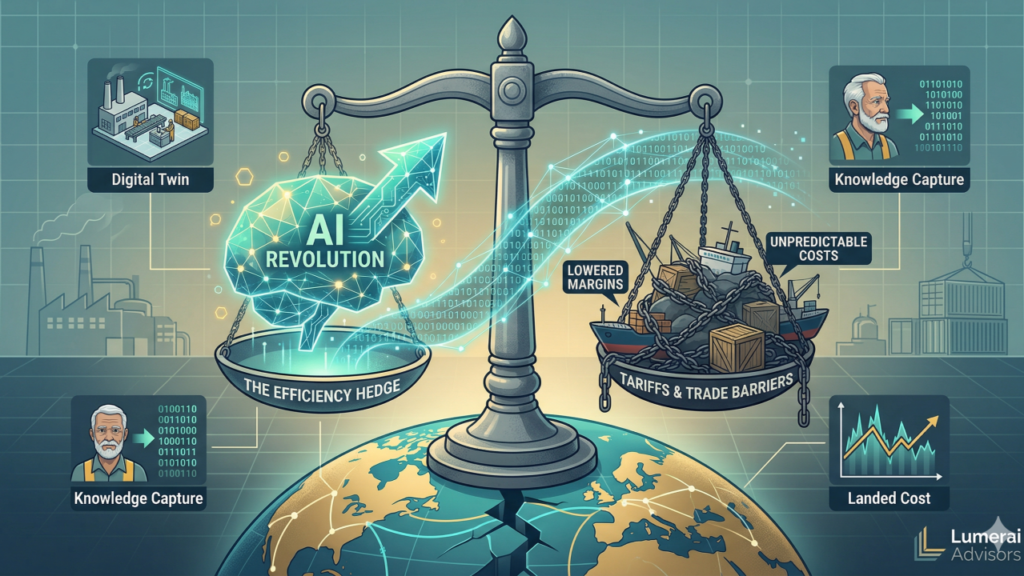
The Efficiency Hedge: Why Tariffs are Quietly Accelerating the AI Revolution
For decades, the manufacturing playbook was simple: chase the lowest labor cost across the globe. But as we move through 2026, that playbook has been shredded. Between the sweeping “Liberation Day” tariffs of 2025 and the ongoing restructuring of global trade, the “landed cost” of goods has become a moving target.
At Lumerai Advisors, we are seeing a fascinating paradox. While trade barriers were designed to protect domestic industry, their primary side effect has been a massive, forced acceleration of Artificial Intelligence. In a high-tariff environment, AI is no longer a “future tech” experiment—it has become a financial hedge.
The “Double Squeeze” of 2026
U.S. manufacturers are currently navigating a “double squeeze.” According to recent National Association of Manufacturers (NAM) reports, 93% of leaders now agree that America’s industrial advantage depends entirely on intelligent systems. Why? Because the 2025–2026 tariff landscape has acted as a “tax on inefficiency.”
When input costs rise by 15-20% due to trade duties, you can no longer afford the “hidden taxes” of unplanned downtime, bloated inventory, or supply chain opacity. The most resilient firms aren’t just raising prices; they are using AI to “engineer out” the waste that trade policy has “engineered in.”
1. The Math of Mitigation: From Prediction to Action
When replacement parts for your specialized machinery are 20% more expensive due to trade barriers, breaking a component prematurely is a failure of fiscal policy as much as maintenance.
Leading firms are moving beyond simple “Predictive Maintenance” into Agentic Maintenance. In 2026, we are seeing a shift where AI doesn’t just alert a manager to a vibration—it autonomously generates a repair plan, checks the current “landed cost” of the spare part, and schedules the fix during the lowest-cost energy window.
The ROI is clear: AI-driven stability can reduce downtime by 30–50%, effectively neutralizing the margin hit from tariffed materials.
2. The Death of the Spreadsheet: AI “Control Towers”
The 2025–2026 trade environment has created what analysts call “sourcing paralysis”—a state where firms are too afraid to move their supply chains but too squeezed to stay put.
The antidote is the AI Control Tower. Leading manufacturers are deploying federated data architectures that monitor geopolitical shifts in real-time. These systems use “digital twins” to simulate thousands of “what-if” scenarios. If a new trade restriction is flagged at a specific port, the AI calculates the exact point where “near-shoring” to Mexico or Canada becomes more cost-effective than absorbing the duty. It allows leaders to pivot their logistics in 24 hours rather than 24 weeks.
3. The Human Factor: Capturing Institutional Knowledge
As 2026 sees record-high retirements of skilled Baby Boomer technicians, AI is acting as a “Knowledge Bridge.” By capturing the tacit knowledge of departing experts into large language models (LLMs) and agentic workflows, mid-market firms are allowing younger, tech-savvy workers to perform at expert levels from day one. This augmentation—not replacement—is what allows a leaner workforce to manage more complex, regionalized operations without a proportional increase in headcount.
The Lumerai Perspective: Illuminating the Path Forward
At Lumerai Advisors , we believe that tariffs are the “why,” but AI is the “how” for the next era of American industrial leadership. The question for 2026 is no longer “How do we avoid tariffs?” but “How do we use technology to make tariffs irrelevant?”
The winners of 2027 and beyond will be those who treat data as “industrial capital”—investing in the digital infrastructure today to ensure they aren’t out-competed tomorrow.
The 2026 AI-Readiness Checklist
Is your operation prepared for a high-tariff, high-tech world? Audit your “AI-Readiness” with these five critical markers:
- [ ] Data Orchestration: Are your OT (floor) and IT (office) data streams unified, or are they trapped in “silos” that prevent real-time decision-making?
- [ ] Landed-Cost Visibility: Can your system calculate the impact of a 10% tariff shift on a specific SKU in under 60 seconds?
- [ ] Predictive Baseline: Is at least 40% of your critical machinery monitored by sensors that feed into an AI-driven failure model?
- [ ] Human-in-the-Loop Governance: Do you have a clear framework for when an AI “Agent” can make a sourcing decision versus when it must escalate to a human?
- [ ] Knowledge Capture: Do you have a digital process for capturing the “hidden expertise” of your retiring workforce?