The Efficiency Hedge: Why Tariffs are Quietly Accelerating the AI Revolution
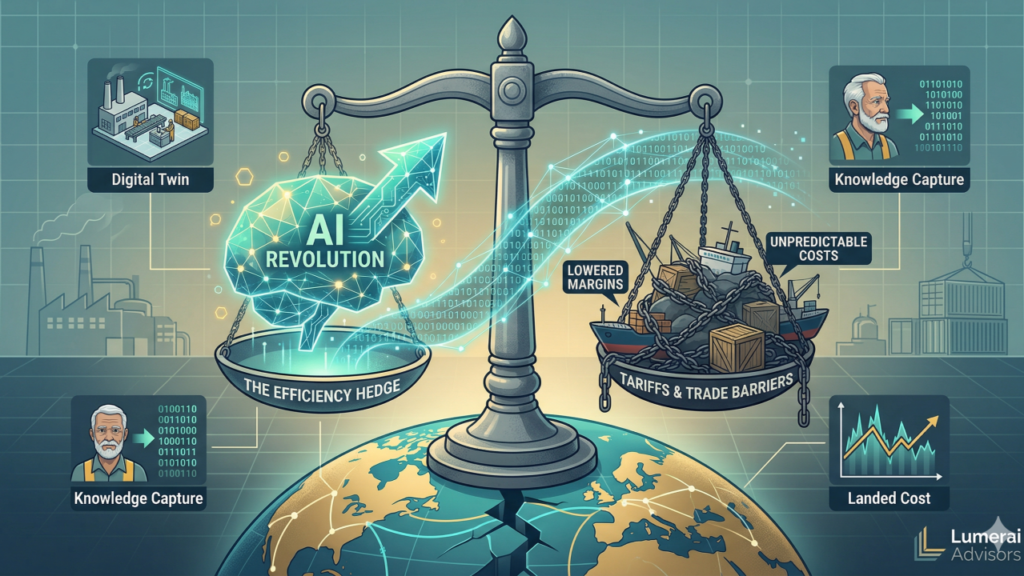
The Efficiency Hedge: Why Tariffs are Quietly Accelerating the AI Revolution For decades, the manufacturing playbook was simple: chase the lowest labor cost across the globe. But as we move through 2026, that playbook has been shredded. Between the sweeping “Liberation Day” tariffs of 2025 and the ongoing restructuring of global trade, the “landed cost” of goods has become a moving target. At Lumerai Advisors, we are seeing a fascinating paradox. While trade barriers were designed to protect domestic industry, their primary side effect has been a massive, forced acceleration of Artificial Intelligence. In a high-tariff environment, AI is no longer a “future tech” experiment—it has become a financial hedge. The “Double Squeeze” of 2026 U.S. manufacturers are currently navigating a “double squeeze.” According to recent National Association of Manufacturers (NAM) reports, 93% of leaders now agree that America’s industrial advantage depends entirely on intelligent systems. Why? Because the 2025–2026 tariff landscape has acted as a “tax on inefficiency.” When input costs rise by 15-20% due to trade duties, you can no longer afford the “hidden taxes” of unplanned downtime, bloated inventory, or supply chain opacity. The most resilient firms aren’t just raising prices; they are using AI to “engineer out” the waste that trade policy has “engineered in.” 1. The Math of Mitigation: From Prediction to Action When replacement parts for your specialized machinery are 20% more expensive due to trade barriers, breaking a component prematurely is a failure of fiscal policy as much as maintenance. Leading firms are moving beyond simple “Predictive Maintenance” into Agentic Maintenance. In 2026, we are seeing a shift where AI doesn’t just alert a manager to a vibration—it autonomously generates a repair plan, checks the current “landed cost” of the spare part, and schedules the fix during the lowest-cost energy window. The ROI is clear: AI-driven stability can reduce downtime by 30–50%, effectively neutralizing the margin hit from tariffed materials. 2. The Death of the Spreadsheet: AI “Control Towers” The 2025–2026 trade environment has created what analysts call “sourcing paralysis”—a state where firms are too afraid to move their supply chains but too squeezed to stay put. The antidote is the AI Control Tower. Leading manufacturers are deploying federated data architectures that monitor geopolitical shifts in real-time. These systems use “digital twins” to simulate thousands of “what-if” scenarios. If a new trade restriction is flagged at a specific port, the AI calculates the exact point where “near-shoring” to Mexico or Canada becomes more cost-effective than absorbing the duty. It allows leaders to pivot their logistics in 24 hours rather than 24 weeks. 3. The Human Factor: Capturing Institutional Knowledge As 2026 sees record-high retirements of skilled Baby Boomer technicians, AI is acting as a “Knowledge Bridge.” By capturing the tacit knowledge of departing experts into large language models (LLMs) and agentic workflows, mid-market firms are allowing younger, tech-savvy workers to perform at expert levels from day one. This augmentation—not replacement—is what allows a leaner workforce to manage more complex, regionalized operations without a proportional increase in headcount. The Lumerai Perspective: Illuminating the Path Forward At Lumerai Advisors , we believe that tariffs are the “why,” but AI is the “how” for the next era of American industrial leadership. The question for 2026 is no longer “How do we avoid tariffs?” but “How do we use technology to make tariffs irrelevant?” The winners of 2027 and beyond will be those who treat data as “industrial capital”—investing in the digital infrastructure today to ensure they aren’t out-competed tomorrow. The 2026 AI-Readiness Checklist Is your operation prepared for a high-tariff, high-tech world? Audit your “AI-Readiness” with these five critical markers: [ ] Data Orchestration: Are your OT (floor) and IT (office) data streams unified, or are they trapped in “silos” that prevent real-time decision-making? [ ] Landed-Cost Visibility: Can your system calculate the impact of a 10% tariff shift on a specific SKU in under 60 seconds? [ ] Predictive Baseline: Is at least 40% of your critical machinery monitored by sensors that feed into an AI-driven failure model? [ ] Human-in-the-Loop Governance: Do you have a clear framework for when an AI “Agent” can make a sourcing decision versus when it must escalate to a human? [ ] Knowledge Capture: Do you have a digital process for capturing the “hidden expertise” of your retiring workforce?
AI Is Turning Technical Debt Into Strategic Debt
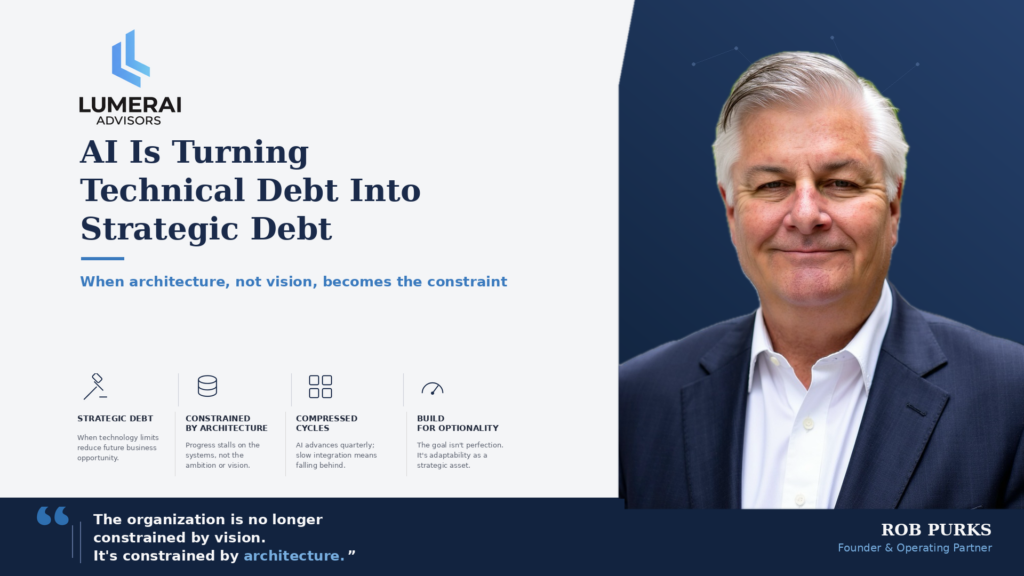
For years companies have accumulated Technical Debt. With the introduction of AI, Technical Debt is impeding your strategy to leverage the benefits of AI – this creates Strategic Debt.
A Survival Guide for Today’s Tech Leader
“The most dangerous place to be as a technology leader is surrounded by people who only agree with you.” The Clock Is Already Ticking If you are a CIO, the data on your tenure is sobering. The average CIO tenure now sits between 3 and 5 years, significantly shorter than CEOs and CFOs. The tenure is not just short, it is getting worse. According to the Nash Squared Digital Leadership Report, over 70% of CIOs have been in their positions for less than five years, with nearly 40% serving for two years or less. The Failure Rates Are Not Getting Better If tenure trends are troubling, the correlated project failure data is even more alarming. A Bain 2024 study puts failed business transformations at a staggering 88%. An MIT Project NANDA’s study found that after investing $30–40 billion in GenAI, 95% of businesses see little or no ROI. ERP implementations, often the centerpiece of a technology transformation, are especially brutal. Gartner estimates 70% of ERP projects fail to meet their objectives and 25% will fail catastrophically. The Echo Chamber Nobody Admits Exists Most major technology investment plans are built, reviewed, and approved by the same people who created them. Vendors have their own agenda. Consultancies have preferred platforms. Board members rarely have the technical depth to meaningfully challenge. No one in the room is truly incentivized to say “this will not work.” The Second Opinion Your Strategy Deserves Very few patients skip a second opinion before major surgery. The stakes are too high, and the consequences of a wrong call are too significant. When using a Generative AI Model to review content, which feedback personality do you really use? Do you want friendly or candid feedback? Why, then, do so many technology leaders approve $10M, $20M, or $50M transformation programs without a single independent voice in the room? An independent advisor does not replace your team or your consultants. They pressure-test the strategy, approach and plan. They identify the gaps your internal team is too close to see. They can benchmark your approach against what has actually worked at comparable organizations. Those independent advisors will provide you an unbiased read on feasibility before you stand up in front of your CEO or Board and stake your credibility on it. Most importantly, they are free to be honest with you. That isn’t something you can attain internally. The Conflict-of-Interest Problem with Traditional Advisors Not all advisors operate with equal independence. Large consultancies often have preferred vendor relationships that quietly shape their recommendations. Others avoid hard conversations simply to protect long-standing relationships. They know that delivering uncomfortable news risks the engagement and potentially vendor relationships. So the feedback gets softened, the risks get minimized, and the client believes they are receiving objective consultation when they are actually receiving managed guidance. A small boutique advisory firm is structurally better positioned to give you the truth. Fewer vendor entanglements, more accountability, and a business model built on your success rather than on hitting a vendor quota or preserving a relationship. Their reputation is the product, getting your recommendation right is the only incentive that matters. What Good Independent Advice Actually Looks Like You will know you have found the right advisor when they do several things most advisors do not: Give you a candid assessment of your current state versus where you think you are, including the uncomfortable parts. Red-team your strategy, arguing the case against your plan before your someone else does. Identify specific, actionable gaps, not a glossy report full of frameworks and 2×2 matrices. Benchmark your approach against real organizations, not vendor-sponsored research. Tell you when the timing is wrong, the data is not clean, the team is not ready, or the vendor is not the right fit, even when that is not what you want to hear. The relationship should be built on your success — not on the next engagement. The Cost of Not Getting a Second Opinion Once CIO credibility is lost, it is almost impossible to recover. Boards do not forgive a “we followed our vendor’s advice” excuse. Tenure data suggests you may only get one shot at this and if it goes sideways, the clock does not restart, it stops. The cost of an independent advisor is a rounding error against the risk of a failed implementation. The real question is not whether you can afford an independent voice, it is whether you will survive without one. The critical inquiry is not about the cost of securing an impartial perspective, but rather the risk of your continued viability without one. The Best Tech Leaders Do Not Go It Alone The best CIOs and CTOs are not the ones with all the answers. They are the ones who build the right conditions to find the right answers, which means surrounding themselves with people who are paid to be honest, not to be agreeable. Before you go into that board room, before you sign that software or implementation contract, before you stake your career on a plan you built inside a room full of people who need you to succeed, get an independent perspective. Echo chambers feel like alignment. Until the project fails, and they feel like something else entirely.
Aligning Technology Strategy with ESGObjectives

Aligning Technology Strategy with ESG Objectives Most ESG conversations in enterprise technology focus on what companies are building toward — renewable energy integration, AI-driven efficiency, decarbonization roadmaps. Fewer focus on what organizations are destroying in the process. Large-scale ERP migrations consume enormous resources, displace experienced teams, and generate emissions that never show up in sustainability reports. That gap deserves attention. ERP vendors have spent decades perfecting the art of manufactured urgency. End-of-support deadlines. Cloud migration mandates. “Strategic roadmap” language that obscures what customers are actually being asked to fund. For energy, utilities, and industrial companies carrying real ESG commitments alongside constrained IT budgets, the reflexive acceptance of vendor upgrade cycles is worth examining more critically. The Environmental Cost Nobody Accounts For A large ERP migration typically runs 18 to 36 months. During that period, the organization runs parallel systems — old and new — which can effectively double electricity consumption for extended stretches. Consultant teams fly in for workshops, go-live sprints, and hypercare support. The emissions from that travel are real, calculable, and almost never included in the upgrade business case. For companies that have made public Scope 3 commitments, this matters. Scope 3 covers indirect emissions across the value chain, and IT project activity is a legitimate contributor. The carbon footprint of a major implementation — consultant flights, parallel infrastructure, the organizational churn of managing two systems simultaneously — is not trivial. It just goes unmeasured because the conversation never starts there. Extending the life of existing enterprise software eliminates that footprint. A system already in production, already optimized, already running lean, does not carry those migration costs. That is a real environmental benefit — not a theoretical one. Companies serious about Scope 3 should be tracking it. The AI dimension adds another layer. Data centers running enterprise AI workloads draw heavily on electricity and water. As organizations scale inference and agentic AI applications, infrastructure costs grow. That is not an argument against AI investment — predictive maintenance, smart grid optimization, and real-time emissions monitoring all deliver genuine sustainability value. But it does mean the capital allocation question matters. An avoidable $30M ERP upgrade that consumes two years of IT bandwidth is a real opportunity cost against the AI capabilities that actually move emissions metrics. What Happens to the People IT moves fast and discards slowly. When a company replaces a core enterprise system, it is not just swapping software — it is displacing years of institutional knowledge. The finance analyst who spent eight years learning how the system was configured for the company’s specific processes. The IT team that built the integrations and kept them running. The workflow optimizations that took three years of refinement to get right. Those things do not transfer automatically to the new platform. Some of them disappear. The workforce disruption from large-scale migrations rarely shows up in ROI calculations, but it shows up clearly in culture, morale, and retention data in the years following go-live. Organizations that hold onto stable, well-optimized systems — and layer innovation on top rather than underneath — protect that institutional capital. They also free IT leadership to invest in the workforce development that actually matters: reskilling for AI and data roles, change management for operational technology, the human infrastructure that makes digital transformation stick. The capital freed by avoiding a major migration does not disappear. It can go into training programs, community energy initiatives, distributed energy resource platforms, or the operational technology upgrades that reduce real emissions in the field. A utility that makes that choice is making a better ESG investment than one that spent the same budget satisfying a vendor’s upgrade timeline. Governance Means Owning the Decision Here is the governance reality that most IT organizations do not say out loud: when 60 to 70 cents of every IT dollar goes to maintaining existing systems — vendor support, forced upgrades, unplanned migrations — that is not a strategy. It is a default. Someone else is setting the agenda. Strong technology governance starts with controlling the capital allocation. Organizations that extend enterprise software lifecycles through independent support and lifecycle optimization reclaim that control. They get to decide what gets funded and when, based on business priorities rather than vendor support schedules. That is a governance improvement with direct ESG consequences — because it means the capital can go where it should go. From a fiduciary standpoint, there is also a straightforward case for ESG ratings. Organizations that maximize the return on existing software investments, rather than retiring functional assets prematurely, earn credit for circularity and resource efficiency. That is not a side benefit — it is how lifecycle discipline gets scored. The governance risk argument runs the other direction too. Rushed migrations fail. Data integrity problems surface 18 months post-go-live. Business disruption from system transitions has derailed entire transformation programs. Those are governance failures with financial and reputational consequences. Avoiding them is not conservative — it is prudent. Boards are watching technology governance more closely now than they were five years ago. Cyber risk, AI oversight, regulatory scrutiny around data infrastructure — the bar has risen. CIOs who can demonstrate that they are making deliberate, strategic technology investments — not just responding to vendor pressure — are in a stronger position with their boards than those who cannot explain why the ERP migration consumed three years of IT capacity. The AI Infrastructure Trade-off The energy demands of enterprise AI are real and worth being direct about. Training frontier models is electricity-intensive. Running inference at scale — particularly for always-on agentic applications — requires persistent data center investment. Water consumption for cooling is a growing concern in regions already under pressure. For energy and utilities companies, this creates a tension that is not going away: sustainability commitments on one side, AI adoption imperatives on the other. The companies navigating this well are not trying to slow AI — they are funding it more intelligently. Stable core platforms that do not require constant reinvestment create the budget headroom