The First 100 Days After Close
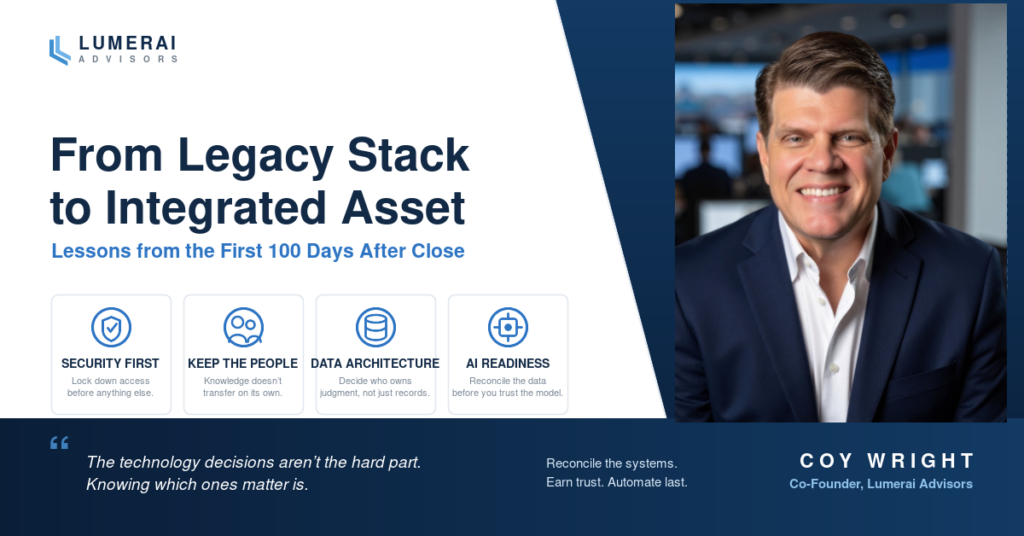
Why Technology Integration Determines Whether the Investment Thesis Survives. Lessons from post-acquisition technology integration, by Coy Wright, Lumerai Advisors Every acquisition has two closing dates. The one celebrated in the boardroom and the one that begins Monday morning when the systems must work together. Everyone gets excited about the diligence phase. AI-powered underwriting, data rooms parsed in hours instead of weeks, models that flag reserve risk before a human analyst finishes their coffee. It’s useful work, and it deserves the attention it gets. But diligence tells you what you’re buying. It doesn’t tell you what happens the Monday after close, when a field office in the Permian is still running production reports through a spreadsheet macro nobody has touched since 2019, the SCADA historian license responsible for operational production data is about to lapse, and the person who knows both systems just found out she’s “at risk” and is polishing her resume. The handoff, more than the diligence itself, is usually where deals actually lose value. For a PE-backed platform, this isn’t an IT problem sitting off to the side of the deal. It’s deal risk. The underwriting thesis assumed a certain pace of consolidation, a certain cost structure, a certain path to the next add-on. Every week the integration team spends firefighting instead of executing is a week that thesis quietly erodes, and it rarely shows up on a dashboard until it’s already expensive. Research on post-merger integration puts the failure rate at 70 to 90 percent of deals falling short of the value they were underwritten for, and the reasons named most often (incompatible systems, fragmented data, execution slower than planned) are exactly the ones that surface first in a technology stack. Executive Takeaways Technology integration is primarily an operational judgement challenge. Stabilization comes before modernization Institutional knowledge is often more valuable than documentation. AI should be deployed after data integrity is established, not before. The first 100 days determine whether deal value is realized or quietly eroded. Day one is about continuity, not transformation The instinct after close is to start modernizing immediately. New platform, new dashboards, new standards. Resist it for the first few weeks. The only job on day one is making sure nothing that currently works stops working: Production accounting keeps running Field data keeps flowing off the SCADA network Land and lease records stay accessible Payroll and AFE approvals don’t stall This means a real inventory before anything else, not the one sitting in the data room: every system actually touching production, land, HSE, and finance, who administers it, what the license and support terms are, and which of those systems have a single person who understands them well enough to keep them alive. That last category is the one that gets missed, and it’s the one that causes outages. A well-documented ERP is manageable. An undocumented historian configuration that lives in one engineer’s head is a ticking clock, especially if that engineer is uncertain about their future with the new owner. This lines up with what advisory firms like RSM have found studying post-merger integration broadly: the first 100 days is where quick, stabilizing wins need to happen, and where confusing that stabilization work with the long-term transformation plan is one of the more common ways integrations go sideways. Retention of institutional knowledge matters more than retention of headcount Every acquisition has some overlap to rationalize, and the pressure to move fast on org design is real. But the people who know why a particular well pad’s telemetry has been routed through a workaround for three years, or which spreadsheet is actually the source of truth versus which one is decorative, are not replaceable on a 100-day timeline. Identify them early, tell them directly why they matter, and keep them through at least one full reporting cycle before any staffing decisions touch their function. This is cheaper than the alternative, which is rebuilding tribal knowledge from scratch while also trying to close the books. Security comes before optimization A newly acquired asset is, for a window of time, the least defended part of the combined company: Credentials from the prior ownership are still active Vendor remote-access accounts haven’t been audited Nobody has yet mapped which of the acquired company’s systems can reach which of yours Access review and network segmentation belong in the first two weeks, not the first analysis of where AI could add value. This is unglamorous work and it rarely makes the integration deck, but it’s the difference between a clean 100 days and an incident report. Data architecture decisions get made whether you make them deliberately or not By day 60 or so, the temptation shifts from “keep it running” to “make it ours.” This is where the real architecture choice shows up: do you migrate the acquired company’s data into your existing platform, run both in parallel, or build a genuine integration layer between them. Each has a real cost. Migration is clean but risks losing context that lived in the old system’s structure, the tags, the naming conventions, the workarounds that encoded real operational knowledge even if they look messy. Parallel operation is fast but defers the actual integration problem and usually calcifies into permanent duplication if nobody forces the follow-through. An integration layer is the right long-term answer more often than either extreme, but it takes real engineering time that a 100-day plan rarely budgets for honestly. Underneath the plumbing question is a bigger one that most integration plans never name out loud: which system gets to be the source of judgment, not just the source of record, once the two organizations are running on shared data. Whoever’s platform wins that fight inherits the assumptions baked into it, good and bad. Get that decision right early and deliberately, and the rest of the technical integration follows a clear logic. Leave it to default to whichever system happened to be bigger at close, and you’ll spend the next two years discovering, one bad report at a
The True Costs of Conflicted Technology Advice
Nobody hires a conflicted advisor on purpose. That’s what makes this problem sopersistent. The bias in technology advisory is rarely explicit. It doesn’t show up in disclosedarrangements or flagged footnotes. It’s baked into business models — into how analyst firms generate revenue, how consulting practices are structured, how expert networks source their rosters. The organizations making the largest technology decisions of their careers are, in most cases, operating on advice shaped by interests that are neversurfaced in the engagement letter. I’ve watched this play out from multiple vantage points: as a technology executive making the decisions, as an industry advisor observing where they go wrong, and as someone who spent years inside the systems that produce the advice. The cost is real. The mechanisms are specific. And the fact that most organizations have no way tomeasure it doesn’t mean it isn’t happening. How the Conflicts Actually Work Analyst firms — the Gartners and Forresters of the world- derive substantial revenuefrom the vendors they evaluate. Research sponsorships, paid briefings, event participation fees, and custom inquiry access. None of that necessarily produces a false recommendation. But it shapes what gets studied, which vendors appear incomparisons, and how risks and limitations are framed. The analysis that reaches atechnology executive is downstream of commercial relationships that the executive never sees. The consulting firms have a related but more expensive problem. McKinsey, Deloitte,KPMG — these are not bad organizations, but their economics are not aligned withindependent technology judgment. The advisory fees are modest relative to theimplementation revenues those recommendations generate. When the same firm advises you to modernize your ERP and then bids to deliver the modernization, that advice is inseparable from the revenue opportunity it creates. The account team isn’t corrupt; the structure is just compromised. Expert networks occupy a different category. The pitch is compelling: get access toexecutives who’ve done what you’re trying to do. In practice, the quality control is thin.Someone who held a CIO role five years ago, available for a 45-minute call with noongoing accountability, no organizational context, and no incentive beyond the hourlyfee — that is a long way from trusted advisory. It’s a useful data point at best.Organizations consistently confuse the two. None of these players is behaving badly within their own business models. That’sactually what makes the problem durable. The conflicts are structural, not ethical.Pointing that out is not a criticism of individuals. It’s a description of a market that has not produced what it pretends to produce. The Junior Leverage Problem There’s a second failure mode in traditional consulting that gets less attention than bias.But it probably destroys more value. The economics of major consulting firms require that senior partners stay thinly spread across many engagements. At the same time, the actual work is done by analysts and associates who are, by definition, early in their careers. This is not a secret — it’s the model. It works reasonably well for financial modeling, market sizing, and process documentation. It works poorly for the technology decisions that actually matter most.A 27-year-old with two years of consulting experience cannot tell you whether a vendor’s implementation partner has the depth to deliver a large-scale SAP transformation. They can’t read a cybersecurity posture and distinguish genuine riskmanagement from compliance theater. They can’t assess whether the IT leadershipteam of an acquisition target has the operational credibility to execute an integration ona private equity timeline. These aren’t things you can develop by reading about them. They come from having been accountable for the outcome under real conditions, fromHaving your career on the line when the go-live goes sideways. Organizations often accept the output of junior teams because recognizable firm brands staff the engagement, and the deliverables look thorough. Slide quality is not a proxy for judgment quality. The two are frequently inversely correlated. What Bad Advice Actually Costs The direct costs are visible in the wreckage: ERP transformations that deliver a fraction of projected ROI, AI programs that generate impressive demos and negligible operational impact, cybersecurity investments that check compliance boxes whileleaving material risks unaddressed. These failures are common enough that mosttechnology executives have lived through at least one. They tend to be attributed toexecution problems rather than advisory failures, which means the root cause doesn’t get fixed. The indirect costs are harder to measure but likely larger. When a technology initiative fails publicly, the damage to organizational credibility extends well beyond the project. The CIO or CISO whose reputation takes the hit. The board that loses confidence in the technology investment thesis. The talent that leaves because they were part of something that went badly wrong. These are real costs that don’t show up in thepost-mortem. The opportunity cost is the one that keeps me up at night. Every dollar consumed by avendor-mandated upgrade that didn’t need to happen is a dollar that didn’t go towardsomething that could have. The AI capabilities a competitor built while your budget wastied up in a migration. The operational technology investment that would have reduced costs 20% but kept getting deferred. The grid modernization project would have changed your competitive position in a market that’s moving faster than your planning cycle. These costs are invisible because they’re counterfactual. Nobody writes a post-mortemon the things that didn’t get built. But they accumulate, and the organizations thatconsistently make better technology decisions compound those advantages over time in ways that become very hard to close. What PE Firms Are Getting Wrong Private equity deserves its own section here because the stakes and the failure modes are specific. Technology due diligence in most PE transactions is still treated as a technical audit rather than a strategic risk assessment. The question being answered is “is the technology functional?” when the question that actually matters is “will this technologycreate or destroy value across the hold period?” Those are different questions withdifferent answers, and they require different expertise to assess. The integration execution risk in platform acquisitions is routinely underweighted. Bolt-on technology assessments frequently overlook the practical complexity of connecting systems across entities
Aligning Technology Strategy with ESGObjectives

Aligning Technology Strategy with ESG Objectives Most ESG conversations in enterprise technology focus on what companies are building toward — renewable energy integration, AI-driven efficiency, decarbonization roadmaps. Fewer focus on what organizations are destroying in the process. Large-scale ERP migrations consume enormous resources, displace experienced teams, and generate emissions that never show up in sustainability reports. That gap deserves attention. ERP vendors have spent decades perfecting the art of manufactured urgency. End-of-support deadlines. Cloud migration mandates. “Strategic roadmap” language that obscures what customers are actually being asked to fund. For energy, utilities, and industrial companies carrying real ESG commitments alongside constrained IT budgets, the reflexive acceptance of vendor upgrade cycles is worth examining more critically. The Environmental Cost Nobody Accounts For A large ERP migration typically runs 18 to 36 months. During that period, the organization runs parallel systems — old and new — which can effectively double electricity consumption for extended stretches. Consultant teams fly in for workshops, go-live sprints, and hypercare support. The emissions from that travel are real, calculable, and almost never included in the upgrade business case. For companies that have made public Scope 3 commitments, this matters. Scope 3 covers indirect emissions across the value chain, and IT project activity is a legitimate contributor. The carbon footprint of a major implementation — consultant flights, parallel infrastructure, the organizational churn of managing two systems simultaneously — is not trivial. It just goes unmeasured because the conversation never starts there. Extending the life of existing enterprise software eliminates that footprint. A system already in production, already optimized, already running lean, does not carry those migration costs. That is a real environmental benefit — not a theoretical one. Companies serious about Scope 3 should be tracking it. The AI dimension adds another layer. Data centers running enterprise AI workloads draw heavily on electricity and water. As organizations scale inference and agentic AI applications, infrastructure costs grow. That is not an argument against AI investment — predictive maintenance, smart grid optimization, and real-time emissions monitoring all deliver genuine sustainability value. But it does mean the capital allocation question matters. An avoidable $30M ERP upgrade that consumes two years of IT bandwidth is a real opportunity cost against the AI capabilities that actually move emissions metrics. What Happens to the People IT moves fast and discards slowly. When a company replaces a core enterprise system, it is not just swapping software — it is displacing years of institutional knowledge. The finance analyst who spent eight years learning how the system was configured for the company’s specific processes. The IT team that built the integrations and kept them running. The workflow optimizations that took three years of refinement to get right. Those things do not transfer automatically to the new platform. Some of them disappear. The workforce disruption from large-scale migrations rarely shows up in ROI calculations, but it shows up clearly in culture, morale, and retention data in the years following go-live. Organizations that hold onto stable, well-optimized systems — and layer innovation on top rather than underneath — protect that institutional capital. They also free IT leadership to invest in the workforce development that actually matters: reskilling for AI and data roles, change management for operational technology, the human infrastructure that makes digital transformation stick. The capital freed by avoiding a major migration does not disappear. It can go into training programs, community energy initiatives, distributed energy resource platforms, or the operational technology upgrades that reduce real emissions in the field. A utility that makes that choice is making a better ESG investment than one that spent the same budget satisfying a vendor’s upgrade timeline. Governance Means Owning the Decision Here is the governance reality that most IT organizations do not say out loud: when 60 to 70 cents of every IT dollar goes to maintaining existing systems — vendor support, forced upgrades, unplanned migrations — that is not a strategy. It is a default. Someone else is setting the agenda. Strong technology governance starts with controlling the capital allocation. Organizations that extend enterprise software lifecycles through independent support and lifecycle optimization reclaim that control. They get to decide what gets funded and when, based on business priorities rather than vendor support schedules. That is a governance improvement with direct ESG consequences — because it means the capital can go where it should go. From a fiduciary standpoint, there is also a straightforward case for ESG ratings. Organizations that maximize the return on existing software investments, rather than retiring functional assets prematurely, earn credit for circularity and resource efficiency. That is not a side benefit — it is how lifecycle discipline gets scored. The governance risk argument runs the other direction too. Rushed migrations fail. Data integrity problems surface 18 months post-go-live. Business disruption from system transitions has derailed entire transformation programs. Those are governance failures with financial and reputational consequences. Avoiding them is not conservative — it is prudent. Boards are watching technology governance more closely now than they were five years ago. Cyber risk, AI oversight, regulatory scrutiny around data infrastructure — the bar has risen. CIOs who can demonstrate that they are making deliberate, strategic technology investments — not just responding to vendor pressure — are in a stronger position with their boards than those who cannot explain why the ERP migration consumed three years of IT capacity. The AI Infrastructure Trade-off The energy demands of enterprise AI are real and worth being direct about. Training frontier models is electricity-intensive. Running inference at scale — particularly for always-on agentic applications — requires persistent data center investment. Water consumption for cooling is a growing concern in regions already under pressure. For energy and utilities companies, this creates a tension that is not going away: sustainability commitments on one side, AI adoption imperatives on the other. The companies navigating this well are not trying to slow AI — they are funding it more intelligently. Stable core platforms that do not require constant reinvestment create the budget headroom