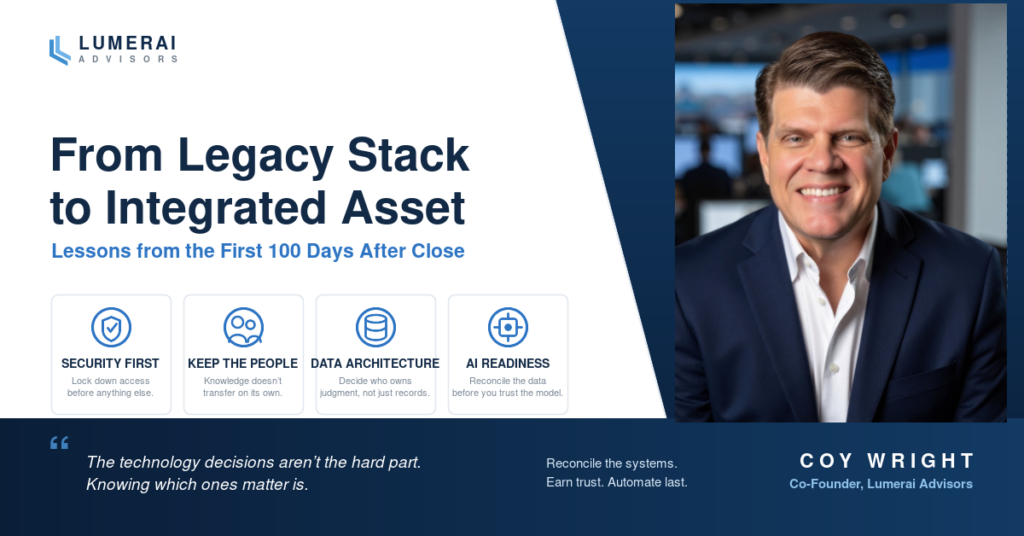
Why Technology Integration Determines Whether the Investment Thesis Survives.
Lessons from post-acquisition technology integration, by Coy Wright, Lumerai Advisors
Every acquisition has two closing dates. The one celebrated in the boardroom and the one that begins Monday morning when the systems must work together.
Everyone gets excited about the diligence phase. AI-powered underwriting, data rooms parsed in hours instead of weeks, models that flag reserve risk before a human analyst finishes their coffee. It’s useful work, and it deserves the attention it gets.
But diligence tells you what you’re buying. It doesn’t tell you what happens the Monday after close, when a field office in the Permian is still running production reports through a spreadsheet macro nobody has touched since 2019, the SCADA historian license responsible for operational production data is about to lapse, and the person who knows both systems just found out she’s “at risk” and is polishing her resume.
The handoff, more than the diligence itself, is usually where deals actually lose value.
For a PE-backed platform, this isn’t an IT problem sitting off to the side of the deal. It’s deal risk. The underwriting thesis assumed a certain pace of consolidation, a certain cost structure, a certain path to the next add-on. Every week the integration team spends firefighting instead of executing is a week that thesis quietly erodes, and it rarely shows up on a dashboard until it’s already expensive. Research on post-merger integration puts the failure rate at 70 to 90 percent of deals falling short of the value they were underwritten for, and the reasons named most often (incompatible systems, fragmented data, execution slower than planned) are exactly the ones that surface first in a technology stack.
Executive Takeaways
- Technology integration is primarily an operational judgement challenge.
- Stabilization comes before modernization Institutional knowledge is often more valuable than documentation.
- AI should be deployed after data integrity is established, not before.
- The first 100 days determine whether deal value is realized or quietly eroded.
Day one is about continuity, not transformation
The instinct after close is to start modernizing immediately. New platform, new dashboards, new standards. Resist it for the first few weeks. The only job on day one is making sure nothing that currently works stops working:
- Production accounting keeps running
- Field data keeps flowing off the SCADA network
- Land and lease records stay accessible
- Payroll and AFE approvals don’t stall
This means a real inventory before anything else, not the one sitting in the data room: every system actually touching production, land, HSE, and finance, who administers it, what the license and support terms are, and which of those systems have a single person who understands them well enough to keep them alive. That last category is the one that gets missed, and it’s the one that causes outages. A well-documented ERP is manageable. An undocumented historian configuration that lives in one engineer’s head is a ticking clock, especially if that engineer is uncertain about their future with the new owner. This lines up with what advisory firms like RSM have found studying post-merger integration broadly: the first 100 days is where quick, stabilizing wins need to happen, and where confusing that stabilization work with the long-term
transformation plan is one of the more common ways integrations go sideways.
Retention of institutional knowledge matters more than retention of headcount
Every acquisition has some overlap to rationalize, and the pressure to move fast on org design is real. But the people who know why a particular well pad’s telemetry has been routed through a workaround for three years, or which spreadsheet is actually the source of truth versus which one is decorative, are not replaceable on a 100-day timeline. Identify them early, tell them directly why they matter, and keep them through at least one full reporting cycle before any staffing decisions
touch their function. This is cheaper than the alternative, which is rebuilding tribal knowledge from scratch while also trying to close the books.
Security comes before optimization
A newly acquired asset is, for a window of time, the least defended part of the combined company:
- Credentials from the prior ownership are still active
- Vendor remote-access accounts haven’t been audited
- Nobody has yet mapped which of the acquired company’s systems can reach which of yours
Access review and network segmentation belong in the first two weeks, not the first analysis of where AI could add value. This is unglamorous work and it rarely makes the integration deck, but it’s the difference between a clean 100 days and an incident report.
Data architecture decisions get made whether you make them deliberately or not
By day 60 or so, the temptation shifts from “keep it running” to “make it ours.” This is where the real architecture choice shows up: do you migrate the acquired company’s data into your existing platform, run both in parallel, or build a genuine integration layer between them. Each has a real cost. Migration is clean but risks losing context that lived in the old system’s structure, the tags, the naming conventions, the workarounds that encoded real operational knowledge even if they look messy. Parallel operation is fast but defers the actual integration problem and usually calcifies into permanent duplication if nobody forces the follow-through. An integration layer is the right long-term answer more often than either extreme, but it takes real engineering time that a 100-day plan rarely budgets for honestly.
Underneath the plumbing question is a bigger one that most integration plans never name out loud: which system gets to be the source of judgment, not just the source of record, once the two organizations are running on shared data. Whoever’s platform wins that fight inherits the assumptions baked into it, good and bad. Get that decision right early and deliberately, and the rest of the technical integration follows a clear logic. Leave it to default to whichever system happened to be bigger at close, and you’ll spend the next two years discovering, one bad report at a time, whose assumptions actually won.
The AI conversation always shows up too early
Every integration kickoff eventually reaches the same slide: how fast can we get the newly acquired asset onto the AI tooling running across the rest of the portfolio. Field development optimization, automated underwriting support, whatever the flagship use case is. The instinct makes sense. It’s also premature almost every time, and its usually the newest, most enthusiastic people in the room pushing hardest for it. A model does’t care that the land data is still being reconciled between two systems, or that nobody’s confirmed which of three conflicting lateral lengths in the well file is actually correct. It will run anyway, and it will produce confident, plausible-looking output built on a foundation nobody has verified. That’s a worse outcome than waiting, because a bad answer that looks reasonable travels much further through an organization than an honest “we’re not ready yet.” The tell is almost always enthusiasm outrunning verification: the newer and shinier the tool, the more eager everyone is to point it at data that hasn’t earned trust yet.
“Bad data doesn’t slow AI down. It simply makes AI wrong faster”.
The unglamorous, correct sequence:
- Reconcile the systems
- Establish a clean, verified stretch of history
- Confirm who actually owns each field
- Only then let the AI tooling near it
Skipping that order doesn’t make AI adoption faster. It moves the failure downstream, to the point where it’s harder to trace and far more expensive to unwind, usually right around the moment someone in a portfolio review meeting asks why two reports don’t agree.
Warning Signs Your Integration is Already Off Track
- Critical systems have no documented owner.
- Key personnel are leaving before knowledge transfer.
- Multiple versions of operational data exist.
- AI initiatives begin before data reconciliation.
- Security reviews lag behind integration.
- Teams are discussing modernization before stabilization.
This is a judgment problem before it’s a technology problem
None of the above comes from a template, and it doesn’t come from running an integration playbook against a checklist. It comes from having stood in the field office when the SCADA link drops during a cold snap and knowing within thirty seconds whether that’s an emergency or a Tuesday. It comes from having made the call, more than once, on which “temporary” workaround installed three field superintendents ago is actually load-bearing and which one really can be switched off without anyone noticing.
Someone who has only ever integrated systems from a whiteboard treats every line item in the inventory as equally urgent, because on paper they all look the same: a system, an owner, a risk rating. Someone who has actually run operations knows within a day which three items on that list will take the asset down if mishandled, and which twenty can wait until month four. It isn’t a documentation gap so much as the difference between reading about a workover rig and standing next to one when something goes sideways.
This judgment doesn’t transfer from a resume built entirely in corporate IT or management consulting, and it’s the single biggest predictor of whether a 100-day plan survives contact with an actual field team. The technology decisions in most integrations are not that hard. Knowing which ones matter, in what order, under real operational pressure, and knowing it fast enough to act before the asset teaches you the hard way, is the part that only comes from having done it before. A leader who has lived through a prior acquisition brings that to the table. An org chart full of the right titles doesn’t guarantee it.
“Technology decisions are rarely the hardest part. Knowing which decisions matter first is”.
The firms doing this well treat the first 100 days as instrumentation, not transformation. You’re not trying to deploy the AI tooling or the unified reporting platform in that window. You’re trying to get clean, complete, trustworthy data flowing from the new asset into a place where it can be acted on, without losing the people and the context that make the data meaningful in the first place. The field development optimization and the portfolio-wide analytics that make headlines later all depend on that groundwork holding.
The underwriting model can tell you an asset is worth acquiring. It can’t tell you whether the team integrating it understood that the real value was sitting in a historian configuration and an engineer’s head, not in the reserve report. Recognizing the difference is a separate skill, and it’s the one that determines whether the deal thesis actually shows up in the numbers eighteen months later.
This is the gap between technology diligence and technology execution, and it’s why more PE firms are bringing in operators who’ve actually run the integration, not just advised on one, for the first 100 days after close.
Technology diligence tells you whether you should buy the asset.
Technology execution determines whether you keep the value you paid for.
At Lumerai Advisors, this is the work: former Fortune 500 CIOs sitting inside portfolio companies during exactly this window, doing the unglamorous instrumentation work so the value creation plan has something real to stand on. If your fund has a platform sitting inside that window right now, the First 100 Days Engagement is built specifically for it: an operator embedded on-site from day one, running the inventory, the retention conversations, and the security review before the
architecture debate even starts.