Lumerai Technology Value Realization Series | Part 3
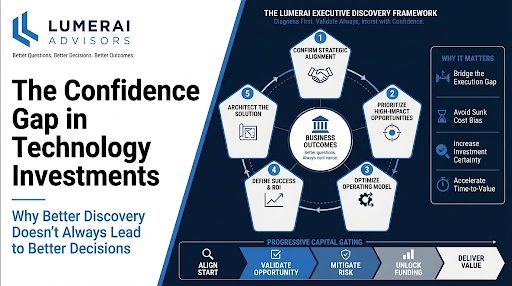
Why Better Discovery Doesn’t Always Lead to Better Decisions The Confidence Gap in Technology Investments Technology investment decisions rarely fail because organizations lack information. They fail because organizations often mistake more information for greater decision confidence. By the time a technology initiative reaches executive leadership, months of work have often been completed. Business cases have been drafted. Requirements have been documented. Vendors have been shortlisted. Demonstrations have been conducted. Scorecards have been completed. Research from organizations such as Gartner and McKinsey has consistently highlighted the difficulty organizations face in translating major technology and transformation investments into expected business value. Despite months of rigorous preparation, executive leadership is frequently left asking the exact same fundamental question: “How do we know this is the right investment?” That is the Confidence Gap: the distance between having enough information to make a technology decision and having enough evidence to make a confident decision about business outcomes. In the first article of this series, I argued that organizations often solve the wrong problem because they skip structured discovery. In the second article, I introduced the Lumerai Executive Discovery Framework, a disciplined approach to validating business opportunities before evaluating technology solutions. Discovery improves the quality of the problem definition. It does not, by itself, guarantee the quality of the investment decision. Transforming discovery into realized value requires structured executive decision governance. When Good Analysis Produces Poor Decisions One of the most persistent misconceptions in enterprise IT strategy is the belief that more analysis produces better decisions. It does not. During enterprise software evaluations, organizations routinely generate an extraordinary amount of analysis and documentation: Ironically, this abundance of data frequently induces decision paralysis rather than strategic clarity. Executives become overwhelmed by competing departmental priorities, conflicting vendor claims, and technical minutiae. As a result, executive discussions regress from strategic outcome validation to tactical feature grading, pricing negotiations, and deployment timelines. Technology selection becomes the primary objective, while business value realization fades into the background. Confidence Is an Executive Asset Enterprise technology investments are rarely approved simply because a vendor offers the longest feature list. Successful investments are approved when leadership establishes high decision confidence that the deployment will produce its intended business outcomes. Executive decision confidence relies on validating five fundamental governance questions: When these questions are answered with evidence rather than vendor assumptions, governance transitions from passive procurement to active strategic leadership. The Lumerai Executive Decision Framework The primary objective of the Lumerai Executive Decision Framework is not to select software. Its objective is to identify the investment decision that yields the highest confidence of achieving target business outcomes. The framework evaluates major capital investments across six progressive decision gates: Stage 1: Validate Strategic Alignment Establish whether the initiative directly accelerates enterprise revenue, cost efficiency, or competitive differentiation. Initiatives lacking clear strategic alignment should not advance to subsequent investment gates, regardless of technical capability. Stage 2: Define Decision Criteria Before engaging vendors, leadership establishes non-negotiable success criteria driven strictly by operational imperatives. Business outcomes drive technology selection—never the reverse. Stage 3: Evaluate Solution Architecture Assess integration complexity, scalability, security posture, and operating model alignment. Technology is evaluated as a capability enabler within the broader ecosystem. Stage 4: Assess Enterprise Risk Evaluate operational, financial, vendor stability, cybersecurity, and organizational change risks collectively rather than in isolation. Stage 5: Compare Future Scenarios Test how candidate solutions perform across distinct future business scenarios—such as rapid scaling, M&A integration, regulatory shifts, and emerging AI capabilities. Stage 6: Establish Decision Confidence Final investment sign off should occur only when the evidence demonstrates that the business problem has been validated, alternatives have been objectively evaluated, risks are understood, and clear value realization metrics have been established. Confidence does not mean certainty. No major technology investment comes with certainty. It means leadership understands the evidence, the assumptions, the risks, the alternatives, and the expected outcomes well enough to make a defensible decision. Five Biases That Can Distort Technology Decisions Even disciplined organizations are susceptible to cognitive bias. Five biases appear repeatedly during enterprise technology evaluations: Recognizing these biases does not eliminate them. The objective of governance is to make them visible, challenge their influence, and ensure that major investment decisions are ultimately supported by evidence rather than assumption. Executive Example Consider an enterprise modernizing its service architecture following a structured discovery phase. Three finalists remain: Vendor A: May create the greatest long term capability, but introduces significant organizational and implementation risk. Vendor B: May offer the strongest operational fit, but requires a higher initial investment. Vendor C: May produce the strongest financial case today, but could constrain future growth through customization requirements. All three can satisfy the requirements. The decision therefore cannot be resolved by requirements compliance alone. Which investment gives us the greatest confidence that we will achieve the business outcomes we defined? Under the Lumerai Executive Decision Framework, the decision shifts from “Which platform scores highest?” to “Which capital allocation provides the highest decision confidence for our strategic outcomes?” By evaluating each vendor against future operating scenarios and risk tolerances, leadership converts an ambiguous software comparison into a confident strategic decision. Better Decisions Require Better Governance Technology investments should never be authorized simply because a platform tops a feature matrix. They should be authorized because executive leadership has evidence based confidence that the investment aligns with strategic objectives, addresses a validated business problem, appropriately manages enterprise risk, and establishes a credible path to measurable economic value. True decision confidence is not executive intuition. It is the outcome of disciplined decision architecture. Conclusion Technology investment decisions are often portrayed as exercises in software selection. In reality, they are exercises in executive judgment regarding business outcomes. Organizations that consistently outperform their peers are not necessarily better at evaluating technology. They are better at making decisions. They understand that every technology investment is ultimately a business decision supported by technology, not the other way around. Discovery identifies the right problem. Decision making determines the right investment. Execution delivers the solution. Value realization measures success.
Nobody Decided to Let Software Decide
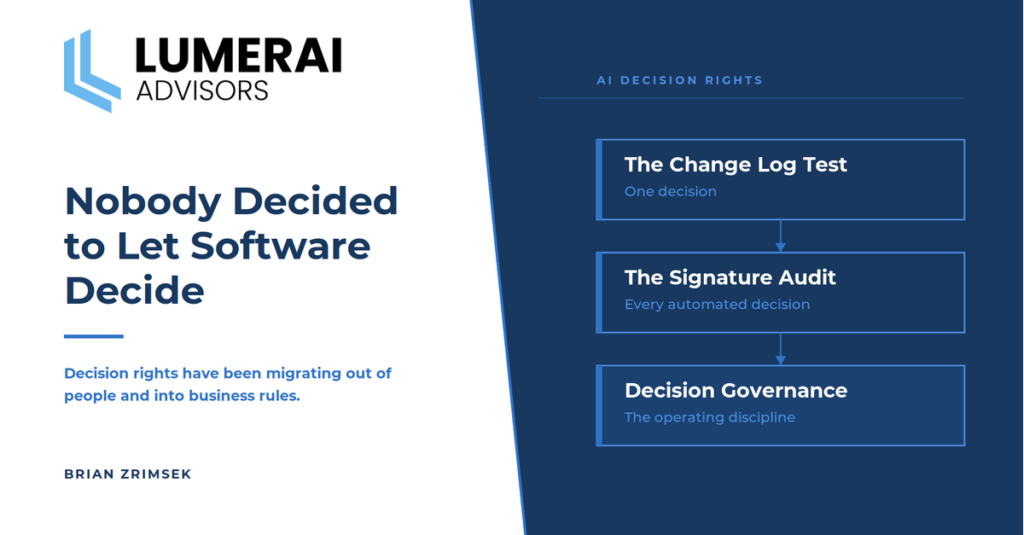
Decision rights have been migrating out of people and into business rules nobody owns. Real estate got the bill first. What every executive should know.
The Hidden Risk of AI: Building Transformation Programs for a Future That May Not Exist
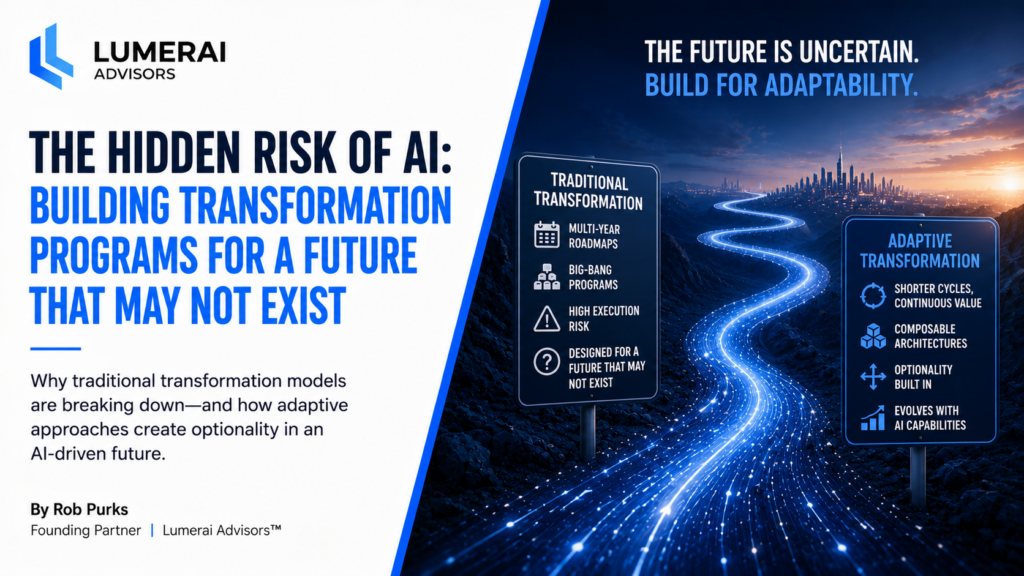
For decades, enterprise transformation followed a familiar model: define a future state, build a multi-year roadmap, and execute with discipline. That model is now under pressure—not because transformation is no longer necessary, but because the assumptions behind it are rapidly breaking down. Large transformation programs rely on a core premise: that we can reasonably predict the future operating model. In an AI-driven environment, that premise is increasingly fragile. Capabilities are evolving faster than planning cycles, and organizations are designing multi-year programs against a moving target. McKinsey & Company has highlighted that while generative AI could create significant economic value, organizations are capturing impact fastest through incremental deployment embedded in existing workflows, not large, monolithic transformations. Value is emerging in shorter cycles, not long-duration bets. At the same time, execution risk was already high. Boston Consulting Group estimates that 70% of digital transformations fail to meet their objectives, even in more stable environments. AI does not reduce that risk—it amplifies it. But there is a more fundamental issue emerging—one that is still underappreciated. We are designing transformation programs without a clear understanding of what AI will actually be capable of in two to three years. This introduces a new form of exposure. Not just whether a program will be delivered successfully, but whether it is solving the right problem at all. Entire layers of functionality being built today—workflow orchestration, decision support, even elements of system integration—may be simplified, automated, or eliminated as AI capabilities mature. The risk is no longer just execution failure. It is design risk leading to solution irrelevance. Programs that are delivered on time, on budget, and exactly as designed—but no longer aligned with the business or technology landscape by the time they go live. This is why we are seeing leading organizations shift away from “big-bang” transformation toward more adaptive models. Composable architectures, incremental modernization, and shorter investment cycles are becoming the preferred approach—not as a compromise, but as a strategic response to uncertainty. The question is no longer, “What should our business look like in five years?” It is, “How do we remain adaptable over the next five quarters?” For CEOs, CIOs, and private equity leaders, this has direct implications for capital allocation and risk management. Transformation programs must be structured with optionality—designed to evolve as capabilities evolve, rather than locking into a fixed future state. In many cases, the right answer is not to stop transformation—but to deconstruct it. Rob Purks is a Founding Partner at Lumerai Advisors, a technology strategy advisory firm. Lumerai Advisors provides an unbiased perspective which is not influenced by vendor relationships. With over 150 years of CIO and technology experience, the founding partners bring an honest and complete perspective on technology strategies and challenges. #Telecom #DigitalTransformation #PrivateEquity #ITStrategy #CIO #EnterpriseArchitecture #OPEX #AI #Cloud Lumerai Advisors
The AI ROI Panic Is About to Create the Next Legacy System
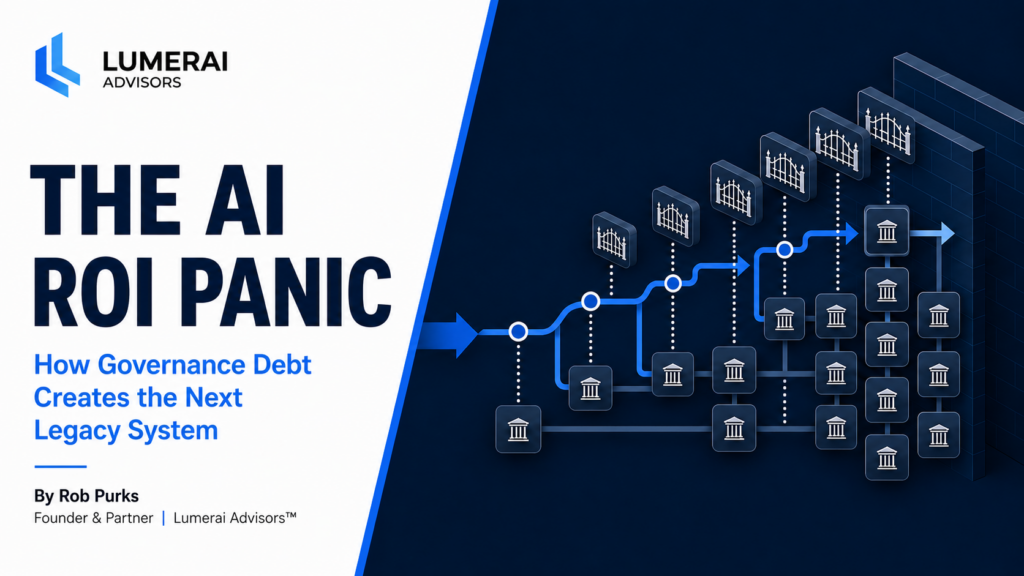
By Rob Purks, Founding & Operating Partner, Lumerai Advisors There is a quiet panic spreading through boardrooms right now, and it has nothing to do with whether AI works. It has to do with whether anyone can prove it. The numbers behind that panic are real. Hyperscalers are on track to spend roughly $675 billion on AI infrastructure this year alone. Meanwhile, MIT’s Project NANDA found that 95% of enterprise AI pilots deliver no measurable P&L impact. S&P Global reported that 42% of companies abandoned most of their AI initiatives last year which is more than double the rate of the year before. Forrester is now predicting a market correction with enterprises deferring a quarter of their planned 2026 AI spend into 2027. Even the debt markets have weighed in: Citi identified a measurable credit spread penalty for companies classified as AI adopters without evidence of return. Spending without proof is now literally priced into the cost of capital. I am not here to argue with the data. The data is right. I am here to argue with the response. Key Takeaways The Control Reflex: Why AI Governance Backfires When boards see numbers like these, they react the way boards have always reacted: with control. AI steering committees and per-use-case business cases. ROI attestation before funding. Approval gates between pilot and production. Governance councils that meet monthly to review initiatives that move weekly. Every one of these mechanisms is individually defensible. That is exactly what makes them dangerous. I have spent my career on both sides of this dynamic, as a CIO running technology for telecom operators in Latin America, and later advising enterprises on transformation at Accenture, IBM, and Ericsson. And I can tell you what happens next, because I have watched it happen with every major technology wave: the control structure built to manage today’s uncertainty becomes tomorrow’s constraint. It outlives the problem it was created to solve. Nobody is ever promoted for dismantling a governance committee. I learned this the hard way by inheriting the aftermath of one. At a Latin American operator a major CRM transformation had been put in front of a review board and killed on grounds that were individually hard to argue with: the projected budget was steep, the internal skills weren’t fully in place, and the business wasn’t deemed ready. Every objection was reasonable. The board did exactly what it was designed to do. And while we sat on a defensible “not yet” a competitor moved, modernized its customer platform, and took ground we never fully recovered. The control worked perfectly. The company lost anyway. That is the trap: the most dangerous governance failures don’t look like failures at all, they look like prudence. We have seen this exact movie before. Cloud and agile both promised speed. In most enterprises they delivered something closer to “the same speed with more meetings.” The technology arrived, the operating model absorbed it, neutralized it, and carried on. The gains didn’t disappear, they were quietly strangled by slow decisions and diffused accountability. The ROI panic is now rebuilding that machinery, at speed, with the best of intentions. Except this time there is a difference that should worry every executive: when the constraint is a legacy system you can eventually migrate off it. When the constraint is a legacy operating structure there is no migration project. It just becomes how the company works. I call this Governance Debt: the accumulated drag of controls that outlast the uncertainty they were built to manage. Like technical debt it compounds quietly and like technical debt the interest is paid in speed. The Wrong Diagnosis: It’s Not an AI Adoption Problem Here is the tell that we are solving the wrong problem. In one of the most striking findings of this cycle 97% of executives report personally benefiting from AI yet only 29% see significant organizational ROI. Read that gap carefully. It is not an adoption problem. It is not a model-quality problem. And it is emphatically not a control problem. It is a compounding problem. Value is being created at the level of individuals and teams and the organization has no mechanism to aggregate it, redirect it, or build on it. Adding oversight to that situation does not create compounding. It adds friction to the one place value actually exists. Look at what the successful 29% actually have in common: AI tied to revenue outcomes, business teams owning the workflows, and the whole effort treated as organizational redesign rather than technology deployment.[1] Notice what is not on that list: more approval gates. The organizations seeing returns did not out-govern their peers. They out decided them. What to Build Instead: A Velocity-First AI Operating Model If the answer isn’t heavier oversight, what is it? Three structural moves none of which require a committee: Replace approval gates with kill cycles. Don’t make initiatives prove their worth before they start, make them prove it on a clock. Every AI initiative launches with pre-agreed kill criteria and a fixed time box. The discipline shifts from “may we begin?” to “did we learn enough to continue?” That is governance measured in velocity, not meetings. Measure ROI at the portfolio level, not the use case. Demanding a business case from every individual experiment guarantees you will only fund the safe, incremental, and ultimately unimportant. Venture and private equity investors figured this out decades ago: the portfolio carries the math so the individual bets can take real risk. It is the same logic that drives value creation across a portfolio of companies, you manage the aggregate, not the average. Boards should hold leadership accountable for portfolio-level return and learning rate, not for the survival of any single pilot. Put a sunset clause on every control. Any governance mechanism created to manage AI uncertainty should carry an expiration date and a renewal test: what decision did this body accelerate this quarter? If the honest answer is none, it isn’t governing, it’s accumulating. This is how you keep
The 95% AI Pilot Failure Rate Is Good News
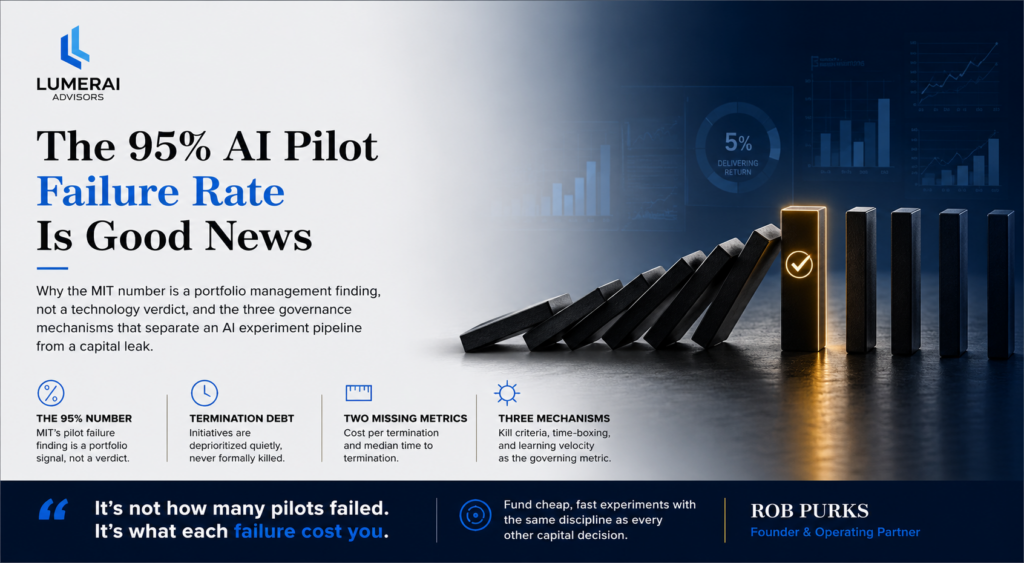
Why the MIT number is a portfolio management finding, not a technology verdict, and the three governance mechanisms that separate an AI experiment pipeline from a capital leak.
The Missing Stage in Every Technology Investment
McKinsey estimates that approximately 70% of digital transformations fail to meet their objectives. Why? Most technology decisions don’t fail because organizations choose the wrong technology. They fail because they begin by solving the wrong problem. After more than three decades helping executives make major technology decisions, I’ve noticed something: the best executive teams don’t necessarily have better answers. They ask better questions. It often starts with a statement like: Most organizations immediately begin discussing vendors. A different conversation begins by asking, “What business problem are we actually trying to solve?” Technology requests are rarely the problem. They are hypotheses about the solution. Executive leadership begins by validating the problem before validating the technology. Exceptional leaders separate business problems from proposed solutions. That’s why I believe the quality of every technology investment is determined long before technology is ever selected. Better decisions begin with better questions. Executive Takeaways Where Most Investment Processes Break Down Imagine building a new corporate headquarters. No executive team would approve the full construction budget before understanding the business requirements, evaluating alternative designs, assessing the site, and validating the long term operating model. Yet organizations routinely approve technology investments with an equivalent level of uncertainty. Not because they’re careless. Because the investment process encourages certainty before sufficient understanding exists. Business cases are often written while assumptions still outweigh evidence. Benefits are estimated before outcomes are fully defined. Budgets are approved before organizations truly understand the problem they are trying to solve. Then implementation begins and the organization spends months learning what it could have discovered before approval. We’ve normalized learning after approval. Instead of learning before commitment. Technology Investments Should Mature Like Executive Decisions One of the lessons I’ve taken from working with executive teams is that confidence isn’t something you create. It’s something you earn. The best investors understand this instinctively. They don’t commit all of their capital on day one. They invest in reducing uncertainty. Every conversation. Every discovery session. Every customer interview. Every piece of evidence either increases confidence or challenges assumptions. Technology investments should work exactly the same way. As knowledge increases… Decision confidence should increase. As decision confidence increases… Investment commitment should increase. Instead, many organizations reverse the sequence. They commit significant capital first. Then spend months validating assumptions they could have challenged before funding was approved. The Lumerai Technology Value Realization Framework™ After seeing this pattern repeat across hundreds of technology decisions, we developed the Lumerai Technology Value Realization Framework™ to help executives improve decision quality before major investments are made. At its core is a simple principle: investment confidence should increase before capital commitment. Rather than viewing technology investments as a single approval event, the framework treats them as a progression of executive decisions. Each stage is designed to answer one critical question before additional resources, executive attention, or capital are committed. It begins with a Business Opportunity. Not a technology request. Not a vendor presentation. A business opportunity. From there, each stage progressively reduces uncertainty while increasing executive confidence. Each stage exists for one purpose: replacing assumptions with evidence before increasing commitment. Every stage earns the right to unlock the next investment decision. Warning Signs You’re Investing Too Early The Role of the Modern CIO Is Changing For decades, CIOs were measured by operational excellence. System availability. Cost management. Project delivery. Those responsibilities remain essential. But executive leadership increasingly expects something more. Boards, CEOs, CFOs, and investors increasingly expect CIOs to improve the quality of enterprise technology investment decisions, not simply the quality of technology delivery. That requires a different leadership mindset. One that values curiosity before certainty. Business outcomes before technology features. Questions before answers. The CIO of the future won’t be defined by the systems they implement. They’ll be defined by the quality of the decisions they help their organizations make. A Question Worth Asking Before approving your next major technology investment, ask one simple question. Are we solving the right problem? It sounds obvious. Yet it may be the most valuable question an executive team can ask. Technology alone doesn’t create business value. Better decisions do. Those decisions come from solving the right problems, executing with confidence, and replacing assumptions with evidence. And every one of those things begins with asking better questions. Coming Next: The Most Expensive Technology Mistake You Can Make Most technology requests arrive disguised as solutions. “We need AI.” “We need a new ERP.” “We need to move everything to the cloud.” But what if those aren’t business problems at all? In the next article, we’ll explore why organizations so often mistake technology requests for business needs, and how a disciplined discovery process can dramatically improve technology investment decisions before a single dollar is committed. Before committing to your next major technology investment, explore Lumerai’s Technology Strategy Assessment to clarify priorities, test assumptions, and build an executable path forward.
Governance Debt: The Hidden AI Liability Every Private Equity Investor Is Buying

For PE Operating Partners: the AI-era liability hiding inside every portfolio company’s tech stack, invisible to diligence until it’s already yours. By Rob Purks, Founder and Operating Partner, Lumerai Advisors The tech diligence came back clean. SOC 2 current, licenses reconciled, infrastructure spend in line with the model. On paper, the platform company was exactly what the thesis assumed – a solid operational base to build the value creation plan on top of. Four months into a hold, that gap stops being abstract. The automation initiative the plan counted on stalls – not because the AI model is bad, but because nobody can trust the data feeding it, no one owns the pipeline, and half the “adoption” the seller showed you was employees quietly using personal tools that leave the moment they do. That is Governance Debt. And by the time you see it, you already own it. The Blind Spot Standard Diligence Was Never Built to Find Governance Debt is the accumulated liability a company takes on when it deploys AI faster than it governs it: ungoverned pilots, shadow model usage, and unowned data pipelines that no one is accountable for. Like technical debt, it compounds quietly. Unlike technical debt, it does not show up in a code review or a cost audit – because it is behavioral, not architectural. That distinction is the whole problem for diligence. Standard tech due diligence is built to inspect things that are static and auditable: infrastructure, licenses, security posture, spend. You take a point-in-time snapshot and verify it. Governance Debt is neither static nor auditable that way. It is additive -accumulating every week through pilots that never got governed, models that never got owned, and AI tools employees adopted without anyone sanctioning them. A snapshot taken on diligence day captures none of it, because the debt lives in behavior and accountability gaps, not in the systems inventory. So the diligence report is not wrong. It is answering a different question than the one your return actually depends on. Why This Is an ROI Problem, Not a Risk Problem Risk language undersells it. This is not a tail risk that might cost you – it is a discount already priced into the return, whether or not it appears in your model. The mechanism is simple arithmetic against a finite clock. PitchBook and BCG put average private equity hold periods at roughly 5.8 to 7.1 years. Against that window, AI initiatives that require 12 to 18 months to reach production – if they reach it at all – consume a meaningful slice of the value creation runway before delivering a dollar. When the underlying data and governance foundation cannot support the build, that timeline does not hold. It slips, or the initiative is abandoned, and the efficiency gain your model underwrote never materializes. The base rates are sobering. MIT’s NANDA initiative, in its 2025 State of AI in Business study, found that roughly 95% of enterprise generative AI pilots deliver no measurable impact on the P&L – only about 5% achieve real revenue acceleration. That is the outcome distribution across an estimated $30 to $40 billion in enterprise AI investment. And critically, MIT traced the failures not to weak models but to enterprise conditions set before the model was ever built fragmented, ungoverned production data and no clear owner after deployment. Read that against your hold clock and the ROI logic is unavoidable. You are underwriting AI-driven gains on a foundation that, in 95% of cases, cannot deliver on the timeline your return requires. The Governance Debt is the reason the foundation cannot – and you paid for the gains at close. Four Questions Your Diligence Should Be Asking – and Usually Isn’t Governance Debt can be incorporated into diligence. It just requires questions aimed at ownership and behavior rather than inventory. Each of these maps to one of the failure conditions MIT identified – reframed as something you can ask before you close. Who owns each AI model and data pipeline after deployment? MIT found that a defining failure condition is that no one owns the model once it is live. Ask for the named accountable owner – a person, not a team – for every AI system and the data feeding it. If the answer is vague, the debt is already there. Can the data team define the top five KPIs and show they agree on each? Ask the data leaders to define the five metrics that matter most, show where each is sourced, and demonstrate that every function agrees on the definition. If that takes more than an afternoon or surfaces disagreement, the data estate is fragmented – and any AI deployed on it will amplify the fragmentation, not the value. What is the real inventory of AI tools in use – including the ones IT never sanctioned? MIT’s research documented a shadow AI economy in which employees at more than 90% of firms use personal AI tools even when official pilots fail. That usage looks like adoption in a demo and evaporates at close, because it was never owned or governed. Ask what employees are actually using, not what the company licensed. Was the workflow ever redesigned to use the AI output – or just bolted on? A pilot that produces output nobody’s process is built to act. Ask to see where an AI output changed a decision or a workflow in production. If the process still runs exactly as it did before, the pilot is not value – it is Governance Debt wearing a demo’s clothing. Reframe It as Underwriting Discipline Catching Governance Debt before close is not a compliance chore. It is an underwriting input. If the debt is real, it changes the price you should pay or the plan you should build – you can discount the entry, extend the timeline, or budget the remediation into the value creation plan from day one. Miss it, and you discover the discount after you have already paid full
The First 100 Days After Close
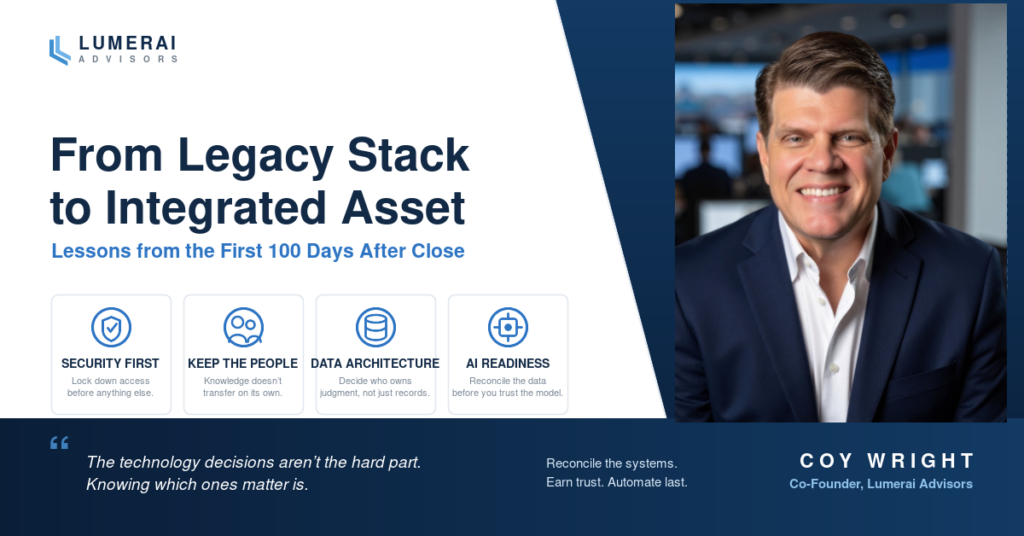
Why Technology Integration Determines Whether the Investment Thesis Survives. Lessons from post-acquisition technology integration, by Coy Wright, Lumerai Advisors Every acquisition has two closing dates. The one celebrated in the boardroom and the one that begins Monday morning when the systems must work together. Everyone gets excited about the diligence phase. AI-powered underwriting, data rooms parsed in hours instead of weeks, models that flag reserve risk before a human analyst finishes their coffee. It’s useful work, and it deserves the attention it gets. But diligence tells you what you’re buying. It doesn’t tell you what happens the Monday after close, when a field office in the Permian is still running production reports through a spreadsheet macro nobody has touched since 2019, the SCADA historian license responsible for operational production data is about to lapse, and the person who knows both systems just found out she’s “at risk” and is polishing her resume. The handoff, more than the diligence itself, is usually where deals actually lose value. For a PE-backed platform, this isn’t an IT problem sitting off to the side of the deal. It’s deal risk. The underwriting thesis assumed a certain pace of consolidation, a certain cost structure, a certain path to the next add-on. Every week the integration team spends firefighting instead of executing is a week that thesis quietly erodes, and it rarely shows up on a dashboard until it’s already expensive. Research on post-merger integration puts the failure rate at 70 to 90 percent of deals falling short of the value they were underwritten for, and the reasons named most often (incompatible systems, fragmented data, execution slower than planned) are exactly the ones that surface first in a technology stack. Executive Takeaways Technology integration is primarily an operational judgement challenge. Stabilization comes before modernization Institutional knowledge is often more valuable than documentation. AI should be deployed after data integrity is established, not before. The first 100 days determine whether deal value is realized or quietly eroded. Day one is about continuity, not transformation The instinct after close is to start modernizing immediately. New platform, new dashboards, new standards. Resist it for the first few weeks. The only job on day one is making sure nothing that currently works stops working: Production accounting keeps running Field data keeps flowing off the SCADA network Land and lease records stay accessible Payroll and AFE approvals don’t stall This means a real inventory before anything else, not the one sitting in the data room: every system actually touching production, land, HSE, and finance, who administers it, what the license and support terms are, and which of those systems have a single person who understands them well enough to keep them alive. That last category is the one that gets missed, and it’s the one that causes outages. A well-documented ERP is manageable. An undocumented historian configuration that lives in one engineer’s head is a ticking clock, especially if that engineer is uncertain about their future with the new owner. This lines up with what advisory firms like RSM have found studying post-merger integration broadly: the first 100 days is where quick, stabilizing wins need to happen, and where confusing that stabilization work with the long-term transformation plan is one of the more common ways integrations go sideways. Retention of institutional knowledge matters more than retention of headcount Every acquisition has some overlap to rationalize, and the pressure to move fast on org design is real. But the people who know why a particular well pad’s telemetry has been routed through a workaround for three years, or which spreadsheet is actually the source of truth versus which one is decorative, are not replaceable on a 100-day timeline. Identify them early, tell them directly why they matter, and keep them through at least one full reporting cycle before any staffing decisions touch their function. This is cheaper than the alternative, which is rebuilding tribal knowledge from scratch while also trying to close the books. Security comes before optimization A newly acquired asset is, for a window of time, the least defended part of the combined company: Credentials from the prior ownership are still active Vendor remote-access accounts haven’t been audited Nobody has yet mapped which of the acquired company’s systems can reach which of yours Access review and network segmentation belong in the first two weeks, not the first analysis of where AI could add value. This is unglamorous work and it rarely makes the integration deck, but it’s the difference between a clean 100 days and an incident report. Data architecture decisions get made whether you make them deliberately or not By day 60 or so, the temptation shifts from “keep it running” to “make it ours.” This is where the real architecture choice shows up: do you migrate the acquired company’s data into your existing platform, run both in parallel, or build a genuine integration layer between them. Each has a real cost. Migration is clean but risks losing context that lived in the old system’s structure, the tags, the naming conventions, the workarounds that encoded real operational knowledge even if they look messy. Parallel operation is fast but defers the actual integration problem and usually calcifies into permanent duplication if nobody forces the follow-through. An integration layer is the right long-term answer more often than either extreme, but it takes real engineering time that a 100-day plan rarely budgets for honestly. Underneath the plumbing question is a bigger one that most integration plans never name out loud: which system gets to be the source of judgment, not just the source of record, once the two organizations are running on shared data. Whoever’s platform wins that fight inherits the assumptions baked into it, good and bad. Get that decision right early and deliberately, and the rest of the technical integration follows a clear logic. Leave it to default to whichever system happened to be bigger at close, and you’ll spend the next two years discovering, one bad report at a
AI Is Turning Technical Debt Into Strategic Debt
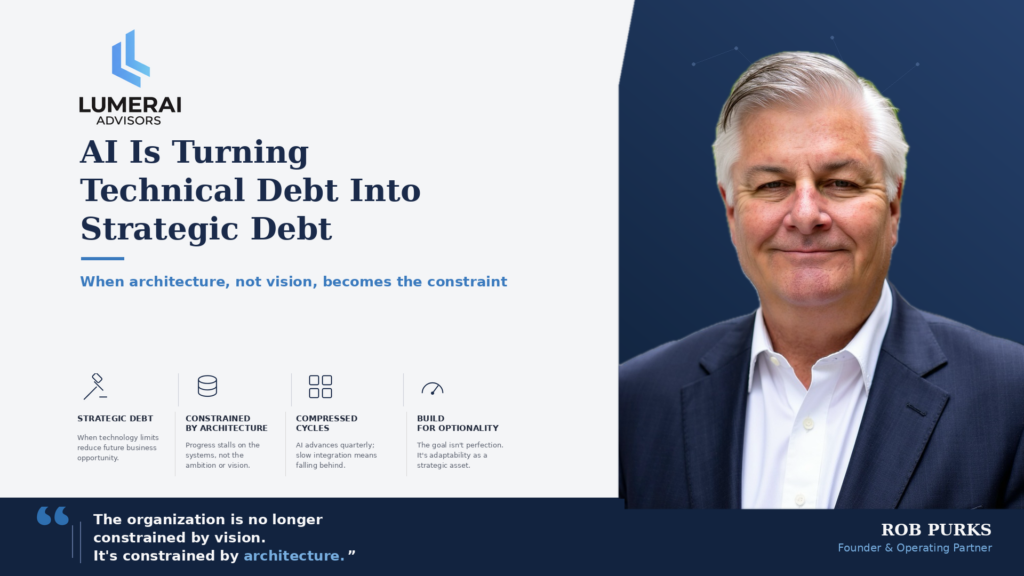
For years companies have accumulated Technical Debt. With the introduction of AI, Technical Debt is impeding your strategy to leverage the benefits of AI – this creates Strategic Debt.
A Survival Guide for Today’s Tech Leader
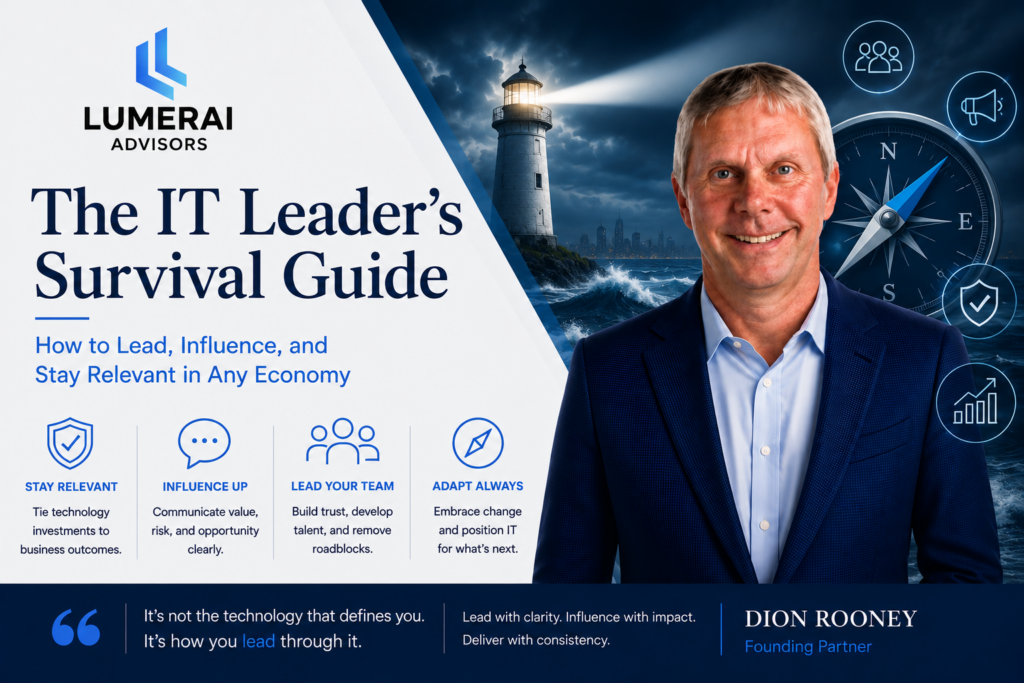
“The most dangerous place to be as a technology leader is surrounded by people who only agree with you.” The Clock Is Already Ticking If you are a CIO, the data on your tenure is sobering. The average CIO tenure now sits between 3 and 5 years, significantly shorter than CEOs and CFOs. The tenure is not just short, it is getting worse. According to the Nash Squared Digital Leadership Report, over 70% of CIOs have been in their positions for less than five years, with nearly 40% serving for two years or less. The Failure Rates Are Not Getting Better If tenure trends are troubling, the correlated project failure data is even more alarming. A Bain 2024 study puts failed business transformations at a staggering 88%. An MIT Project NANDA’s study found that after investing $30–40 billion in GenAI, 95% of businesses see little or no ROI. ERP implementations, often the centerpiece of a technology transformation, are especially brutal. Gartner estimates 70% of ERP projects fail to meet their objectives and 25% will fail catastrophically. The Echo Chamber Nobody Admits Exists Most major technology investment plans are built, reviewed, and approved by the same people who created them. Vendors have their own agenda. Consultancies have preferred platforms. Board members rarely have the technical depth to meaningfully challenge. No one in the room is truly incentivized to say “this will not work.” The Second Opinion Your Strategy Deserves Very few patients skip a second opinion before major surgery. The stakes are too high, and the consequences of a wrong call are too significant. When using a Generative AI Model to review content, which feedback personality do you really use? Do you want friendly or candid feedback? Why, then, do so many technology leaders approve $10M, $20M, or $50M transformation programs without a single independent voice in the room? An independent advisor does not replace your team or your consultants. They pressure-test the strategy, approach and plan. They identify the gaps your internal team is too close to see. They can benchmark your approach against what has actually worked at comparable organizations. Those independent advisors will provide you an unbiased read on feasibility before you stand up in front of your CEO or Board and stake your credibility on it. Most importantly, they are free to be honest with you. That isn’t something you can attain internally. The Conflict-of-Interest Problem with Traditional Advisors Not all advisors operate with equal independence. Large consultancies often have preferred vendor relationships that quietly shape their recommendations. Others avoid hard conversations simply to protect long-standing relationships. They know that delivering uncomfortable news risks the engagement and potentially vendor relationships. So the feedback gets softened, the risks get minimized, and the client believes they are receiving objective consultation when they are actually receiving managed guidance. A small boutique advisory firm is structurally better positioned to give you the truth. Fewer vendor entanglements, more accountability, and a business model built on your success rather than on hitting a vendor quota or preserving a relationship. Their reputation is the product, getting your recommendation right is the only incentive that matters. What Good Independent Advice Actually Looks Like You will know you have found the right advisor when they do several things most advisors do not: Give you a candid assessment of your current state versus where you think you are, including the uncomfortable parts. Red-team your strategy, arguing the case against your plan before your someone else does. Identify specific, actionable gaps, not a glossy report full of frameworks and 2×2 matrices. Benchmark your approach against real organizations, not vendor-sponsored research. Tell you when the timing is wrong, the data is not clean, the team is not ready, or the vendor is not the right fit, even when that is not what you want to hear. The relationship should be built on your success — not on the next engagement. The Cost of Not Getting a Second Opinion Once CIO credibility is lost, it is almost impossible to recover. Boards do not forgive a “we followed our vendor’s advice” excuse. Tenure data suggests you may only get one shot at this and if it goes sideways, the clock does not restart, it stops. The cost of an independent advisor is a rounding error against the risk of a failed implementation. The real question is not whether you can afford an independent voice, it is whether you will survive without one. The critical inquiry is not about the cost of securing an impartial perspective, but rather the risk of your continued viability without one. The Best Tech Leaders Do Not Go It Alone The best CIOs and CTOs are not the ones with all the answers. They are the ones who build the right conditions to find the right answers, which means surrounding themselves with people who are paid to be honest, not to be agreeable. Before you go into that board room, before you sign that software or implementation contract, before you stake your career on a plan you built inside a room full of people who need you to succeed, get an independent perspective. Echo chambers feel like alignment. Until the project fails, and they feel like something else entirely.