The Difference Between Job Displacement and Job Elimination
As artificial intelligence reshapes the modern workplace, leaders should remember an important lesson from technology history: automation often changes jobs more than it eliminates them.
Executive Takeaways
- AI is more likely to displace work than eliminate work.
- The greatest risk is not job loss but workforce transition.
- Organizations should redesign roles before reducing headcount.
- Human judgment, relationships, and creativity become more valuable as automation expands.
- Leaders should invest in workforce capability alongside AI technology.
A Machine Arrives
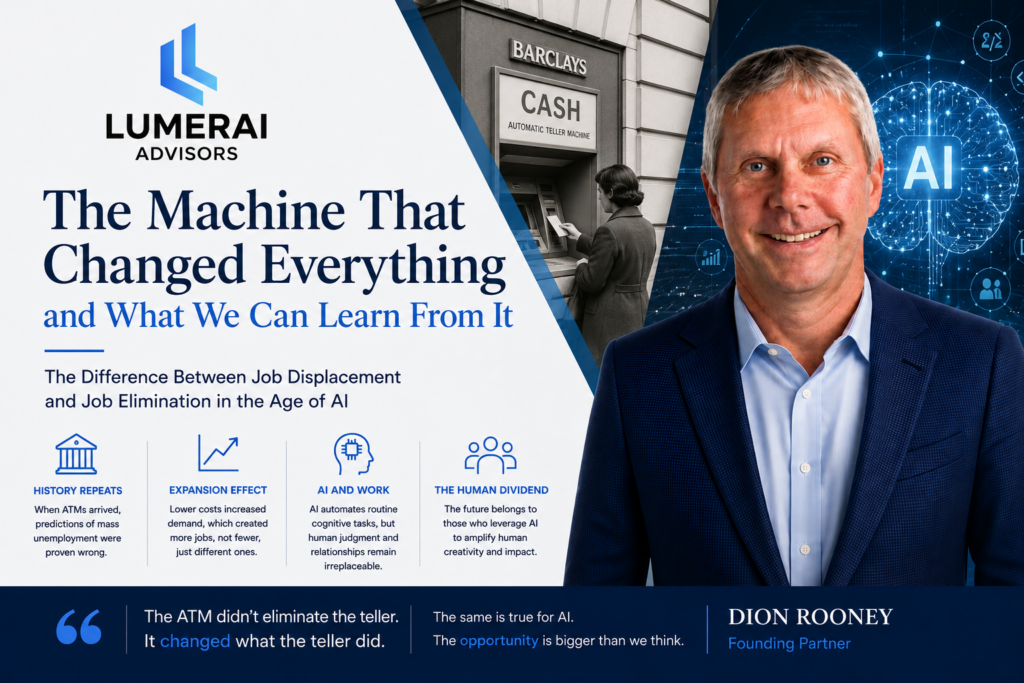
It was 1967, and a London bank called Barclays quietly installed a strange new device in its Enfield branch. Customers could insert a coded paper voucher, and the machine would dispense cash no teller required. The Automated Teller Machine had arrived.
The reaction was predictable:
- Unions sounded the alarm.
- Economists predicted mass unemployment among bank tellers.
- Writers warned of a jobless economy where machines served customers.
The story was persuasive and easy to grasp, yet as time would reveal entirely wrong.
The Numbers Tell a Different Story
Between 1970 and 2010, the number of ATMs in the United States grew from essentially zero to well over 400,000. Over that same period, the number of bank tellers in America did not shrink. It grew from approximately 300,000 to over 550,000.
How is that possible? The answer lies in a dynamic that technology critics routinely underestimate. When automation reduces the cost of a service, demand for that service expands, and that expanded demand requires more human labor.
ATMs made it dramatically cheaper for banks to operate a branch. With lower overhead costs, banks opened more branches in more locations — particularly in smaller communities and suburbs that had never had convenient banking access before. Each branch still needed human staff. Not just tellers, but loan officers, financial advisors, relationship managers, and customer service representatives handling the complex transactions that machines couldn’t resolve. The ATM didn’t eliminate the teller. It changed what the teller did.
“The ATM didn’t eliminate the teller. It changed what the teller did freeing humans to focus on judgment, relationships, and complexity.”
Displacement vs. Elimination
This is not to say automation is painless, individual tellers who lost their jobs to ATMs faced real hardship. Communities where bank branches consolidated experienced genuine disruption. The macro outcome, more jobs overall, offered little comfort to the person who lost a specific job in a specific town in a specific year.
But the ATM story illustrates a distinction that is critical to understanding technological change, the difference between displacement and elimination. Jobs are displaced constantly by technology. Roles shift, skills become obsolete, industries restructure. What history consistently shows is that elimination the permanent net reduction in human employment is far rarer than the headlines suggest.
The pattern repeats across sectors:
- The spreadsheet didn’t eliminate accountants, it made financial analysis accessible to thousands of businesses that had never employed one.
- The word processor didn’t eliminate secretaries, it transformed the role and eventually created an entirely new category of administrative professional.
- Digital Photography displaced darkroom technicians, but created digital editing, printing services, and content creators.
- Streaming displaced movie rental services, but spawned an entire digital content industry that supports more than 25x the content.
- E-commerce didn’t eliminate retail workers, the explosion in fulfillment, logistics, and customer support created millions of new warehouse and delivery jobs.
Enter Artificial Intelligence
Which brings us to the present moment. Artificial intelligence, particularly the large language models and generative tools that have captured global attention since 2022 is being greeted with the same mix of wonder and dread that met the ATM in 1967. The scale, however, feels different. While the ATM automated a narrow physical task (dispensing cash), AI can automate cognition itself: writing, analysis, coding, legal reasoning, medical diagnosis, creative work.
If machines can think, the concern goes, what is left for humans to do?
It is a serious question that deserves a serious answer and the ATM offers the beginning of one. What AI is demonstrably doing right now is automating the routine, predictable, high-volume cognitive tasks. These are the intellectual equivalents of dispensing cash.
“What AI automates today are the routine cognitive tasks the intellectual equivalent of dispensing cash. What remains is judgment, creativity, and human connection.”
What it is not doing, at least not yet, is replacing the judgment-intensive, relationship-dependent, contextually complex work that defines the most valuable human contributions in virtually every field.
The Lumerai Expansion Effect
| Step | Outcome |
| Automation reduces cost | Services become more affordable |
| Lower cost increases demand | More customers can access the service |
| Increased demand expands human work | New roles and opportunities emerge |
| Human work shifts upward | People focus on judgment, relationships, and complexity |
The ATM lesson also points to something AI optimists cite but skeptics tend to dismiss, the expansion effect. When a capability becomes cheaper and more accessible, demand for it and for everything adjacent to it tends to grow dramatically.
Legal advice has historically been expensive enough that most individuals and small businesses simply go without it. If AI makes quality legal guidance affordable at scale, the number of people seeking legal counsel may multiply many times over. Lawyers may find their practices transformed, but the total demand for legal expertise could increase substantially rather than contract.
The same logic applies to medicine, financial planning, software development, education, and virtually any knowledge-intensive field. AI acts as a force multiplier, enabling practitioners to serve more clients, take on more complex cases, and focus their energy where human insight genuinely differentiates outcomes.
For executives, the implication is clear. The primary question is not which jobs AI will eliminate. It is how AI will reshape the economics of work within your industry. Organizations that focus solely on headcount reduction may capture short term savings. Organizations that redesign work around AI may create entirely new sources of growth.
Warning Signs You’re Viewing AI Through the Wrong Lens
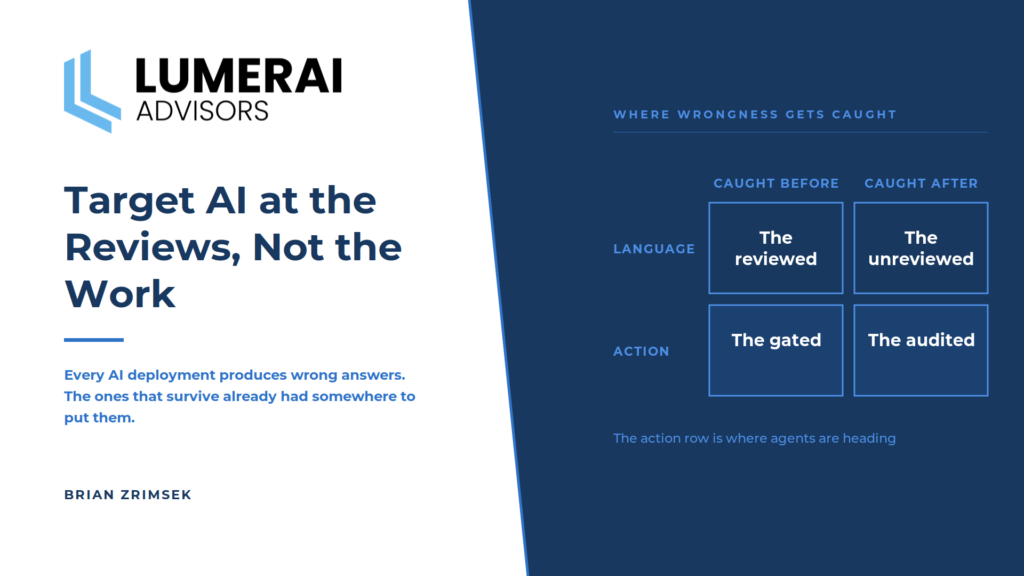
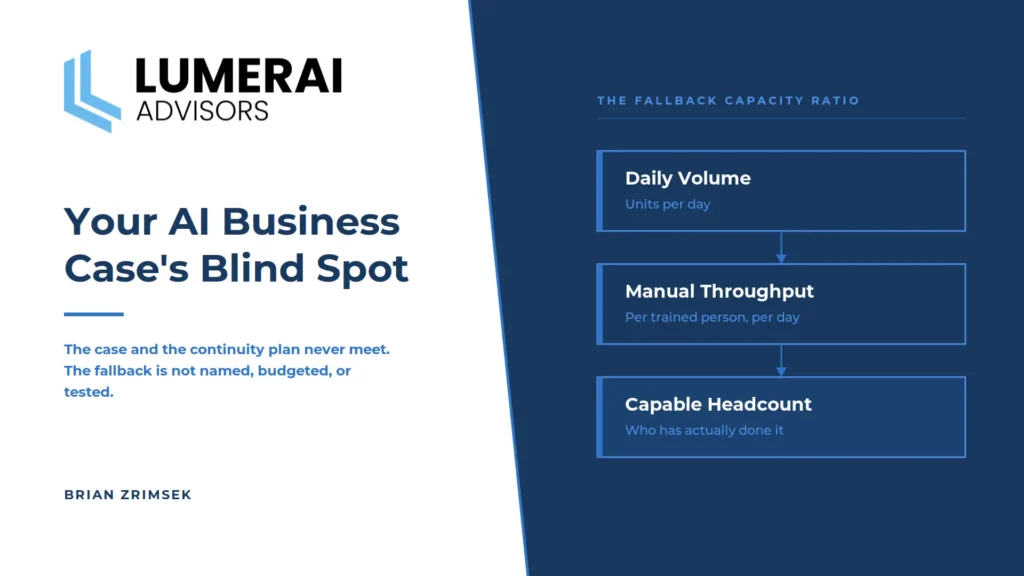
Your AI business case is built entirely on labor reduction.
You measure AI success only through cost savings.
Workforce planning discussions focus on positions rather than capabilities.
No one has defined how roles will evolve after AI deployment.
Training budgets decrease while AI spending increases.
What History Doesn’t Guarantee
History is instructive, but it isn’t deterministic. There are meaningful differences between the ATM era and the AI era that warrant genuine concern.
- Speed of change. The ATM rollout unfolded over decades, giving labor markets, educational institutions, and policymakers time to adapt. AI capabilities are advancing at a pace that may not allow for comparable adjustment periods. Workers whose skills are displaced may not have the runway to retrain before their savings run out.
- Breadth of impact. Previous automation waves tended to affect specific categories of work, physical labor, repetitive manufacturing, routine data entry. AI’s reach across cognitive tasks means that the number of workers simultaneously facing disruption may be unprecedented.
- Distribution of gains. The economic benefits of the ATM era were reasonably well distributed, new jobs were created across income levels, and branch banking expansion brought services to underserved communities. There is a legitimate concern that AI’s productivity gains could accrue disproportionately to capital owners and a small class of highly skilled workers, deepening inequality even as aggregate employment remains stable.
The Human Dividend
The ATM story offers valuable insight into what AI displacement might look like. The bank teller who survived the ATM era was not the one who competed with the machine at its own game. It was the one who leaned into what machines could not replicate, customer service, trust, judgment, and the capacity to understand a customer’s full financial picture and respond with genuine, personalized guidance.
The workers who will thrive in an AI-integrated economy are likely those who make a similar pivot. Not competing with AI on speed or information retrieval, but leveraging AI as a tool to free up time and cognitive bandwidth for the work that at least for today will likely require a human, building relationships, exercising moral judgment, navigating ambiguity, and creating meaning.
The ATM did not make bankers obsolete. It made them more human. There is reason to believe AI may do the same, albeit at a much larger scale.
What This Means for Leaders
Organizations that treat AI primarily as a cost reduction tool may achieve short term savings but miss the larger strategic opportunity. History suggests that the greatest value from automation comes from expanding capability, increasing access, and creating new forms of work.
Leaders should:
• Focus workforce planning on role redesign rather than role elimination.
• Pair AI investments with workforce capability investments.
• Measure productivity gains and capacity creation before workforce reduction.
• Identify where lower costs could unlock entirely new customer demand.
The leaders who win in the AI era will not ask, “How many jobs can AI eliminate?” They will ask, “How much more value can humans create when AI handles the routine work?”