
Lumerai Technology Value Realization Series | Part 3
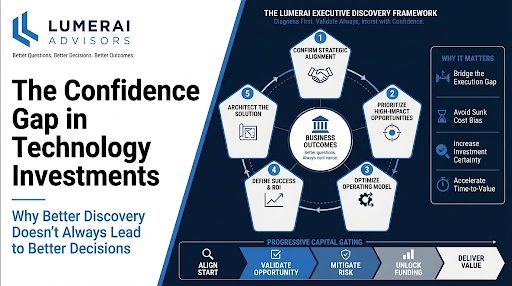
Why Better Discovery Doesn’t Always Lead to Better Decisions The Confidence Gap in Technology Investments Technology investment decisions rarely fail because organizations lack information. They fail because organizations often mistake more information for greater decision confidence. By the time a technology initiative reaches executive leadership, months of work have often been completed. Business cases have been drafted. Requirements have been documented. Vendors have been shortlisted. Demonstrations have been conducted. Scorecards have been completed. Research from organizations such as Gartner and McKinsey has consistently highlighted the difficulty organizations face in translating major technology and transformation investments into expected business value. Despite months of rigorous preparation, executive leadership is frequently left asking the exact same fundamental question: “How do we know this is the right investment?” That is the Confidence Gap: the distance between having enough information to make a technology decision and having enough evidence to make a confident decision about business outcomes. In the first article of this series, I argued that organizations often solve the wrong problem because they skip structured discovery. In the second article, I introduced the Lumerai Executive Discovery Framework, a disciplined approach to validating business opportunities before evaluating technology solutions. Discovery improves the quality of the problem definition. It does not, by itself, guarantee the quality of the investment decision. Transforming discovery into realized value requires structured executive decision governance. When Good Analysis Produces Poor Decisions One of the most persistent misconceptions in enterprise IT strategy is the belief that more analysis produces better decisions. It does not. During enterprise software evaluations, organizations routinely generate an extraordinary amount of analysis and documentation: Ironically, this abundance of data frequently induces decision paralysis rather than strategic clarity. Executives become overwhelmed by competing departmental priorities, conflicting vendor claims, and technical minutiae. As a result, executive discussions regress from strategic outcome validation to tactical feature grading, pricing negotiations, and deployment timelines. Technology selection becomes the primary objective, while business value realization fades into the background. Confidence Is an Executive Asset Enterprise technology investments are rarely approved simply because a vendor offers the longest feature list. Successful investments are approved when leadership establishes high decision confidence that the deployment will produce its intended business outcomes. Executive decision confidence relies on validating five fundamental governance questions: When these questions are answered with evidence rather than vendor assumptions, governance transitions from passive procurement to active strategic leadership. The Lumerai Executive Decision Framework The primary objective of the Lumerai Executive Decision Framework is not to select software. Its objective is to identify the investment decision that yields the highest confidence of achieving target business outcomes. The framework evaluates major capital investments across six progressive decision gates: Stage 1: Validate Strategic Alignment Establish whether the initiative directly accelerates enterprise revenue, cost efficiency, or competitive differentiation. Initiatives lacking clear strategic alignment should not advance to subsequent investment gates, regardless of technical capability. Stage 2: Define Decision Criteria Before engaging vendors, leadership establishes non-negotiable success criteria driven strictly by operational imperatives. Business outcomes drive technology selection—never the reverse. Stage 3: Evaluate Solution Architecture Assess integration complexity, scalability, security posture, and operating model alignment. Technology is evaluated as a capability enabler within the broader ecosystem. Stage 4: Assess Enterprise Risk Evaluate operational, financial, vendor stability, cybersecurity, and organizational change risks collectively rather than in isolation. Stage 5: Compare Future Scenarios Test how candidate solutions perform across distinct future business scenarios—such as rapid scaling, M&A integration, regulatory shifts, and emerging AI capabilities. Stage 6: Establish Decision Confidence Final investment sign off should occur only when the evidence demonstrates that the business problem has been validated, alternatives have been objectively evaluated, risks are understood, and clear value realization metrics have been established. Confidence does not mean certainty. No major technology investment comes with certainty. It means leadership understands the evidence, the assumptions, the risks, the alternatives, and the expected outcomes well enough to make a defensible decision. Five Biases That Can Distort Technology Decisions Even disciplined organizations are susceptible to cognitive bias. Five biases appear repeatedly during enterprise technology evaluations: Recognizing these biases does not eliminate them. The objective of governance is to make them visible, challenge their influence, and ensure that major investment decisions are ultimately supported by evidence rather than assumption. Executive Example Consider an enterprise modernizing its service architecture following a structured discovery phase. Three finalists remain: Vendor A: May create the greatest long term capability, but introduces significant organizational and implementation risk. Vendor B: May offer the strongest operational fit, but requires a higher initial investment. Vendor C: May produce the strongest financial case today, but could constrain future growth through customization requirements. All three can satisfy the requirements. The decision therefore cannot be resolved by requirements compliance alone. Which investment gives us the greatest confidence that we will achieve the business outcomes we defined? Under the Lumerai Executive Decision Framework, the decision shifts from “Which platform scores highest?” to “Which capital allocation provides the highest decision confidence for our strategic outcomes?” By evaluating each vendor against future operating scenarios and risk tolerances, leadership converts an ambiguous software comparison into a confident strategic decision. Better Decisions Require Better Governance Technology investments should never be authorized simply because a platform tops a feature matrix. They should be authorized because executive leadership has evidence based confidence that the investment aligns with strategic objectives, addresses a validated business problem, appropriately manages enterprise risk, and establishes a credible path to measurable economic value. True decision confidence is not executive intuition. It is the outcome of disciplined decision architecture. Conclusion Technology investment decisions are often portrayed as exercises in software selection. In reality, they are exercises in executive judgment regarding business outcomes. Organizations that consistently outperform their peers are not necessarily better at evaluating technology. They are better at making decisions. They understand that every technology investment is ultimately a business decision supported by technology, not the other way around. Discovery identifies the right problem. Decision making determines the right investment. Execution delivers the solution. Value realization measures success.
Lumerai Technology Value Realization – Part 2
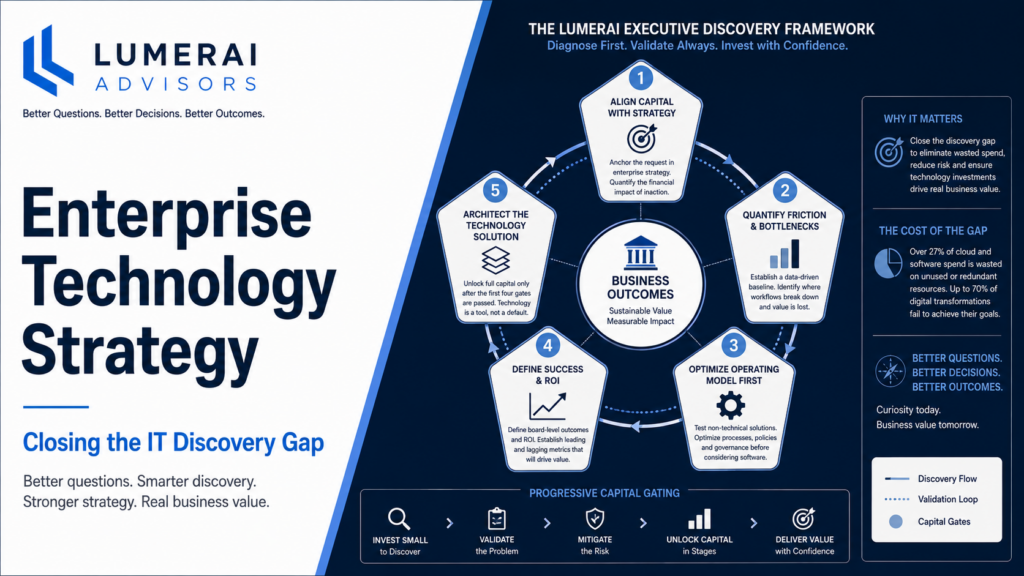
Enterprise Technology Strategy: Closing the IT Discovery Gap Enterprise technology investments often fail long before a single line of code is written or a software vendor is selected. The structural breakdown happens silently in the transition between identifying an operational friction point and proposing a technology solution. In my previous piece, The Missing Stage in Every Technology Investment, I outlined how organizations consistently collapse problem discovery into immediate project execution. This second article explores that failure: The Discovery Gap. Organizations often believe technology investments fail during implementation. In reality, many fail months earlier. They fail during discovery, when assumptions are accepted as facts and proposed solutions are mistaken for business requirements. That is the Discovery Gap. In our work advising enterprise boards and private equity operating partners, the Discovery Gap typically manifests when an organization mistakes a technology request for a strategic business need. To close this gap and protect capital allocation, enterprise leaders must transition away from passive requirements gathering toward a disciplined, data-driven discovery process. The Capital Failure of Traditional Procurement Traditional procurement processes were designed to compare solutions, not validate problems. They excel at evaluating vendors once an organization has already decided what it wants to buy. What they rarely challenge is whether the organization should be buying that solution at all. A business unit submits a request for a new platform, and the IT organization immediately begins gathering requirements. This legacy approach asks: This approach turns technology teams into order-takers. It assumes the initial software requested is the correct solution to the underlying business problem. By skipping the diagnostic phase entirely, organizations spend millions automating fundamentally broken workflows. Is IT’s role to provide what is being asked for or delivering what the company needs? The macroeconomic cost of this gap is staggering. Contemporary enterprise data from Gartner indicates that over 27% of cloud and software spend is completely wasted on unutilized or redundant resources. Furthermore, McKinsey research shows that up to 70% of digital transformations fall short of their goals due to organizational and process misalignments. Unlike standard Business Requirements Documents (BRDs) or Agile User Stories, which merely log and format user desires, true enterprise technology strategy requires a framework that interrogates the business context before capital is deployed. The Lumerai Executive Discovery Framework The Lumerai Executive Discovery Framework reverses the traditional procurement paradigm. It introduces a disciplined, five-stage diagnostic process designed to validate the business opportunity, map the operating model, and challenge assumptions before any software alternatives are evaluated. Crucially, the framework introduces a financial model of Progressive Capital Gating. Rather than funding a major initiative based on unverified assumptions, organizations allocate minimal capital during initial discovery and incrementally unlock funding as risks are mitigated and the problem becomes clearer. Stage 1: Aligning Capital with The Enterprise Strategy Before discussing software, or software features, leaders must anchor the request in the overall corporate strategy. Capital allocation at this initial gate is limited strictly to validation with a small investment. Stage 2: Quantifying Operational Friction and Bottlenecks Establish an objective, data-driven baseline. Investment decisions must rely on operational data rather than anecdotal sentiment from business leaders. Stage 3: Optimizing the Corporate Operating Model over Software This is the critical inflection point where the framework diverges from traditional IT procurement. Capital is seed-funded to test non-technical fixes, focusing on corporate governance, and process optimization. This stage requires a cross-functional steering committee to formally sign off on process optimization before any software evaluation. Stage 4: Defining Board-Level Success Metrics and ROI Value must be quantified before vendor conversations begin. This stage establishes the precise leading and lagging metrics that will govern the final investment business case. Stage 5: Architecting the Technology Solution Only after passing the first four gates is the full capital expenditure (CapEx) budget unlocked. Technology enters the conversation not as a default starting point, but as a calibrated tool. Executive Reality: The AI Customer Service Trap To see the Lumerai Executive Discovery Framework in practice, consider a common modern scenario: A business leader requests an advanced Generative AI solution to automate customer service. The instinctive response from a traditional IT organization is to immediately evaluate AI platforms, compare LLM accuracy rates, and calculate software licensing costs. A discovery-led approach asks entirely different questions: If data reveals that 70 percent of customer inquiries stem from inaccurate billing statements or confusing corporate cancellation policies, implementing an AI chatbot does not solve the root issue. It simply automates customer frustration at scale. The superior investment is to redesign the billing workflow and clarify customer communications. Once the underlying process is effective, AI can be introduced to enhance an already optimized experience. The technology choice hasn’t changed. The definition of the problem has. And with it, the likelihood of realizing meaningful business value. Better Decisions Begin with Better Questions To shift your organizational culture toward a discovery-led mindset, leadership must change the vocabulary of technology procurement. 💡 The Lumerai Shift Conclusion Organizations often believe technology investments begin with selecting vendors, issuing RFPs, or evaluating software demos. In reality, successful digital transformations begin much earlier. They begin with curiosity. The enterprises that consistently realize the highest ROI from their technology investments are not those with the largest budgets or the newest platforms. They are the ones willing to spend the necessary time understanding the problem before pursuing the solution. The quality of every technology investment is ultimately determined by the quality of the questions that precede it. Better decisions begin with better questions. Technology should be the last answer we evaluate, not the first. Executive FAQ What is the difference between business discovery and requirements gathering? Traditional requirements gathering accepts a technology request as a given and logs the features users want. The Lumerai Executive Discovery Framework challenges the initial request, utilizing diagnostic frameworks to find the root business problem before evaluating any software options. Why do enterprise technology investments fail to deliver ROI? Gartner indicates that over 27% of cloud and software spend is completely wasted on unutilized
The Missing Stage in Every Technology Investment
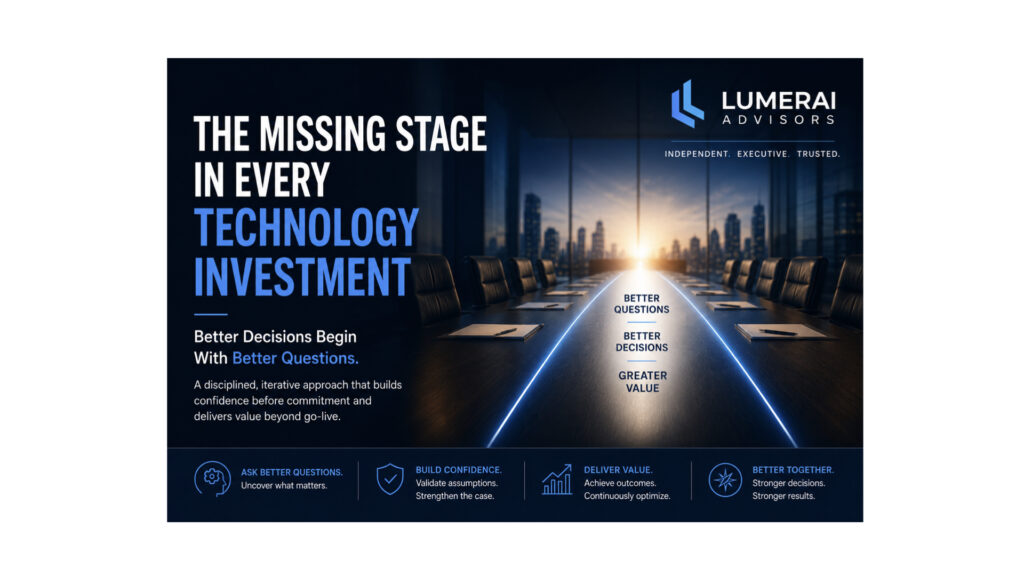
McKinsey estimates that approximately 70% of digital transformations fail to meet their objectives. Why? Most technology decisions don’t fail because organizations choose the wrong technology. They fail because they begin by solving the wrong problem. After more than three decades helping executives make major technology decisions, I’ve noticed something: the best executive teams don’t necessarily have better answers. They ask better questions. It often starts with a statement like: Most organizations immediately begin discussing vendors. A different conversation begins by asking, “What business problem are we actually trying to solve?” Technology requests are rarely the problem. They are hypotheses about the solution. Executive leadership begins by validating the problem before validating the technology. Exceptional leaders separate business problems from proposed solutions. That’s why I believe the quality of every technology investment is determined long before technology is ever selected. Better decisions begin with better questions. Executive Takeaways Where Most Investment Processes Break Down Imagine building a new corporate headquarters. No executive team would approve the full construction budget before understanding the business requirements, evaluating alternative designs, assessing the site, and validating the long term operating model. Yet organizations routinely approve technology investments with an equivalent level of uncertainty. Not because they’re careless. Because the investment process encourages certainty before sufficient understanding exists. Business cases are often written while assumptions still outweigh evidence. Benefits are estimated before outcomes are fully defined. Budgets are approved before organizations truly understand the problem they are trying to solve. Then implementation begins and the organization spends months learning what it could have discovered before approval. We’ve normalized learning after approval. Instead of learning before commitment. Technology Investments Should Mature Like Executive Decisions One of the lessons I’ve taken from working with executive teams is that confidence isn’t something you create. It’s something you earn. The best investors understand this instinctively. They don’t commit all of their capital on day one. They invest in reducing uncertainty. Every conversation. Every discovery session. Every customer interview. Every piece of evidence either increases confidence or challenges assumptions. Technology investments should work exactly the same way. As knowledge increases… Decision confidence should increase. As decision confidence increases… Investment commitment should increase. Instead, many organizations reverse the sequence. They commit significant capital first. Then spend months validating assumptions they could have challenged before funding was approved. The Lumerai Technology Value Realization Framework™ After seeing this pattern repeat across hundreds of technology decisions, we developed the Lumerai Technology Value Realization Framework™ to help executives improve decision quality before major investments are made. At its core is a simple principle: investment confidence should increase before capital commitment. Rather than viewing technology investments as a single approval event, the framework treats them as a progression of executive decisions. Each stage is designed to answer one critical question before additional resources, executive attention, or capital are committed. It begins with a Business Opportunity. Not a technology request. Not a vendor presentation. A business opportunity. From there, each stage progressively reduces uncertainty while increasing executive confidence. Each stage exists for one purpose: replacing assumptions with evidence before increasing commitment. Every stage earns the right to unlock the next investment decision. Warning Signs You’re Investing Too Early The Role of the Modern CIO Is Changing For decades, CIOs were measured by operational excellence. System availability. Cost management. Project delivery. Those responsibilities remain essential. But executive leadership increasingly expects something more. Boards, CEOs, CFOs, and investors increasingly expect CIOs to improve the quality of enterprise technology investment decisions, not simply the quality of technology delivery. That requires a different leadership mindset. One that values curiosity before certainty. Business outcomes before technology features. Questions before answers. The CIO of the future won’t be defined by the systems they implement. They’ll be defined by the quality of the decisions they help their organizations make. A Question Worth Asking Before approving your next major technology investment, ask one simple question. Are we solving the right problem? It sounds obvious. Yet it may be the most valuable question an executive team can ask. Technology alone doesn’t create business value. Better decisions do. Those decisions come from solving the right problems, executing with confidence, and replacing assumptions with evidence. And every one of those things begins with asking better questions. Coming Next: The Most Expensive Technology Mistake You Can Make Most technology requests arrive disguised as solutions. “We need AI.” “We need a new ERP.” “We need to move everything to the cloud.” But what if those aren’t business problems at all? In the next article, we’ll explore why organizations so often mistake technology requests for business needs, and how a disciplined discovery process can dramatically improve technology investment decisions before a single dollar is committed. Before committing to your next major technology investment, explore Lumerai’s Technology Strategy Assessment to clarify priorities, test assumptions, and build an executable path forward.
The question isn’t whether your organization will be transformed by AI. That ship has sailed.
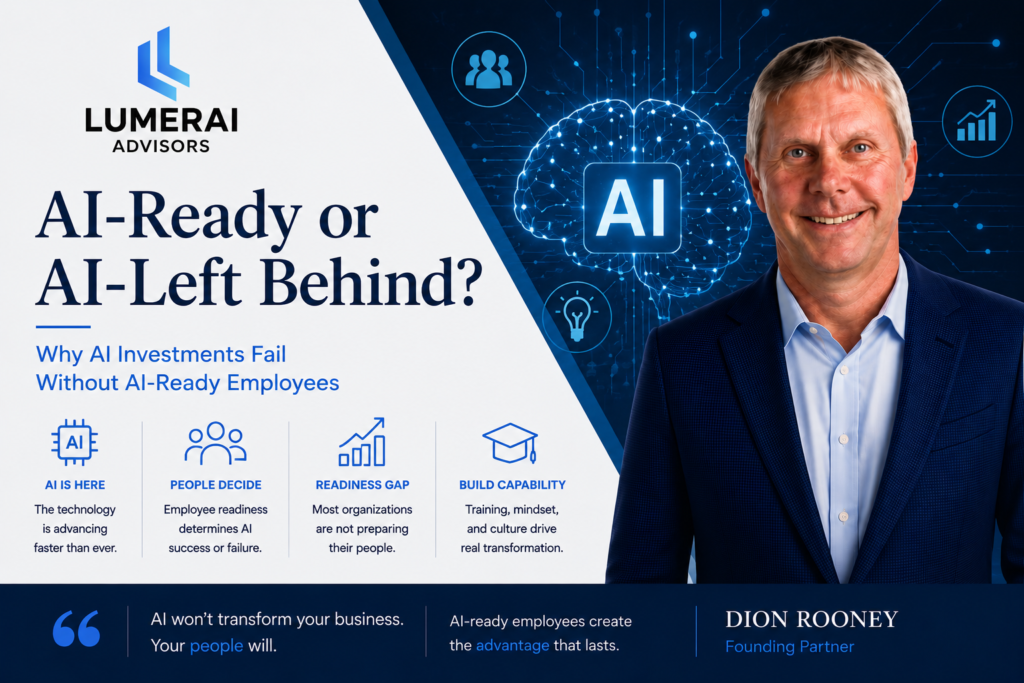
The question is whether your workforce will become a competitive advantage in an AI-powered economy or whether AI will simply expose capability gaps that already exist. Your AI strategy is only as strong as the people expected to execute it. Most organizations are measuring the wrong thing. They track AI licenses, adoption, training completion rates, and prompt engineering workshops. Yet despite billions of dollars invested in AI, only a small percentage of organizations are realizing meaningful business value. The reason is simple. AI transformation is not primarily a technology problem. It is a workforce capability problem. The question leaders should be asking is not whether employees can use AI. It is whether they can make better decisions because of it. Do your people actually know how to work in an AI-powered world? Not “have they attended a webinar” or “did we roll out Copilot.” I mean: do they fundamentally understand how to think alongside AI, direct it, interrogate its outputs, and apply judgment where the machine falls short? That’s a very different bar — and most organizations have no honest answer. Executive Takeaways The Numbers Are Damning The data is in, and it’s unambiguous. According to IDC, 94% of CEOs and CHROs identify AI as their top in-demand skill for 2025, yet only 35% of leaders feel they’ve actually prepared their employees for AI-driven roles. Meanwhile, a 2026 DataCamp/YouGov survey of 500+ enterprise leaders found that 59% admit their organization has an AI skills gap, even though most are already spending on AI tools. Think about that: majority investment, minority readiness. PwC’s 2025 AI Jobs Barometer adds another dimension: AI-exposed roles are evolving 66% faster than other positions and command a 56% wage premium. That means the gap isn’t just an operational inconvenience — it’s a competitive liability that compounds every quarter you don’t address it. We’ve Been Asking the Wrong Question Most workforce AI assessments are built around the wrong mental model. They ask: “Can this person use the AI tool?” That’s like evaluating a surgeon by whether they can hold a scalpel. The right question is: “Can this person make better decisions because of AI?” Working effectively in an AI world requires a fundamentally different skill architecture than what most job descriptions, competency models, and performance reviews are built to measure. It’s not about prompt engineering. It’s about something deeper. The World Economic Forum’s Future of Jobs Report puts it plainly: employers anticipate that 40% of core skills will change by 2030. Not augmented — changed. That’s not a training program. That’s a reinvention of what “qualified” means. What “AI-Ready” Actually Looks Like After 35 years leading technology transformation across global retailers, manufacturers, and PE-backed companies, I’ve seen many skill paradigm shifts. This one is different in a critical way, it cuts across every function, every level, and every geography simultaneously. True AI readiness requires capabilities across three dimensions, yet most organizations focus exclusively on the first. The Lumerai AI Readiness Model Level 1: Tool Fluency Can employees effectively use AI tools? Level 2: Critical Reasoning Can they challenge and validate AI outputs? Level 3: Human Edge Can they apply uniquely human judgment, creativity, and leadership? BCG research found that companies successfully addressing AI talent shortfalls achieve 2.3x faster AI adoption and 67% higher AI ROI. The skill assessment isn’t a HR box to check, it’s a value creation lever. Warning Signs Your Workforce Isn’t AI Ready Why Most Assessments Miss the Mark Here’s the uncomfortable truth, most organizations are confusing activity with capability. Deploying Copilot is not an AI strategy. Sending people to a LinkedIn Learning course is not workforce transformation. And asking employees to self-report AI comfort level is not an assessment. The DataCamp report reveals the paradox in stark terms, most enterprises are offering some form of AI training, yet only 35% have a mature, workforce-wide upskilling program. The organizations with that mature program are nearly twice as likely to report significant AI ROI. The rest are spending money and just making noise. Effective assessment requires measuring against a defined target, not a generic “AI skills” list, but a role-specific, business-context-specific model of what AI-assisted performance actually looks like in your environment. A Framework Worth Building If you’re serious about knowing where your workforce stands, here’s where to start: Map your role exposure: Not every role is equally disrupted or equally enabled by AI. Start with a realistic heat map of AI exposure across your organization — which roles are most automatable, which are most augmentable, and which create the highest risk if AI is used without adequate oversight. Define role-specific AI competency profiles: A CFO who needs to interrogate AI-generated financial models requires a different skill profile than an operations manager using AI for demand forecasting. Generic frameworks produce generic results. Assess with scenarios, not surveys: Self-assessment is unreliable for novel skill domains. Scenario-based evaluations present a realistic AI-assisted decision situation worth observing. Close the loop with your technology roadmap: Your AI skills strategy needs to anticipate where your tools are heading, not just where they are today. Agentic AI is arriving faster than most teams realize. If your workforce isn’t prepared to work alongside autonomous AI agents, you’ll be wasting time and money rebuilding capability. The Leaders Who Act Now Will Define the Gap McKinsey estimates that 88% of organizations now use AI in at least one business function. Only 1% have achieved true AI maturity. The distance between those two numbers is, in large part, a human capability problem. The CEOs and CIOs who understand that AI tools without AI-ready people produce expensive mediocrity will act differently in 2026. They’ll treat workforce AI assessment not as a one-time initiative, but as an ongoing strategic process as embedded in their operating rhythm as financial reviews and technology audits. The question isn’t whether your organization will be transformed by AI. That ship has sailed. The question is whether your workforce will become a competitive advantage in an AI-powered economy or whether AI will
A Survival Guide for Today’s Tech Leader
“The most dangerous place to be as a technology leader is surrounded by people who only agree with you.” The Clock Is Already Ticking If you are a CIO, the data on your tenure is sobering. The average CIO tenure now sits between 3 and 5 years, significantly shorter than CEOs and CFOs. The tenure is not just short, it is getting worse. According to the Nash Squared Digital Leadership Report, over 70% of CIOs have been in their positions for less than five years, with nearly 40% serving for two years or less. The Failure Rates Are Not Getting Better If tenure trends are troubling, the correlated project failure data is even more alarming. A Bain 2024 study puts failed business transformations at a staggering 88%. An MIT Project NANDA’s study found that after investing $30–40 billion in GenAI, 95% of businesses see little or no ROI. ERP implementations, often the centerpiece of a technology transformation, are especially brutal. Gartner estimates 70% of ERP projects fail to meet their objectives and 25% will fail catastrophically. The Echo Chamber Nobody Admits Exists Most major technology investment plans are built, reviewed, and approved by the same people who created them. Vendors have their own agenda. Consultancies have preferred platforms. Board members rarely have the technical depth to meaningfully challenge. No one in the room is truly incentivized to say “this will not work.” The Second Opinion Your Strategy Deserves Very few patients skip a second opinion before major surgery. The stakes are too high, and the consequences of a wrong call are too significant. When using a Generative AI Model to review content, which feedback personality do you really use? Do you want friendly or candid feedback? Why, then, do so many technology leaders approve $10M, $20M, or $50M transformation programs without a single independent voice in the room? An independent advisor does not replace your team or your consultants. They pressure-test the strategy, approach and plan. They identify the gaps your internal team is too close to see. They can benchmark your approach against what has actually worked at comparable organizations. Those independent advisors will provide you an unbiased read on feasibility before you stand up in front of your CEO or Board and stake your credibility on it. Most importantly, they are free to be honest with you. That isn’t something you can attain internally. The Conflict-of-Interest Problem with Traditional Advisors Not all advisors operate with equal independence. Large consultancies often have preferred vendor relationships that quietly shape their recommendations. Others avoid hard conversations simply to protect long-standing relationships. They know that delivering uncomfortable news risks the engagement and potentially vendor relationships. So the feedback gets softened, the risks get minimized, and the client believes they are receiving objective consultation when they are actually receiving managed guidance. A small boutique advisory firm is structurally better positioned to give you the truth. Fewer vendor entanglements, more accountability, and a business model built on your success rather than on hitting a vendor quota or preserving a relationship. Their reputation is the product, getting your recommendation right is the only incentive that matters. What Good Independent Advice Actually Looks Like You will know you have found the right advisor when they do several things most advisors do not: Give you a candid assessment of your current state versus where you think you are, including the uncomfortable parts. Red-team your strategy, arguing the case against your plan before your someone else does. Identify specific, actionable gaps, not a glossy report full of frameworks and 2×2 matrices. Benchmark your approach against real organizations, not vendor-sponsored research. Tell you when the timing is wrong, the data is not clean, the team is not ready, or the vendor is not the right fit, even when that is not what you want to hear. The relationship should be built on your success — not on the next engagement. The Cost of Not Getting a Second Opinion Once CIO credibility is lost, it is almost impossible to recover. Boards do not forgive a “we followed our vendor’s advice” excuse. Tenure data suggests you may only get one shot at this and if it goes sideways, the clock does not restart, it stops. The cost of an independent advisor is a rounding error against the risk of a failed implementation. The real question is not whether you can afford an independent voice, it is whether you will survive without one. The critical inquiry is not about the cost of securing an impartial perspective, but rather the risk of your continued viability without one. The Best Tech Leaders Do Not Go It Alone The best CIOs and CTOs are not the ones with all the answers. They are the ones who build the right conditions to find the right answers, which means surrounding themselves with people who are paid to be honest, not to be agreeable. Before you go into that board room, before you sign that software or implementation contract, before you stake your career on a plan you built inside a room full of people who need you to succeed, get an independent perspective. Echo chambers feel like alignment. Until the project fails, and they feel like something else entirely.
Cloud Repatriation: Why Companies Are Moving Workloads Back from the Cloud
From Cloud-First to Cloud-Smart For more than a decade, enterprise technology strategy was dominated by a simple directive: move to the cloud. Today, many organizations are discovering that cloud adoption and cloud optimization are not the same thing. As a result, a growing number are reevaluating where workloads should reside, leading to a trend commonly called cloud repatriation or cloud exit. Here are some of the most-cited recent statistics: That does not mean companies are abandoning the cloud entirely. Most are moving toward hybrid architectures, keeping some workloads in public cloud while bringing others back to private infrastructure or colocation facilities. Executive Takeaways Why are cloud migration rollbacks happening? Cost Overruns Many organizations discovered that: Several surveys cite cost optimization as the #1 driver. Well-known examples: In our experience, organizations often underestimate cloud operating costs because they evaluate migration costs but fail to model long term consumption patterns, storage growth, and data egress charges. Data Sovereignty and Compliance Regulated industries increasingly want tighter control over: This is particularly strong in Europe, finance, healthcare, and government sectors. Security and Operational Control Some organizations feel they lost visibility or governance in highly distributed cloud environments. Vendor Lock-in Concerns Companies worry about dependence on a single hyperscaler, with proprietary services, and the potential of escalating pricing. Hybrid and multicloud strategies are often attempts to reduce this dependency. Despite this, cloud spending is still growing. Public cloud spending continues to rise, SaaS adoption remains extremely high, and most enterprises are becoming “cloud-smart,” not anti-cloud. The current enterprise pattern is usually: In other words, the market has shifted from “move everything to the cloud”, to “place each workload where it economically and operationally fits best.” Cloud adoption for many workloads is still the right answer, but companies need to conduct detailed diligence on what gets moved and more importantly, how the variable spend model gets managed. At Lumerai Advisors, we use the Lumerai Cloud Placement Framework to help executives evaluate hybrid architecture and workload placement decisions. For private equity-backed organizations, workload placement decisions increasingly affect EBITDA performance, making cloud economics a business strategy issue rather than simply a technology decision. The Lumerai Cloud Placement Framework When evaluating cloud placement decisions, we assess workloads across four dimensions: Dimension Key Question Cost Predictability Can workload consumption be forecast accurately enough to benefit from cloud economics? Performance Requirements Does latency, throughput, or workload intensity justify dedicated infrastructure? Data Sensitivity Do regulatory, security, or data sovereignty requirements necessitate greater control? Business Agility Does the workload require speed, scalability, and flexibility to support growth and innovation? The goal is not to determine whether cloud is good or bad, but to determine which environment delivers the best economic and operational outcome for each workload. Cloud repatriation should not be viewed as a reversal of cloud strategy, but as the natural maturation of enterprise workload placement decisions. The future is not cloud-first or cloud-exit. The future is cloud-smart. The organizations that create the most value will be those that place every workload in the environment that delivers the best combination of performance, economics, security, and agility. Sources and References
The Tech Leaders First 100 Days

The first 100 days of a new IT leadership role are a critical window. This playbook breaks down how to assess your team, identify the right opportunities, review the portfolio, and build a strategy that earns trust and sets the stage for lasting impact. You have been handed the keys. New title, new organization, new expectations, and a clock already running. Whether you are stepping into a CIO role for the first time or taking the helm of a technology function at a company you are still learning, the first 100 days are crucial. Those first 100 days are all about learning what the organization needs most, and positioning yourself and your team to deliver it. This is not a sprint, it is a structured reconnaissance. The leaders who move fastest in their first months are often the ones who stumble hardest by month six. The ones who invest early in listening, assessing, and aligning, deliberately and without ego, are the ones who build the foundation for durable change. The first 100 days are not about what you know. They are about learning what the organization most needs, and earning the right to change it. Executive Takeaways The Lumerai CIO First 100 Days Framework Phase Focus Objective Days 1-30 Listen & Learn Understand the organization before making changes Days 31-60 Assess & Prioritize Evaluate team, portfolio, and opportunities Days 61-90 Align & Act Build stakeholder alignment and begin execution Days 91-100 Commit & Communicate Finalize roadmap and establish accountability The most successful CIOs resist the urge to prove themselves immediately. Instead, they follow a structured progression from understanding to assessment, alignment, and execution. Section 1: Assessing Team Maturity Your team is your first and most important operating context. The tech team’s maturity is critical and that team must provide near flawless execution before you have earned the right to drive the organization where it needs to go. Now is the time to engage them and fairly assess the current maturity and the path to improve. You need an honest picture of where it actually stands, not where it thinks it stands, and not where your predecessor reported it to be. The Lumerai Team Maturity Model Team maturity is not simply a question of technical skill. It encompasses four overlapping dimensions: A technically brilliant team that cannot align to business priorities is just as limiting as a business-savvy team that cannot execute. The most capable IT organizations are both. Team maturity is a stronger predictor of transformation success than technical capability alone. How to Conduct the Assessment Resist the temptation to deploy a formal survey. The data gathered through direct conversation in the first 30 days is richer and more revealing than any survey. Structure your early 1:1s around a consistent set of open questions: Suggested Questions for Early 1:1s: Listen for patterns across these conversations. Recurring themes about process gaps, leadership behaviors, budget constraints, or talent deficits are more diagnostic than any individual answer. Maturity Levels: A Practical Framework Once you have completed your listening tour, work with your direct reports to score the organization across the maturity levels. The goal is not to render a verdict, it is to create a shared baseline that informs your strategy. Your first 100 days should give you enough data to know where you are and your first year’s strategy should have a clear line of sight to where you are going. Section 2: Identifying Strategic Needs and Opportunities Every new leader’s arrival creates an inflection point where people are more open to change. Your job in the first 100 days is to identify the best opportunities before the window closes and the organization settles back into its existing patterns. Quick Wins versus Long-Term Plays Not all opportunities are created equal. One of the most common mistakes new IT leaders make is chasing a large, visible transformation initiative in their first months before they have earned the trust or gathered the context to sustain it. A far more durable approach is to sequence deliberately: Where to Look for Opportunities The highest-value opportunities tend to cluster in a small number of recurring patterns: The highest-leverage opportunities are rarely technical. They are cultural, the invisible friction that slows decisions, creates rework, and keeps good people from doing their best work. Section 3: Navigating Your Own Assimilation The most overlooked dimension of a new leader’s first 100 days is internal. How you show up, how quickly you build trust, and how effectively you read the political and cultural landscape of your new organization will determine how much of your actual agenda you get to execute. The Assimilation Traps Experienced leaders fall into predictable patterns when they are new. Recognizing them in advance is the first step to avoiding them: The Four Assimilation Traps to Avoid: With your new team, a facilitated new leadership assimilation exercise can dramatically speed up the “getting to know each other” process. Warning Signs Your First 100 Days Are Going Off Track Building Trust Across Stakeholder Groups Your stakeholder map in the first 100 days should include at least four distinct constituencies, each with different needs, different definitions of success, and different levels of trust to build: The Working and Listening Tour In your first 30 days, conduct a structured listening tour across the organization. This is not a performance review of the IT function, it is your chance to understand the business through the eyes of the people it serves. Walk the walk and learn how the business operates and how technology either supports or hinders those processes. Work in a plant, warehouse, store of function to learn the end to end of the business. What you will learn will shape every strategic decision you make in the coming months. Section 4: Conducting a budget and ecosystem review A portfolio review is one of the most important and most frequently skipped activities in a new leader’s first 100 days. It is the process of systematically inventorying and evaluating every active
The Machine That Changed Everything and What We Can Learn From It
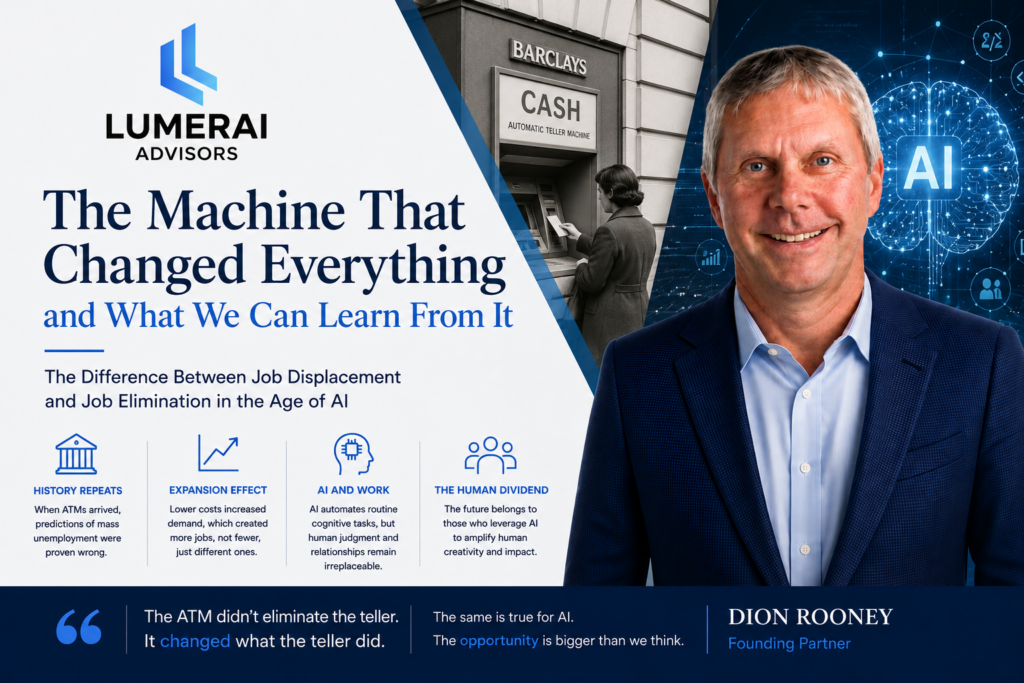
The Difference Between Job Displacement and Job Elimination As artificial intelligence reshapes the modern workplace, leaders should remember an important lesson from technology history: automation often changes jobs more than it eliminates them. Executive Takeaways A Machine Arrives It was 1967, and a London bank called Barclays quietly installed a strange new device in its Enfield branch. Customers could insert a coded paper voucher, and the machine would dispense cash no teller required. The Automated Teller Machine had arrived. The reaction was predictable: The story was persuasive and easy to grasp, yet as time would reveal entirely wrong. The Numbers Tell a Different Story Between 1970 and 2010, the number of ATMs in the United States grew from essentially zero to well over 400,000. Over that same period, the number of bank tellers in America did not shrink. It grew from approximately 300,000 to over 550,000. How is that possible? The answer lies in a dynamic that technology critics routinely underestimate. When automation reduces the cost of a service, demand for that service expands, and that expanded demand requires more human labor. ATMs made it dramatically cheaper for banks to operate a branch. With lower overhead costs, banks opened more branches in more locations — particularly in smaller communities and suburbs that had never had convenient banking access before. Each branch still needed human staff. Not just tellers, but loan officers, financial advisors, relationship managers, and customer service representatives handling the complex transactions that machines couldn’t resolve. The ATM didn’t eliminate the teller. It changed what the teller did. “The ATM didn’t eliminate the teller. It changed what the teller did freeing humans to focus on judgment, relationships, and complexity.” Displacement vs. Elimination This is not to say automation is painless, individual tellers who lost their jobs to ATMs faced real hardship. Communities where bank branches consolidated experienced genuine disruption. The macro outcome, more jobs overall, offered little comfort to the person who lost a specific job in a specific town in a specific year. But the ATM story illustrates a distinction that is critical to understanding technological change, the difference between displacement and elimination. Jobs are displaced constantly by technology. Roles shift, skills become obsolete, industries restructure. What history consistently shows is that elimination the permanent net reduction in human employment is far rarer than the headlines suggest. The pattern repeats across sectors: Enter Artificial Intelligence Which brings us to the present moment. Artificial intelligence, particularly the large language models and generative tools that have captured global attention since 2022 is being greeted with the same mix of wonder and dread that met the ATM in 1967. The scale, however, feels different. While the ATM automated a narrow physical task (dispensing cash), AI can automate cognition itself: writing, analysis, coding, legal reasoning, medical diagnosis, creative work. If machines can think, the concern goes, what is left for humans to do? It is a serious question that deserves a serious answer and the ATM offers the beginning of one. What AI is demonstrably doing right now is automating the routine, predictable, high-volume cognitive tasks. These are the intellectual equivalents of dispensing cash. “What AI automates today are the routine cognitive tasks the intellectual equivalent of dispensing cash. What remains is judgment, creativity, and human connection.” What it is not doing, at least not yet, is replacing the judgment-intensive, relationship-dependent, contextually complex work that defines the most valuable human contributions in virtually every field. The Lumerai Expansion Effect Step Outcome Automation reduces cost Services become more affordable Lower cost increases demand More customers can access the service Increased demand expands human work New roles and opportunities emerge Human work shifts upward People focus on judgment, relationships, and complexity The ATM lesson also points to something AI optimists cite but skeptics tend to dismiss, the expansion effect. When a capability becomes cheaper and more accessible, demand for it and for everything adjacent to it tends to grow dramatically. Legal advice has historically been expensive enough that most individuals and small businesses simply go without it. If AI makes quality legal guidance affordable at scale, the number of people seeking legal counsel may multiply many times over. Lawyers may find their practices transformed, but the total demand for legal expertise could increase substantially rather than contract. The same logic applies to medicine, financial planning, software development, education, and virtually any knowledge-intensive field. AI acts as a force multiplier, enabling practitioners to serve more clients, take on more complex cases, and focus their energy where human insight genuinely differentiates outcomes. For executives, the implication is clear. The primary question is not which jobs AI will eliminate. It is how AI will reshape the economics of work within your industry. Organizations that focus solely on headcount reduction may capture short term savings. Organizations that redesign work around AI may create entirely new sources of growth. Warning Signs You’re Viewing AI Through the Wrong Lens Your AI business case is built entirely on labor reduction. You measure AI success only through cost savings. Workforce planning discussions focus on positions rather than capabilities. No one has defined how roles will evolve after AI deployment. Training budgets decrease while AI spending increases. What History Doesn’t Guarantee History is instructive, but it isn’t deterministic. There are meaningful differences between the ATM era and the AI era that warrant genuine concern. The Human Dividend The ATM story offers valuable insight into what AI displacement might look like. The bank teller who survived the ATM era was not the one who competed with the machine at its own game. It was the one who leaned into what machines could not replicate, customer service, trust, judgment, and the capacity to understand a customer’s full financial picture and respond with genuine, personalized guidance. The workers who will thrive in an AI-integrated economy are likely those who make a similar pivot. Not competing with AI on speed or information retrieval, but leveraging AI as a tool to free up time and cognitive bandwidth