
The first 100 days of a new IT leadership role are a critical window. This playbook breaks down how to assess your team, identify the right opportunities, review the portfolio, and build a strategy that earns trust and sets the stage for lasting impact.
You have been handed the keys. New title, new organization, new expectations, and a clock already running. Whether you are stepping into a CIO role for the first time or taking the helm of a technology function at a company you are still learning, the first 100 days are crucial. Those first 100 days are all about learning what the organization needs most, and positioning yourself and your team to deliver it.
This is not a sprint, it is a structured reconnaissance. The leaders who move fastest in their first months are often the ones who stumble hardest by month six. The ones who invest early in listening, assessing, and aligning, deliberately and without ego, are the ones who build the foundation for durable change.
The first 100 days are not about what you know. They are about learning what the organization most needs, and earning the right to change it.
Executive Takeaways
- Listen before changing.
- Assess before restructuring.
- Govern before transforming.
- Align before executing.
- Build credibility before asking for trust.
The Lumerai CIO First 100 Days Framework
| Phase | Focus | Objective |
| Days 1-30 | Listen & Learn | Understand the organization before making changes |
| Days 31-60 | Assess & Prioritize | Evaluate team, portfolio, and opportunities |
| Days 61-90 | Align & Act | Build stakeholder alignment and begin execution |
| Days 91-100 | Commit & Communicate | Finalize roadmap and establish accountability |
The most successful CIOs resist the urge to prove themselves immediately. Instead, they follow a structured progression from understanding to assessment, alignment, and execution.
Section 1: Assessing Team Maturity
Your team is your first and most important operating context. The tech team’s maturity is critical and that team must provide near flawless execution before you have earned the right to drive the organization where it needs to go. Now is the time to engage them and fairly assess the current maturity and the path to improve. You need an honest picture of where it actually stands, not where it thinks it stands, and not where your predecessor reported it to be.
The Lumerai Team Maturity Model
Team maturity is not simply a question of technical skill. It encompasses four overlapping dimensions:
- Technical Depth: Do team members have genuine expertise in the domains they own, or are they generalists stretched thin across too many responsibilities?
- Process Discipline: Is work managed through repeatable, documented processes, or does everything depend on tribal knowledge and heroic individual effort?
- Business Alignment: Does the team make decisions with a commercial lens or a technologist lens? Can they articulate how their work connects to revenue, margin, or customer experience?
- Cultural Health: Do they act and speak as one team? Do they point fingers? Do they have documented principles that guide their action?
A technically brilliant team that cannot align to business priorities is just as limiting as a business-savvy team that cannot execute. The most capable IT organizations are both. Team maturity is a stronger predictor of transformation success than technical capability alone.
How to Conduct the Assessment
Resist the temptation to deploy a formal survey. The data gathered through direct conversation in the first 30 days is richer and more revealing than any survey. Structure your early 1:1s around a consistent set of open questions:
Suggested Questions for Early 1:1s:
- What are you most proud of that the team has delivered in the last 12 months?
- Where do you feel the team is most constrained and what would unlock it?
- If you could change one thing about how we operate, what would it be?
- What decisions take too long, or get made in the wrong room?
- What keeps you up at night from a technology risk perspective?
Listen for patterns across these conversations. Recurring themes about process gaps, leadership behaviors, budget constraints, or talent deficits are more diagnostic than any individual answer.
Maturity Levels: A Practical Framework
Once you have completed your listening tour, work with your direct reports to score the organization across the maturity levels. The goal is not to render a verdict, it is to create a shared baseline that informs your strategy.
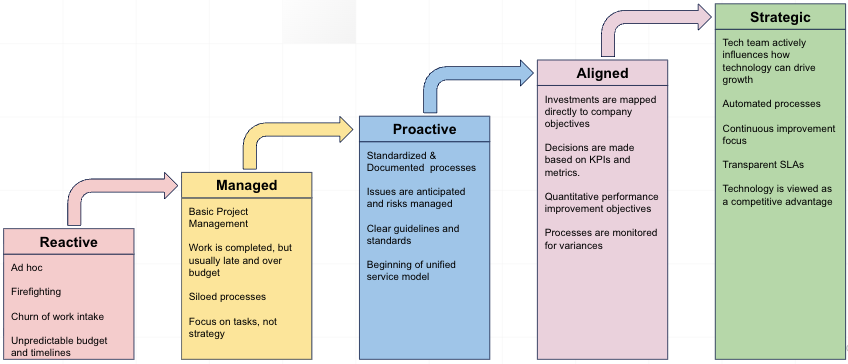
Your first 100 days should give you enough data to know where you are and your first year’s strategy should have a clear line of sight to where you are going.
Section 2: Identifying Strategic Needs and Opportunities
Every new leader’s arrival creates an inflection point where people are more open to change. Your job in the first 100 days is to identify the best opportunities before the window closes and the organization settles back into its existing patterns.
Quick Wins versus Long-Term Plays
Not all opportunities are created equal. One of the most common mistakes new IT leaders make is chasing a large, visible transformation initiative in their first months before they have earned the trust or gathered the context to sustain it. A far more durable approach is to sequence deliberately:
- Quick Wins (Days 1–60): Identify two to three visible, completable improvements that demonstrate competence and build credibility. Fix the Wi-Fi in the conference rooms. Resolve the helpdesk backlog. Retire the shadow IT tool that has been irritating the sales team for two years. These wins are not trivial, they signal that you listen and you execute.
- Medium-Term Opportunities (Months 3–12): Process improvements, budget wins, vendor consolidations, and capability buildouts that require cross-functional alignment but can show measurable progress within the year.
- Transformational Bets (Year 2+): Platform replacements, major architecture shifts, AI integration, or operating model redesigns. These require organizational trust you have not yet accumulated and should be scoped only after your foundation is solid.
Where to Look for Opportunities
The highest-value opportunities tend to cluster in a small number of recurring patterns:
- Data Fragmentation: Multiple systems holding inconsistent versions of the same truth. Opportunity to consolidate, integrate, and unlock analytics.
- Manual Process Overload: Finance, HR, and operations teams spending significant time on spreadsheet-driven workflows that could be automated. High ROI, high visibility, and high goodwill when resolved.
- Vendor Sprawl: An accumulation of overlapping tools, expired contracts, and underutilized licenses. Optimization creates both cost savings and a cleaner architecture.
- Security and Compliance Gaps: Often underinvested in companies relative to their actual risk exposure. An early audit often surfaces quick wins and demonstrates strategic seriousness. Leverage an outside organization to highlight risks (likelyhood and severity grid).
- Customer Experience: Whether the company sells to consumers or enterprises, there is almost always an opportunity to modernize how technology supports the customer journey.
The highest-leverage opportunities are rarely technical. They are cultural, the invisible friction that slows decisions, creates rework, and keeps good people from doing their best work.
Section 3: Navigating Your Own Assimilation
The most overlooked dimension of a new leader’s first 100 days is internal. How you show up, how quickly you build trust, and how effectively you read the political and cultural landscape of your new organization will determine how much of your actual agenda you get to execute.
The Assimilation Traps
Experienced leaders fall into predictable patterns when they are new. Recognizing them in advance is the first step to avoiding them:
The Four Assimilation Traps to Avoid:
- The Expert Trap: Arriving with answers before you understand the questions. Credibility in IT leadership comes from judgment, not just knowledge.
- The Alliance Trap: Forming strong alliances too early, before you understand the full landscape. Early bonds can create dependencies that limit your independence.
- The Pace Trap: Moving at the speed of your ambition rather than the organization’s readiness. Change that outpaces trust creates resistance.
- The Hero Trap: Announcing a transformation before diagnosing the actual problem. Bold declarations without evidence of listening erode credibility quickly.
With your new team, a facilitated new leadership assimilation exercise can dramatically speed up the “getting to know each other” process.
Warning Signs Your First 100 Days Are Going Off Track
- You’ve announced a reorganization before completing your assessment.
- Business leaders cannot explain IT priorities.
- More than half of active projects lack measurable outcomes.
- Team members tell conflicting versions of the same story.
- Most stakeholder conversations focus on technology rather than business objectives.
- You have more opinions than data.
- Stakeholders describe the role of IT differently depending on who you ask.
Building Trust Across Stakeholder Groups
Your stakeholder map in the first 100 days should include at least four distinct constituencies, each with different needs, different definitions of success, and different levels of trust to build:
- Your Team is watching to see if you are someone worth following. Be present, be curious, and suspend judgment publicly while you are still learning. Make no structural changes in the first 60 days.
- Peers care about outcomes, not technology. Learn and speak their language. Understand their pressures and their perception of the department. Be a problem-solver, not a function to be managed around.
- Establish CEO and CFO early alignment on the definition of IT success. What does good look like? What are the non-negotiables? What are the expectations for the first year?
The Working and Listening Tour
In your first 30 days, conduct a structured listening tour across the organization. This is not a performance review of the IT function, it is your chance to understand the business through the eyes of the people it serves. Walk the walk and learn how the business operates and how technology either supports or hinders those processes. Work in a plant, warehouse, store of function to learn the end to end of the business.
What you will learn will shape every strategic decision you make in the coming months.
Section 4: Conducting a budget and ecosystem review
A portfolio review is one of the most important and most frequently skipped activities in a new leader’s first 100 days. It is the process of systematically inventorying and evaluating every active project, system, vendor relationship, and capital commitment that currently sits in the IT organization’s scope.
Done well, a portfolio review tells you three things: where the organization’s resources are actually going (which often differs significantly from where leadership thinks they are going), what the most critical risks and dependencies are, and where the portfolio is misaligned with current business priorities.
What to Review
- Active Work: Every initiative consuming the team’s capacity or budget. Assess scope, status, business sponsor, timeline, and strategic fit. Flag those without business ownership and measurable outcome.
- Landscape: Categorize every system by business criticality, technical health, support status, and strategic relevance. Identify candidates for retirement, replacement, or investment.
- Budget, Vendor and Contract: All active technology vendor relationships, their contract terms, renewal dates, value and total cost. Look for duplication, unused capacity, and near-term renewal leverage.
- Tech Debt: The accumulated cost of past decisions, aging infrastructure, unsupported software, manual workarounds, and integration complexity. Quantify it. Categorize it. Not all debt is equal, and not all of it needs to be addressed immediately.
- Budget and Run Rate: Where is the money going? What is the ratio of keeping the lights on to growth and profitability investments?
The Portfolio Conversation
Once you have completed your inventory, schedule a structured review with your leadership team. The goal is not to make decisions in that meeting, it is to build a shared picture of the current state and surface the most important questions.
The most powerful outcome of a portfolio review is not a list of cancelled projects. It is organizational alignment on what the IT function is actually doing, what it should be doing, and what the gap between those two things costs the business.
Most portfolios in IT organizations are not strategic failures. They are the accumulated residue of good intentions without governance. A portfolio review is the act of bringing governance to what already exists.
Section 5: Developing Your Technology Strategy
By day 60, you have done the listening. You have assessed the team, mapped the portfolio, identified opportunities, and built the early relationships you need to operate. Now it is time to synthesize what you have learned into a strategy that is honest about the current state, specific about future state, and credible about the path between the two.
What a Technology Strategy Is and Is Not
A technology strategy is not a list of projects. It is not a vendor roadmap. It is not a PowerPoint of frameworks borrowed from a Gartner report. A genuine technology strategy answers two questions with clarity:
- Where are we going? What does the tech organization need to be capable of in 18 to 36 months to support the business’s strategic agenda?
- How do we get there? What sequence of investments, organizational changes, and capability buildouts will close the gap between current state and target state?
The Strategy Development Process
A credible strategy is developed with the organization, not for it. The process matters as much as the output because the process is how you build the organizational alignment that makes execution possible. Most times it requires a deeper understanding of the company strategy, it needs to be about business capabilities and experiences, not high level aspirations.
Strategy Development: A 30-Day Sprint (Days 61–90)
- Week 1: Share your current-state assessment with your leadership team. Test your hypotheses. Create space for disagreement.
- Week 2: Facilitate a working session to align on the two or three strategic themes that will anchor the technology agenda.
- Week 3: Draft the strategy narrative. A strategy that cannot be explained in plain language is a strategy that will not be executed.
- Week 4: Pressure-test the draft with key business stakeholders before presenting to the executive team.
Strategic Themes That Matter in Mid-Market IT
While every organization’s strategy will be shaped by its specific context, several themes consistently emerge as high-priority for mid-market IT leaders navigating their first 100 days:
- Simplification: Complexity is the enemy of execution. Every strategy should have an explicit component aimed at reducing the complexity of the application landscape, vendor relationships, and operating processes.
- Data as a Strategic Asset: Most organizations are sitting on significant untapped value in their data.
- Security and Resilience: Cyber risk is no longer a back-office concern. A clear, jargon-free narrative on the organization’s security posture and investment trajectory is essential for board-level trust.
- Talent and Culture: The technology strategy is executed by people. A strategy that does not address the organizational and talent dimension will underdeliver, regardless of how sound the technology choices are.
- AI and Automation: Even organizations that are not ready for large-scale AI adoption benefit from a clear point of view on where AI applies in their specific business context and what the path to readiness looks like.
Communicating the Strategy
The most carefully constructed strategy is only as valuable as the organization’s ability to internalize and act on it. Communication is not a final step in the strategy development process — it is a continuous activity that begins before the strategy is finished.
Plan for at least three distinct communication moments: a leadership team alignment session, an all-hands IT town hall, and a briefing for the board or senior executive team. Each audience needs a different framing — the same content delivered at three different levels of abstraction.
Closing: What the First 100 Days Are Really For
The first 100 days do not exist to transform the technology organization. They exist to give you the insight, the relationships, and the credibility to begin that transformation with the organization behind you.
The new IT leaders who stumble are those who confuse motion with progress, who announce before they understand, restructure before they have diagnosed, and optimize for visibility over impact. The ones who thrive are those who invest the first three months in the hard, quiet work of learning the organization on its own terms.
By day 100, you should have a team that trusts you, a business leadership team that respects you, a portfolio that is visible and governed, and a strategy that is grounded in reality and connected to the future the organization is trying to build.
By day 100, you should not have changed everything. You should know exactly what needs to change and have the relationships to make it happen.
That is not a modest ambition. In most organizations, it has never been done before.
It is exactly the right place to begin.