
The Rise of Systems of Judgment: Why AI Requires a New Enterprise Architecture
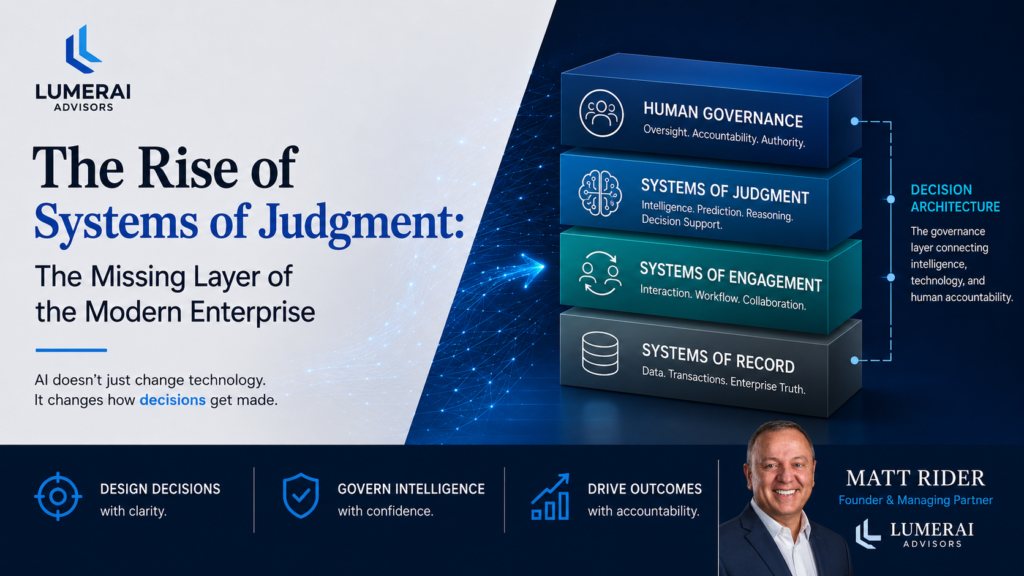
Every enterprise today is racing to deploy artificial intelligence. Yet most organizations are attempting to insert intelligent systems into an architecture that was never designed for machine-assisted decision making. The result is growing uncertainty not about technology, but about authority, accountability, and governance. For decades, enterprise technology architecture has been organized around two foundational layers: systems of record and systems of engagement. Together, they have shaped enterprise technology strategy, digital transformation, and operating models for more than two decades. Artificial intelligence introduces a third architectural layer that fundamentally changes this model. I call these Systems of Judgment. They represent the emergence of Enterprise Decision Architecture, the discipline of designing how intelligence participates in enterprise decisions while preserving accountability, governance, and human oversight. Organizations that recognize this shift early will build AI into the fabric of the enterprise responsibly. Those that do not risk creating faster systems with less clarity over who ultimately owns the decisions those systems influence. The Evolution of Enterprise Architecture For decades, enterprise technology architecture has been understood through two primary lenses. Systems of Record Systems of record manage the authoritative data that underpins the enterprise financial ledgers, customer records, inventory systems, loan platforms, ERP environments, and transaction processing systems. These platforms are built for accuracy, durability, compliance, and consistency. They preserve the organization’s institutional memory and establish a single source of truth. Systems of Engagement As digital transformation accelerated, organizations introduced systems of engagement. Customer portals, mobile applications, collaboration platforms, CRM solutions, workflow engines, and employee experience platforms made it possible to interact with customers and coordinate work in ways traditional transactional systems were never designed to support. Together, systems of record and systems of engagement have defined enterprise IT strategy for more than twenty years. Artificial intelligence changes that architecture. The Rise of Systems of Judgment AI does not simply process information. It interprets information. Unlike traditional enterprise systems, AI evaluates probabilities, recognizes patterns, generates recommendations, prioritizes alternatives, and increasingly initiates actions. That is a fundamentally different responsibility. These are Systems of Judgment. Rather than storing data or facilitating interactions, they participate directly in enterprise decision-making. Examples already exist across nearly every industry. A credit risk model evaluates the probability of default before recommending whether to approve a loan. A fraud detection platform determines whether a transaction should proceed or be blocked. An AI copilot recommends operational changes in response to supply chain disruptions. A predictive maintenance engine determines when expensive equipment should be serviced before failure occurs. In each case, the software is no longer simply processing transactions. It is exercising delegated judgment. When software begins participating in judgment, enterprise architecture must evolve accordingly. From Technology Architecture to Decision Architecture Traditional enterprise systems were deterministic. Given identical inputs, they consistently produced identical outputs. Their responsibility was to execute predefined business logic: process a transaction, update a record, or trigger a workflow. AI-driven systems operate differently. They interpret uncertainty. They evaluate probabilities. They recommend actions that may vary depending on context. That means organizations are no longer designing only technology architectures. They are designing decision architectures. This distinction matters because decisions carry accountability in ways transactions never have. The Decision Stack As intelligent systems mature, enterprise architecture naturally evolves into a layered decision model. Systems of RecordAuthoritative data, transactional integrity, compliance, and institutional memory. Systems of EngagementCustomer experiences, employee interactions, collaboration, and workflow coordination. Systems of JudgmentIntelligence, prediction, reasoning, recommendations, prioritization, and decision support. Human GovernanceExecutive oversight, escalation paths, accountability, risk management, ethics, regulatory compliance, and final authority. Each layer performs a distinct role. The effectiveness of the enterprise increasingly depends on how clearly organizations define the boundaries between automated judgment and human judgment. Today, many organizations have invested heavily in AI while giving comparatively little attention to designing those boundaries. Figure 1. The Enterprise Decision Stack Enterprise AI does not replace existing technology architecture; it extends it. Systems of Judgment introduce a new architectural layer between enterprise data and executive oversight, requiring organizations to intentionally design how intelligence, automation, and human accountability work together. Governance Becomes the Critical Design Challenge As organizations adopt AI-assisted decision making, the central challenge shifts from model accuracy to decision governance. As illustrated in the Enterprise Decision Stack, Systems of Judgment occupy a unique position between enterprise operations and executive oversight. Their value comes not simply from generating recommendations, but from enabling organizations to determine when decisions should be automated, when they should be escalated, and who ultimately remains accountable. Every enterprise must answer several fundamental questions. These are not technology questions. They are enterprise governance questions. Consider a global financial institution processing millions of transactions every day. If an AI-powered fraud engine automatically declines thousands of customer transactions, the organization has delegated judgment, not merely automation. If those decisions prove incorrect, responsibility cannot belong to the algorithm. It belongs to the enterprise that designed the governance model around it. Similarly, if an AI model prioritizes customers, allocates resources, or recommends operational changes across multiple business units, leadership must define who validates those recommendations before execution and how exceptions are managed. Governance, not model sophistication, ultimately determines whether AI creates enterprise value or enterprise risk. Implications for CIO Leadership The emergence of Systems of Judgment significantly expands the role of the modern CIO. Historically, technology executives were measured primarily by platform reliability, scalability, security, availability, and cost efficiency. Those responsibilities remain essential. But AI introduces an entirely new leadership obligation. Technology leaders must now help design the flow of decisions through the enterprise. That includes establishing: Increasingly, CIOs are not simply architects of technology. They are architects of enterprise decision systems. Why This Matters for Every Enterprise Artificial intelligence will continue becoming more capable. Models will improve. Automation will expand. Agentic AI will increasingly coordinate complex work across multiple systems. But the long-term competitive advantage will not come from deploying more models. It will come from designing better systems for governing how those models participate in enterprise decisions. Organizations that intentionally build Systems of Judgment into their enterprise