McKinsey estimates that approximately 70% of digital transformations fail to meet their objectives. Why?
Most technology decisions don’t fail because organizations choose the wrong technology. They fail because they begin by solving the wrong problem. After more than three decades helping executives make major technology decisions, I’ve noticed something: the best executive teams don’t necessarily have better answers. They ask better questions.
It often starts with a statement like:
- “We need AI.”
- “We need a new ERP.”
- “We need to move to the cloud.”
- “We need a new data platform.”
Most organizations immediately begin discussing vendors.
A different conversation begins by asking,
“What business problem are we actually trying to solve?”
Technology requests are rarely the problem. They are hypotheses about the solution. Executive leadership begins by validating the problem before validating the technology.
Exceptional leaders separate business problems from proposed solutions.
That’s why I believe the quality of every technology investment is determined long before technology is ever selected.
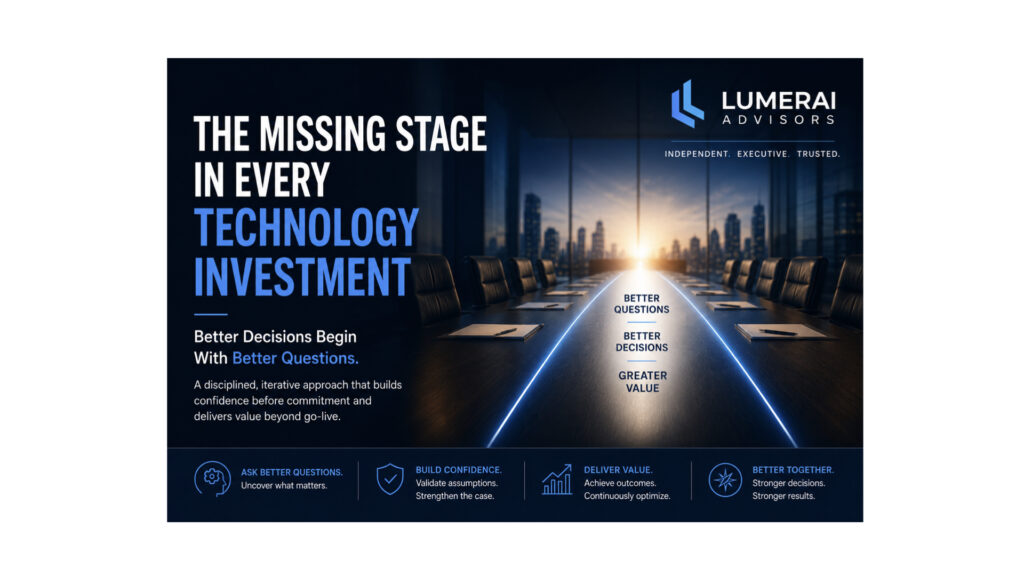
Better decisions begin with better questions.
Executive Takeaways
- Technology requests are often proposed solutions rather than clearly defined business problems.
- Decision quality improves when organizations validate assumptions before approving investments.
- Investment commitment should follow decision confidence, not precede it.
- Discovery is an investment, not a delay.
- Better technology outcomes begin with better executive questions.
Where Most Investment Processes Break Down
Imagine building a new corporate headquarters.
No executive team would approve the full construction budget before understanding the business requirements, evaluating alternative designs, assessing the site, and validating the long term operating model.
Yet organizations routinely approve technology investments with an equivalent level of uncertainty.
Not because they’re careless.
Because the investment process encourages certainty before sufficient understanding exists.
Business cases are often written while assumptions still outweigh evidence.
Benefits are estimated before outcomes are fully defined.
Budgets are approved before organizations truly understand the problem they are trying to solve.
Then implementation begins and the organization spends months learning what it could have discovered before approval.
We’ve normalized learning after approval.
Instead of learning before commitment.
Technology Investments Should Mature Like Executive Decisions
One of the lessons I’ve taken from working with executive teams is that confidence isn’t something you create.
It’s something you earn.
The best investors understand this instinctively.
They don’t commit all of their capital on day one.
They invest in reducing uncertainty.
Every conversation.
Every discovery session.
Every customer interview.
Every piece of evidence either increases confidence or challenges assumptions.
Technology investments should work exactly the same way.
As knowledge increases…
Decision confidence should increase.
As decision confidence increases…
Investment commitment should increase.
Instead, many organizations reverse the sequence.
They commit significant capital first.
Then spend months validating assumptions they could have challenged before funding was approved.
The Lumerai Technology Value Realization Framework™
After seeing this pattern repeat across hundreds of technology decisions, we developed the Lumerai Technology Value Realization Framework™ to help executives improve decision quality before major investments are made.
At its core is a simple principle: investment confidence should increase before capital commitment.
Rather than viewing technology investments as a single approval event, the framework treats them as a progression of executive decisions.
Each stage is designed to answer one critical question before additional resources, executive attention, or capital are committed.
It begins with a Business Opportunity.
Not a technology request.
Not a vendor presentation.
A business opportunity.
From there, each stage progressively reduces uncertainty while increasing executive confidence.
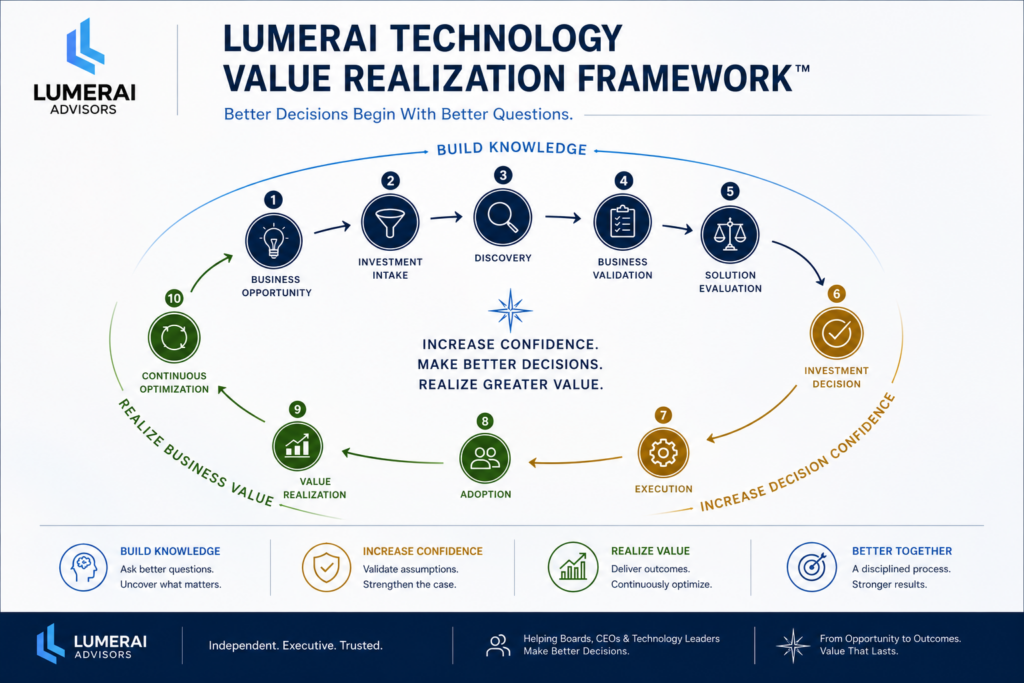
Each stage exists for one purpose: replacing assumptions with evidence before increasing commitment.
- Discover: defines the business problem.
- Assess: validates current capabilities.
- Explore: evaluates alternatives.
- Prioritize: aligns investments.
- Execute: delivers outcomes.
- Measure: confirms value.
Every stage earns the right to unlock the next investment decision.
Warning Signs You’re Investing Too Early
- The technology has already been selected before discovery begins.
- Vendors are discussing features before outcomes.
- Different executives describe different reasons for making the investment.
- Expected benefits cannot be tied to measurable business outcomes.
- The business case contains more assumptions than evidence.
- Discovery is viewed as delaying the project rather than improving the decision.
- The first meaningful discovery happens after funding has already been approved.
The Role of the Modern CIO Is Changing
For decades, CIOs were measured by operational excellence.
System availability.
Cost management.
Project delivery.
Those responsibilities remain essential.
But executive leadership increasingly expects something more.
Boards, CEOs, CFOs, and investors increasingly expect CIOs to improve the quality of enterprise technology investment decisions, not simply the quality of technology delivery.
That requires a different leadership mindset.
One that values curiosity before certainty.
Business outcomes before technology features.
Questions before answers.
The CIO of the future won’t be defined by the systems they implement.
They’ll be defined by the quality of the decisions they help their organizations make.
A Question Worth Asking
Before approving your next major technology investment, ask one simple question.
Are we solving the right problem?
It sounds obvious.
Yet it may be the most valuable question an executive team can ask.
Technology alone doesn’t create business value. Better decisions do. Those decisions come from solving the right problems, executing with confidence, and replacing assumptions with evidence. And every one of those things begins with asking better questions.
Coming Next: The Most Expensive Technology Mistake You Can Make
Most technology requests arrive disguised as solutions.
“We need AI.”
“We need a new ERP.”
“We need to move everything to the cloud.”
But what if those aren’t business problems at all?
In the next article, we’ll explore why organizations so often mistake technology requests for business needs, and how a disciplined discovery process can dramatically improve technology investment decisions before a single dollar is committed.
Before committing to your next major technology investment, explore Lumerai’s Technology Strategy Assessment to clarify priorities, test assumptions, and build an executable path forward.