
Target AI at the Reviews, Not the Work
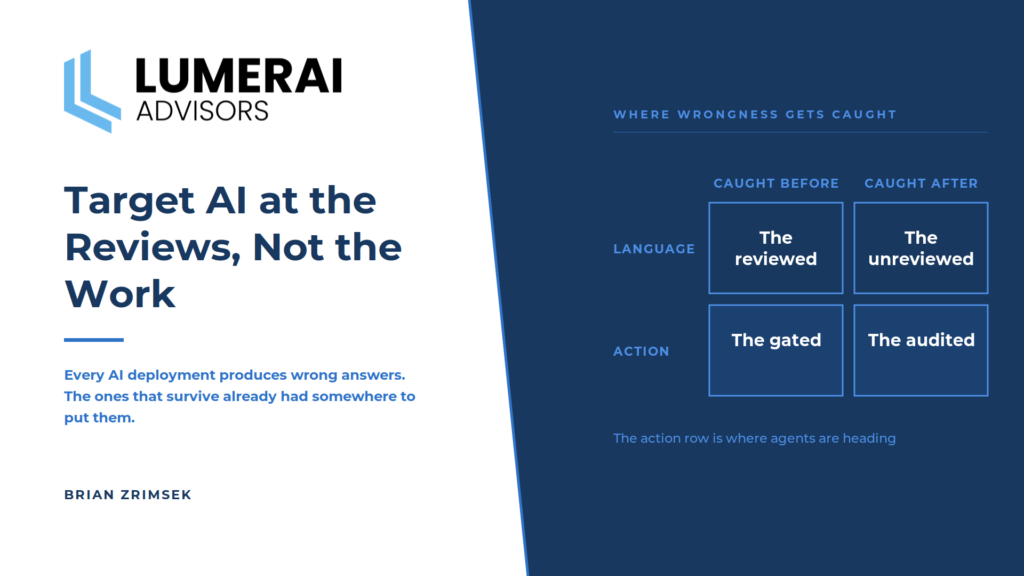
Every AI deployment produces some amount of wrong output, and something has to catch it. The deployments that stick are the ones where that something was already there.
Attention Is Not a Control
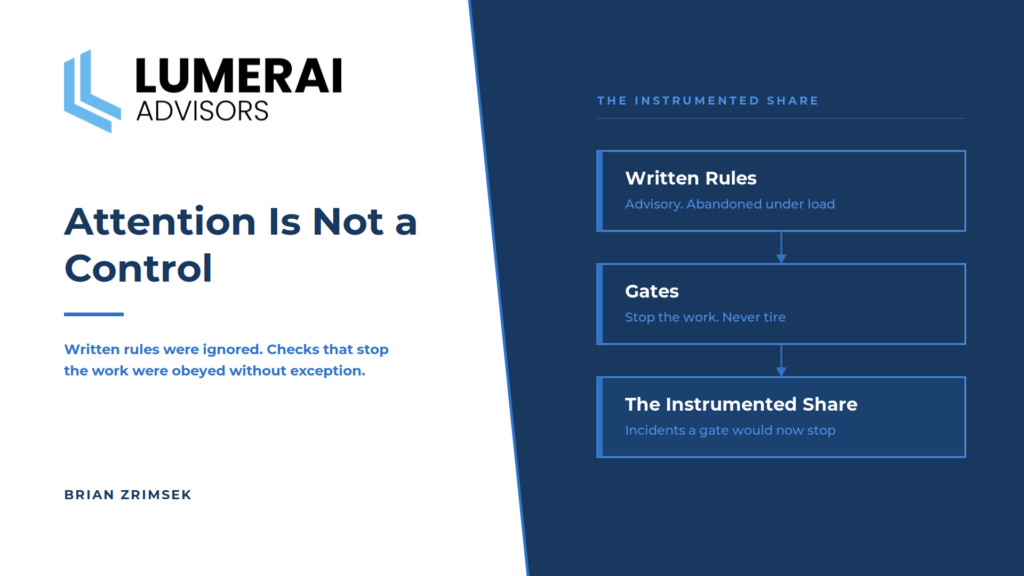
Two kinds of rules governed what the machine was allowed to do. Both were in force the whole time. One was prose. The other was a set of AI guardrails. One was ignored completely, the other obeyed without exception.
Your AI Business Case’s Blind Spot
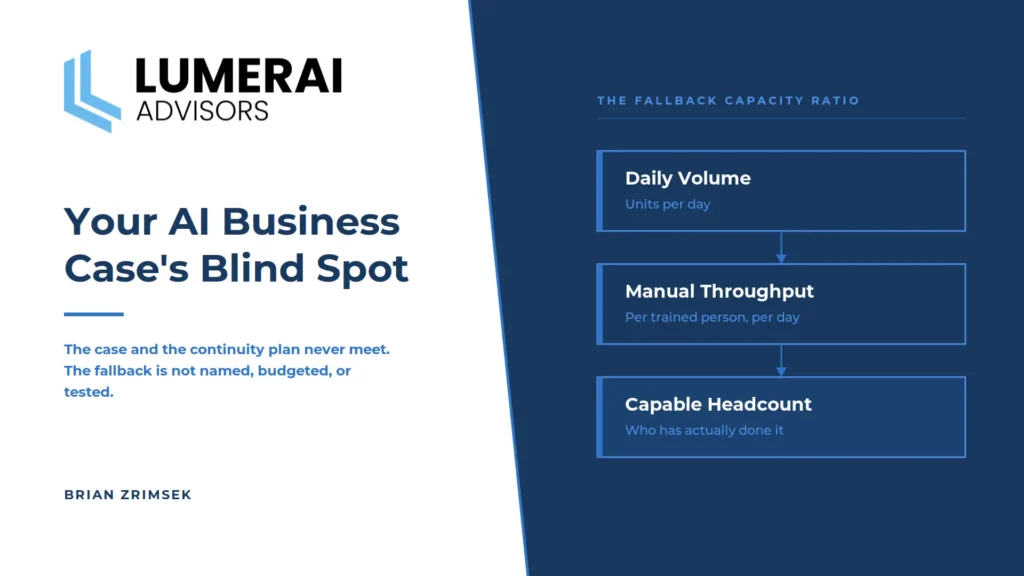
I have worked on hundreds of business cases. Every one was written inside a department or a division, and written for the benefit of that department or division. That is not a criticism. It is what a business case is for. The only one I ever saw that mentioned disaster recovery was a business case about disaster recovery. That was fine for thirty years. It is not fine now, and the reason has nothing to do with the quality of the cases or the people writing them. The AI business case and the continuity plan never meet Two owners, one assumption, no shared document An AI business case is built by a business unit that wants to be better at the thing it does. Faster lease abstraction, cleaner forecasts, fewer touches per invoice. The case compares the world with the project against the world without it, over three or five years, and both of those worlds are assumed to keep operating. Continuity belongs to somebody else. IT owns it, writes the plan, tests it on its own cycle, and reports on it to a different committee. The continuity plans I have read all have a section saying the work will be done manually and reconciled when service returns. Underneath that section sits an assumption: somewhere in the business are people who know how to do the work without the system. Not named. Not budgeted. Not tested. Present. That assumption survived mainframes, client-server, ERP, the web, mobile and the cloud. Every one of those waves changed how the work was done and left behind the people who knew how to do it. The process moved. The knowledge stayed in the building. The gap is not a missing number. It is a seam between two owners. And a second seam opens after the deployment goes live. The business has reduced its human fallback and increased its dependence on a provider it does not control. Two dependencies moving in opposite directions, neither of them recorded in the document that authorized the move. Nobody skipped a step. No step exists. Stated as a CFO would state it: the case captures the labor avoided. It does not capture the replacement cost of the capability being consumed, because that capability has never appeared on any ledger. The first wave that can consume the fallback Earlier automation moved the process and left the practitioners Earlier waves removed people too. Mainframes removed clerks, ERP removed accounting staff, self-service removed transaction processors. The distinction is not headcount. What those waves left behind was enough capability to reconstruct the process. The people who understood the work were still in the building, and parts of the job were still done by hand, so the understanding stayed current without anybody maintaining it. An AI deployment is funded on the basis that it absorbs volume. That is the case, it is usually a good case, and the savings land. What lands with them is the headcount change that made the numbers work. Some of those people leave. Others are redeployed, which sounds gentler and often is, though it depends on how completely and for how long they leave the work. The relevant question is not whether they are still on the payroll. It is whether anyone is still doing the thing by hand, and how recently. Keeping a human in the loop does not solve it What thirty years of research says about reliable systems The obvious answer is that the people are still there, supervising rather than doing. A human stays in the loop, the process gets reviewed, the capability is preserved. Two things are wrong with that, and both are established rather than argued. Reliability degrades the reviewer. Parasuraman, Molloy and Singh ran a multitask flight simulation in 1993. Participants monitored an automated system while handling other jobs. For one group the automation was consistently reliable. For the other it varied. After about twenty minutes, the group watching the reliable automation was substantially worse at catching its failures. The reliability itself degraded the monitor, and the effect disappears when monitoring is the only job, which matters because enterprise reviewers rarely have one job. Rarity degrades detection. Wolfe, Horowitz and Kenner published in Nature in 2005. Observers searched simulated baggage x-rays, and the only thing that changed between conditions was how often a target was actually there. At fifty percent prevalence they missed seven percent. At one percent they missed thirty. Think of it as Where’s Waldo, except Waldo is only on one page in a hundred. You would find him on page one. By page forty you would be flipping. By page ninety-nine you have stopped looking in any way that counts, and when he finally shows up you turn straight past him. Nobody decides to stop looking. The absence of a decision is the whole problem. The two research traditions rarely cite each other, and they describe the same condition from opposite ends. Ninety-nine percent accuracy, from the reviewer’s side of the desk, is an environment where an error shows up once in a hundred. So two things govern whether a reviewer is a control or a formality: how often errors appear, and whether the reviewer is doing anything else. Errors frequent Errors rare Reviewer does nothing else Works. Frequency keeps them calibrated, attention is undivided Prevalence pulls detection down, though single-task monitors held up regardless of reliability Reviewer has a queue and a day job Degraded and still functioning. Finding things regularly keeps them in the task Both effects compound. The quitting threshold falls and attention goes to the work that visibly needs it This is a way of locating the problem rather than a model of it. Bottom right is where many enterprise review roles end up, and it is where a successful deployment can put you. The deployment moves you right, because the errors the reviewer sees become rarer as the model improves. It moves you down, because the headcount that justified the project is
Lumerai Technology Value Realization Series | Part 3
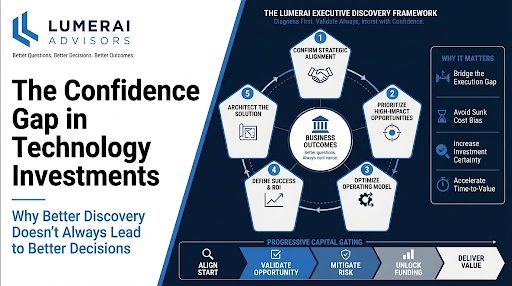
Why Better Discovery Doesn’t Always Lead to Better Decisions The Confidence Gap in Technology Investments Technology investment decisions rarely fail because organizations lack information. They fail because organizations often mistake more information for greater decision confidence. By the time a technology initiative reaches executive leadership, months of work have often been completed. Business cases have been drafted. Requirements have been documented. Vendors have been shortlisted. Demonstrations have been conducted. Scorecards have been completed. Research from organizations such as Gartner and McKinsey has consistently highlighted the difficulty organizations face in translating major technology and transformation investments into expected business value. Despite months of rigorous preparation, executive leadership is frequently left asking the exact same fundamental question: “How do we know this is the right investment?” That is the Confidence Gap: the distance between having enough information to make a technology decision and having enough evidence to make a confident decision about business outcomes. In the first article of this series, I argued that organizations often solve the wrong problem because they skip structured discovery. In the second article, I introduced the Lumerai Executive Discovery Framework, a disciplined approach to validating business opportunities before evaluating technology solutions. Discovery improves the quality of the problem definition. It does not, by itself, guarantee the quality of the investment decision. Transforming discovery into realized value requires structured executive decision governance. When Good Analysis Produces Poor Decisions One of the most persistent misconceptions in enterprise IT strategy is the belief that more analysis produces better decisions. It does not. During enterprise software evaluations, organizations routinely generate an extraordinary amount of analysis and documentation: Ironically, this abundance of data frequently induces decision paralysis rather than strategic clarity. Executives become overwhelmed by competing departmental priorities, conflicting vendor claims, and technical minutiae. As a result, executive discussions regress from strategic outcome validation to tactical feature grading, pricing negotiations, and deployment timelines. Technology selection becomes the primary objective, while business value realization fades into the background. Confidence Is an Executive Asset Enterprise technology investments are rarely approved simply because a vendor offers the longest feature list. Successful investments are approved when leadership establishes high decision confidence that the deployment will produce its intended business outcomes. Executive decision confidence relies on validating five fundamental governance questions: When these questions are answered with evidence rather than vendor assumptions, governance transitions from passive procurement to active strategic leadership. The Lumerai Executive Decision Framework The primary objective of the Lumerai Executive Decision Framework is not to select software. Its objective is to identify the investment decision that yields the highest confidence of achieving target business outcomes. The framework evaluates major capital investments across six progressive decision gates: Stage 1: Validate Strategic Alignment Establish whether the initiative directly accelerates enterprise revenue, cost efficiency, or competitive differentiation. Initiatives lacking clear strategic alignment should not advance to subsequent investment gates, regardless of technical capability. Stage 2: Define Decision Criteria Before engaging vendors, leadership establishes non-negotiable success criteria driven strictly by operational imperatives. Business outcomes drive technology selection—never the reverse. Stage 3: Evaluate Solution Architecture Assess integration complexity, scalability, security posture, and operating model alignment. Technology is evaluated as a capability enabler within the broader ecosystem. Stage 4: Assess Enterprise Risk Evaluate operational, financial, vendor stability, cybersecurity, and organizational change risks collectively rather than in isolation. Stage 5: Compare Future Scenarios Test how candidate solutions perform across distinct future business scenarios—such as rapid scaling, M&A integration, regulatory shifts, and emerging AI capabilities. Stage 6: Establish Decision Confidence Final investment sign off should occur only when the evidence demonstrates that the business problem has been validated, alternatives have been objectively evaluated, risks are understood, and clear value realization metrics have been established. Confidence does not mean certainty. No major technology investment comes with certainty. It means leadership understands the evidence, the assumptions, the risks, the alternatives, and the expected outcomes well enough to make a defensible decision. Five Biases That Can Distort Technology Decisions Even disciplined organizations are susceptible to cognitive bias. Five biases appear repeatedly during enterprise technology evaluations: Recognizing these biases does not eliminate them. The objective of governance is to make them visible, challenge their influence, and ensure that major investment decisions are ultimately supported by evidence rather than assumption. Executive Example Consider an enterprise modernizing its service architecture following a structured discovery phase. Three finalists remain: Vendor A: May create the greatest long term capability, but introduces significant organizational and implementation risk. Vendor B: May offer the strongest operational fit, but requires a higher initial investment. Vendor C: May produce the strongest financial case today, but could constrain future growth through customization requirements. All three can satisfy the requirements. The decision therefore cannot be resolved by requirements compliance alone. Which investment gives us the greatest confidence that we will achieve the business outcomes we defined? Under the Lumerai Executive Decision Framework, the decision shifts from “Which platform scores highest?” to “Which capital allocation provides the highest decision confidence for our strategic outcomes?” By evaluating each vendor against future operating scenarios and risk tolerances, leadership converts an ambiguous software comparison into a confident strategic decision. Better Decisions Require Better Governance Technology investments should never be authorized simply because a platform tops a feature matrix. They should be authorized because executive leadership has evidence based confidence that the investment aligns with strategic objectives, addresses a validated business problem, appropriately manages enterprise risk, and establishes a credible path to measurable economic value. True decision confidence is not executive intuition. It is the outcome of disciplined decision architecture. Conclusion Technology investment decisions are often portrayed as exercises in software selection. In reality, they are exercises in executive judgment regarding business outcomes. Organizations that consistently outperform their peers are not necessarily better at evaluating technology. They are better at making decisions. They understand that every technology investment is ultimately a business decision supported by technology, not the other way around. Discovery identifies the right problem. Decision making determines the right investment. Execution delivers the solution. Value realization measures success.
The Hidden Risk of AI: Building Transformation Programs for a Future That May Not Exist
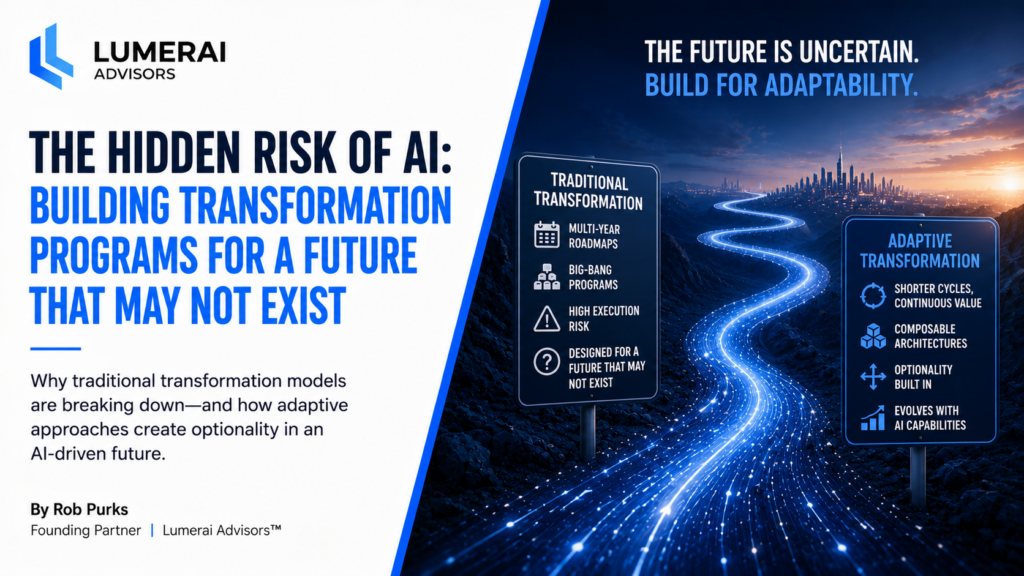
For decades, enterprise transformation followed a familiar model: define a future state, build a multi-year roadmap, and execute with discipline. That model is now under pressure—not because transformation is no longer necessary, but because the assumptions behind it are rapidly breaking down. Large transformation programs rely on a core premise: that we can reasonably predict the future operating model. In an AI-driven environment, that premise is increasingly fragile. Capabilities are evolving faster than planning cycles, and organizations are designing multi-year programs against a moving target. McKinsey & Company has highlighted that while generative AI could create significant economic value, organizations are capturing impact fastest through incremental deployment embedded in existing workflows, not large, monolithic transformations. Value is emerging in shorter cycles, not long-duration bets. At the same time, execution risk was already high. Boston Consulting Group estimates that 70% of digital transformations fail to meet their objectives, even in more stable environments. AI does not reduce that risk—it amplifies it. But there is a more fundamental issue emerging—one that is still underappreciated. We are designing transformation programs without a clear understanding of what AI will actually be capable of in two to three years. This introduces a new form of exposure. Not just whether a program will be delivered successfully, but whether it is solving the right problem at all. Entire layers of functionality being built today—workflow orchestration, decision support, even elements of system integration—may be simplified, automated, or eliminated as AI capabilities mature. The risk is no longer just execution failure. It is design risk leading to solution irrelevance. Programs that are delivered on time, on budget, and exactly as designed—but no longer aligned with the business or technology landscape by the time they go live. This is why we are seeing leading organizations shift away from “big-bang” transformation toward more adaptive models. Composable architectures, incremental modernization, and shorter investment cycles are becoming the preferred approach—not as a compromise, but as a strategic response to uncertainty. The question is no longer, “What should our business look like in five years?” It is, “How do we remain adaptable over the next five quarters?” For CEOs, CIOs, and private equity leaders, this has direct implications for capital allocation and risk management. Transformation programs must be structured with optionality—designed to evolve as capabilities evolve, rather than locking into a fixed future state. In many cases, the right answer is not to stop transformation—but to deconstruct it. Rob Purks is a Founding Partner at Lumerai Advisors, a technology strategy advisory firm. Lumerai Advisors provides an unbiased perspective which is not influenced by vendor relationships. With over 150 years of CIO and technology experience, the founding partners bring an honest and complete perspective on technology strategies and challenges. #Telecom #DigitalTransformation #PrivateEquity #ITStrategy #CIO #EnterpriseArchitecture #OPEX #AI #Cloud Lumerai Advisors
The Missing Stage in Every Technology Investment
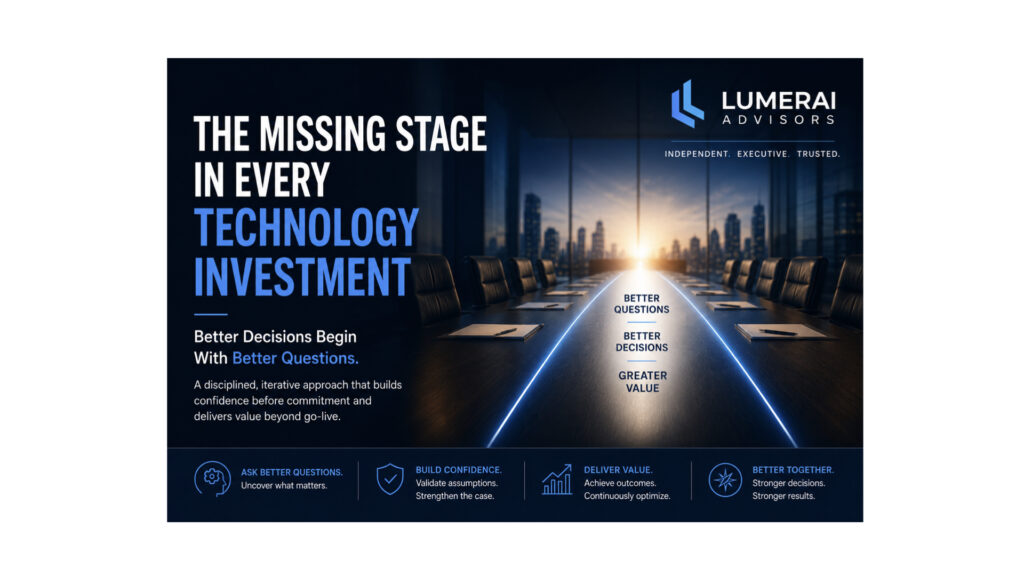
McKinsey estimates that approximately 70% of digital transformations fail to meet their objectives. Why? Most technology decisions don’t fail because organizations choose the wrong technology. They fail because they begin by solving the wrong problem. After more than three decades helping executives make major technology decisions, I’ve noticed something: the best executive teams don’t necessarily have better answers. They ask better questions. It often starts with a statement like: Most organizations immediately begin discussing vendors. A different conversation begins by asking, “What business problem are we actually trying to solve?” Technology requests are rarely the problem. They are hypotheses about the solution. Executive leadership begins by validating the problem before validating the technology. Exceptional leaders separate business problems from proposed solutions. That’s why I believe the quality of every technology investment is determined long before technology is ever selected. Better decisions begin with better questions. Executive Takeaways Where Most Investment Processes Break Down Imagine building a new corporate headquarters. No executive team would approve the full construction budget before understanding the business requirements, evaluating alternative designs, assessing the site, and validating the long term operating model. Yet organizations routinely approve technology investments with an equivalent level of uncertainty. Not because they’re careless. Because the investment process encourages certainty before sufficient understanding exists. Business cases are often written while assumptions still outweigh evidence. Benefits are estimated before outcomes are fully defined. Budgets are approved before organizations truly understand the problem they are trying to solve. Then implementation begins and the organization spends months learning what it could have discovered before approval. We’ve normalized learning after approval. Instead of learning before commitment. Technology Investments Should Mature Like Executive Decisions One of the lessons I’ve taken from working with executive teams is that confidence isn’t something you create. It’s something you earn. The best investors understand this instinctively. They don’t commit all of their capital on day one. They invest in reducing uncertainty. Every conversation. Every discovery session. Every customer interview. Every piece of evidence either increases confidence or challenges assumptions. Technology investments should work exactly the same way. As knowledge increases… Decision confidence should increase. As decision confidence increases… Investment commitment should increase. Instead, many organizations reverse the sequence. They commit significant capital first. Then spend months validating assumptions they could have challenged before funding was approved. The Lumerai Technology Value Realization Framework™ After seeing this pattern repeat across hundreds of technology decisions, we developed the Lumerai Technology Value Realization Framework™ to help executives improve decision quality before major investments are made. At its core is a simple principle: investment confidence should increase before capital commitment. Rather than viewing technology investments as a single approval event, the framework treats them as a progression of executive decisions. Each stage is designed to answer one critical question before additional resources, executive attention, or capital are committed. It begins with a Business Opportunity. Not a technology request. Not a vendor presentation. A business opportunity. From there, each stage progressively reduces uncertainty while increasing executive confidence. Each stage exists for one purpose: replacing assumptions with evidence before increasing commitment. Every stage earns the right to unlock the next investment decision. Warning Signs You’re Investing Too Early The Role of the Modern CIO Is Changing For decades, CIOs were measured by operational excellence. System availability. Cost management. Project delivery. Those responsibilities remain essential. But executive leadership increasingly expects something more. Boards, CEOs, CFOs, and investors increasingly expect CIOs to improve the quality of enterprise technology investment decisions, not simply the quality of technology delivery. That requires a different leadership mindset. One that values curiosity before certainty. Business outcomes before technology features. Questions before answers. The CIO of the future won’t be defined by the systems they implement. They’ll be defined by the quality of the decisions they help their organizations make. A Question Worth Asking Before approving your next major technology investment, ask one simple question. Are we solving the right problem? It sounds obvious. Yet it may be the most valuable question an executive team can ask. Technology alone doesn’t create business value. Better decisions do. Those decisions come from solving the right problems, executing with confidence, and replacing assumptions with evidence. And every one of those things begins with asking better questions. Coming Next: The Most Expensive Technology Mistake You Can Make Most technology requests arrive disguised as solutions. “We need AI.” “We need a new ERP.” “We need to move everything to the cloud.” But what if those aren’t business problems at all? In the next article, we’ll explore why organizations so often mistake technology requests for business needs, and how a disciplined discovery process can dramatically improve technology investment decisions before a single dollar is committed. Before committing to your next major technology investment, explore Lumerai’s Technology Strategy Assessment to clarify priorities, test assumptions, and build an executable path forward.
The question isn’t whether your organization will be transformed by AI. That ship has sailed.
The question is whether your workforce will become a competitive advantage in an AI-powered economy or whether AI will simply expose capability gaps that already exist. Your AI strategy is only as strong as the people expected to execute it. Most organizations are measuring the wrong thing. They track AI licenses, adoption, training completion rates, and prompt engineering workshops. Yet despite billions of dollars invested in AI, only a small percentage of organizations are realizing meaningful business value. The reason is simple. AI transformation is not primarily a technology problem. It is a workforce capability problem. The question leaders should be asking is not whether employees can use AI. It is whether they can make better decisions because of it. Do your people actually know how to work in an AI-powered world? Not “have they attended a webinar” or “did we roll out Copilot.” I mean: do they fundamentally understand how to think alongside AI, direct it, interrogate its outputs, and apply judgment where the machine falls short? That’s a very different bar — and most organizations have no honest answer. Executive Takeaways The Numbers Are Damning The data is in, and it’s unambiguous. According to IDC, 94% of CEOs and CHROs identify AI as their top in-demand skill for 2025, yet only 35% of leaders feel they’ve actually prepared their employees for AI-driven roles. Meanwhile, a 2026 DataCamp/YouGov survey of 500+ enterprise leaders found that 59% admit their organization has an AI skills gap, even though most are already spending on AI tools. Think about that: majority investment, minority readiness. PwC’s 2025 AI Jobs Barometer adds another dimension: AI-exposed roles are evolving 66% faster than other positions and command a 56% wage premium. That means the gap isn’t just an operational inconvenience — it’s a competitive liability that compounds every quarter you don’t address it. We’ve Been Asking the Wrong Question Most workforce AI assessments are built around the wrong mental model. They ask: “Can this person use the AI tool?” That’s like evaluating a surgeon by whether they can hold a scalpel. The right question is: “Can this person make better decisions because of AI?” Working effectively in an AI world requires a fundamentally different skill architecture than what most job descriptions, competency models, and performance reviews are built to measure. It’s not about prompt engineering. It’s about something deeper. The World Economic Forum’s Future of Jobs Report puts it plainly: employers anticipate that 40% of core skills will change by 2030. Not augmented — changed. That’s not a training program. That’s a reinvention of what “qualified” means. What “AI-Ready” Actually Looks Like After 35 years leading technology transformation across global retailers, manufacturers, and PE-backed companies, I’ve seen many skill paradigm shifts. This one is different in a critical way, it cuts across every function, every level, and every geography simultaneously. True AI readiness requires capabilities across three dimensions, yet most organizations focus exclusively on the first. The Lumerai AI Readiness Model Level 1: Tool Fluency Can employees effectively use AI tools? Level 2: Critical Reasoning Can they challenge and validate AI outputs? Level 3: Human Edge Can they apply uniquely human judgment, creativity, and leadership? BCG research found that companies successfully addressing AI talent shortfalls achieve 2.3x faster AI adoption and 67% higher AI ROI. The skill assessment isn’t a HR box to check, it’s a value creation lever. Warning Signs Your Workforce Isn’t AI Ready Why Most Assessments Miss the Mark Here’s the uncomfortable truth, most organizations are confusing activity with capability. Deploying Copilot is not an AI strategy. Sending people to a LinkedIn Learning course is not workforce transformation. And asking employees to self-report AI comfort level is not an assessment. The DataCamp report reveals the paradox in stark terms, most enterprises are offering some form of AI training, yet only 35% have a mature, workforce-wide upskilling program. The organizations with that mature program are nearly twice as likely to report significant AI ROI. The rest are spending money and just making noise. Effective assessment requires measuring against a defined target, not a generic “AI skills” list, but a role-specific, business-context-specific model of what AI-assisted performance actually looks like in your environment. A Framework Worth Building If you’re serious about knowing where your workforce stands, here’s where to start: Map your role exposure: Not every role is equally disrupted or equally enabled by AI. Start with a realistic heat map of AI exposure across your organization — which roles are most automatable, which are most augmentable, and which create the highest risk if AI is used without adequate oversight. Define role-specific AI competency profiles: A CFO who needs to interrogate AI-generated financial models requires a different skill profile than an operations manager using AI for demand forecasting. Generic frameworks produce generic results. Assess with scenarios, not surveys: Self-assessment is unreliable for novel skill domains. Scenario-based evaluations present a realistic AI-assisted decision situation worth observing. Close the loop with your technology roadmap: Your AI skills strategy needs to anticipate where your tools are heading, not just where they are today. Agentic AI is arriving faster than most teams realize. If your workforce isn’t prepared to work alongside autonomous AI agents, you’ll be wasting time and money rebuilding capability. The Leaders Who Act Now Will Define the Gap McKinsey estimates that 88% of organizations now use AI in at least one business function. Only 1% have achieved true AI maturity. The distance between those two numbers is, in large part, a human capability problem. The CEOs and CIOs who understand that AI tools without AI-ready people produce expensive mediocrity will act differently in 2026. They’ll treat workforce AI assessment not as a one-time initiative, but as an ongoing strategic process as embedded in their operating rhythm as financial reviews and technology audits. The question isn’t whether your organization will be transformed by AI. That ship has sailed. The question is whether your workforce will become a competitive advantage in an AI-powered economy or whether AI will
Cloud Repatriation: Why Companies Are Moving Workloads Back from the Cloud
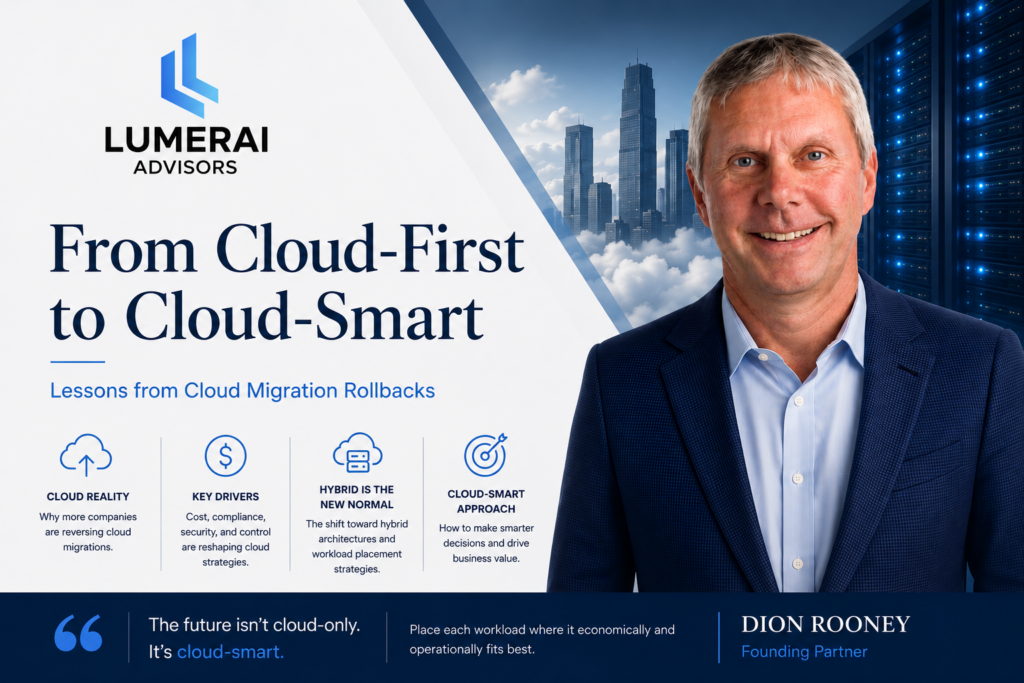
From Cloud-First to Cloud-Smart For more than a decade, enterprise technology strategy was dominated by a simple directive: move to the cloud. Today, many organizations are discovering that cloud adoption and cloud optimization are not the same thing. As a result, a growing number are reevaluating where workloads should reside, leading to a trend commonly called cloud repatriation or cloud exit. Here are some of the most-cited recent statistics: That does not mean companies are abandoning the cloud entirely. Most are moving toward hybrid architectures, keeping some workloads in public cloud while bringing others back to private infrastructure or colocation facilities. Executive Takeaways Why are cloud migration rollbacks happening? Cost Overruns Many organizations discovered that: Several surveys cite cost optimization as the #1 driver. Well-known examples: In our experience, organizations often underestimate cloud operating costs because they evaluate migration costs but fail to model long term consumption patterns, storage growth, and data egress charges. Data Sovereignty and Compliance Regulated industries increasingly want tighter control over: This is particularly strong in Europe, finance, healthcare, and government sectors. Security and Operational Control Some organizations feel they lost visibility or governance in highly distributed cloud environments. Vendor Lock-in Concerns Companies worry about dependence on a single hyperscaler, with proprietary services, and the potential of escalating pricing. Hybrid and multicloud strategies are often attempts to reduce this dependency. Despite this, cloud spending is still growing. Public cloud spending continues to rise, SaaS adoption remains extremely high, and most enterprises are becoming “cloud-smart,” not anti-cloud. The current enterprise pattern is usually: In other words, the market has shifted from “move everything to the cloud”, to “place each workload where it economically and operationally fits best.” Cloud adoption for many workloads is still the right answer, but companies need to conduct detailed diligence on what gets moved and more importantly, how the variable spend model gets managed. At Lumerai Advisors, we use the Lumerai Cloud Placement Framework to help executives evaluate hybrid architecture and workload placement decisions. For private equity-backed organizations, workload placement decisions increasingly affect EBITDA performance, making cloud economics a business strategy issue rather than simply a technology decision. The Lumerai Cloud Placement Framework When evaluating cloud placement decisions, we assess workloads across four dimensions: Dimension Key Question Cost Predictability Can workload consumption be forecast accurately enough to benefit from cloud economics? Performance Requirements Does latency, throughput, or workload intensity justify dedicated infrastructure? Data Sensitivity Do regulatory, security, or data sovereignty requirements necessitate greater control? Business Agility Does the workload require speed, scalability, and flexibility to support growth and innovation? The goal is not to determine whether cloud is good or bad, but to determine which environment delivers the best economic and operational outcome for each workload. Cloud repatriation should not be viewed as a reversal of cloud strategy, but as the natural maturation of enterprise workload placement decisions. The future is not cloud-first or cloud-exit. The future is cloud-smart. The organizations that create the most value will be those that place every workload in the environment that delivers the best combination of performance, economics, security, and agility. Sources and References