
Moving From Pilot Purgatory to Autonomous Operations: The New Genetic Code of Manufacturing
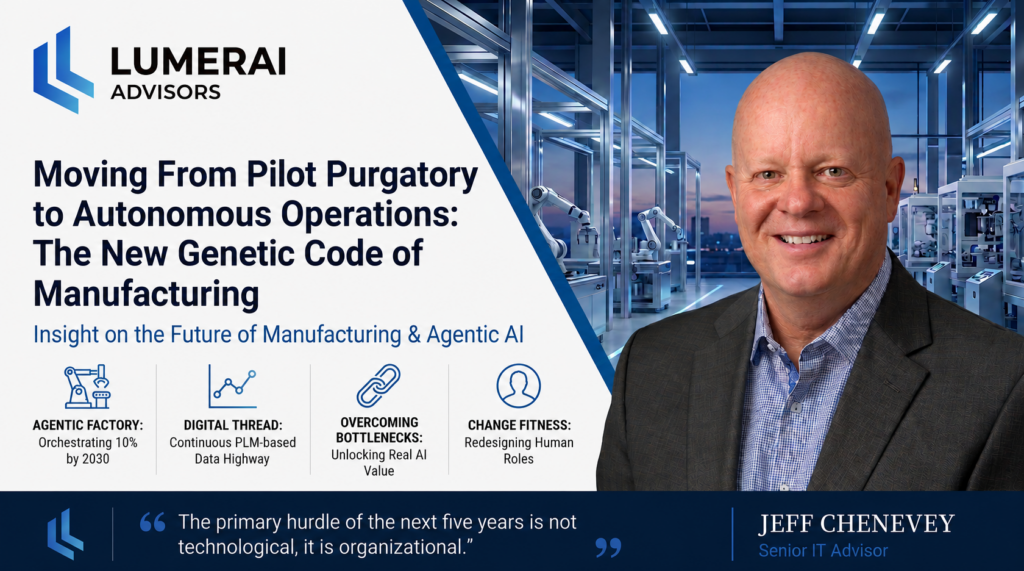
Manufacturing has spent the last five years proving AI works. The next five years will determine whether it creates a competitive advantage. Most manufacturers are no longer asking whether AI belongs in the factory. They’re asking how quickly they can move beyond isolated pilots toward autonomous operations without compromising safety, quality, or resilience. The companies that answer that question first won’t simply become more efficient. They’ll fundamentally redesign how manufacturing operates. Over the next five years, technology will not just change how factories operate; it will rewrite the genetic code of the manufacturing enterprise. At Lumerai Advisors, when we counsel C-suite executives navigating this shift, we emphasize three structural pillars that will separate the legacy operators from the “Frontier Firms.” The Shift from Automation to Autonomy In our work with clients, we are seeing a move beyond static automation to Agentic AI – semiautonomous AI agents capable of interacting, reasoning, and adapting to execute multi-step processes across distributed environments. Consider this stark shift: Gartner reports that while semiautonomous AI agents orchestrated roughly 2% of key production, quality, and maintenance use cases in early 2026, by 2030, they will orchestrate 10% of these core operations, with humans retaining final veto and approval power. Instead of a dashboard alerting a plant manager to a supply chain bottleneck, an agentic workflow will automatically recalculate material requirements, interface with procurement agents, adjust shop-floor schedules, and re-optimize energy use in real time. The factory floor is evolving from a collection of automated machines into a self-orchestrating ecosystem. The Power of the Software-Defined Product and the Digital Thread For decades, hardware design dictated software deployment. Today, the most forward-thinking manufacturers are flipping the script by adopting a “shift-left” strategy, decoupling hardware from software to enable fully parallel development. Gartner notes that manufacturers utilizing this software-defined architecture are seeing a massive acceleration in innovation, including up to a 40% reduction in time-to-market for complex mechatronic products. Organizations with an integrated Digital Thread create a continuous flow of trusted operational data across engineering, manufacturing, quality, and supply chain. That data becomes the foundation for AI agents capable of making faster, more informed decisions. Warning Signs You’re Not Ready for Autonomous Operations AI pilots remain isolated. Manufacturing and IT operate separately. Data quality is inconsistent. AI governance has not been defined. Legacy ERP limits integration. Plant managers don’t trust AI recommendations. ROI comes from individual projects rather than enterprise transformation. The Lumerai Change Fitness Framework As I often tell our clients at Lumerai Advisors, the primary hurdle of the next five years is not technological, it is organizational. Recent Harvard Business School insights highlight that the true differentiator in this era is “change fitness.” When AI moves into core workflows, it shifts the human role from manual execution to strategic oversight and critical thinking. If leaders focus strictly on first-order efficiency gains, they risk alienating their workforce and stripping meaning from the shop floor. To thrive in the upcoming half-decade, manufacturing executives must pivot from process optimization to fundamental process redesign. We recommend using the Lumerai Change Fitness Framework: Unifying the Data Foundation: Building an API-first, contextualized data thread that bridges IT (Information Technology) and OT (Operational Technology). Establishing Rigorous Governance: Defining explicit levels of AI agency and establishing ironclad safety guardrails. Cultivating AI Literacy: Actively modeling AI experimentation from the top down, transforming the factory floor into a continuous learning system. The Executive Imperative Technology is no longer the primary constraint. Leadership is. The manufacturers that outperform over the next decade won’t necessarily have better AI models. They’ll have better governed data. Better integrated systems. Better prepared workforces. Better executive alignment. The next generation of manufacturing will not be defined by who buys the most AI. It will be defined by who redesigns work, data, and decision-making around it. Autonomous operations are no longer a distant vision. They are becoming the new operating model. The organizations that build the data foundation, governance, and workforce capabilities today will define manufacturing leadership for the next decade. At Lumerai Advisors, we call this building organizational Change Fitness. In our experience, technology evolves quickly. Organizations do not. Competitive advantage belongs to those who prepare both. #Manufacturing #ArtificialIntelligence #Industry40 #DigitalTransformation #ExecutiveLeadership #LumeraiAdvisors
The Efficiency Hedge: Why Tariffs are Quietly Accelerating the AI Revolution
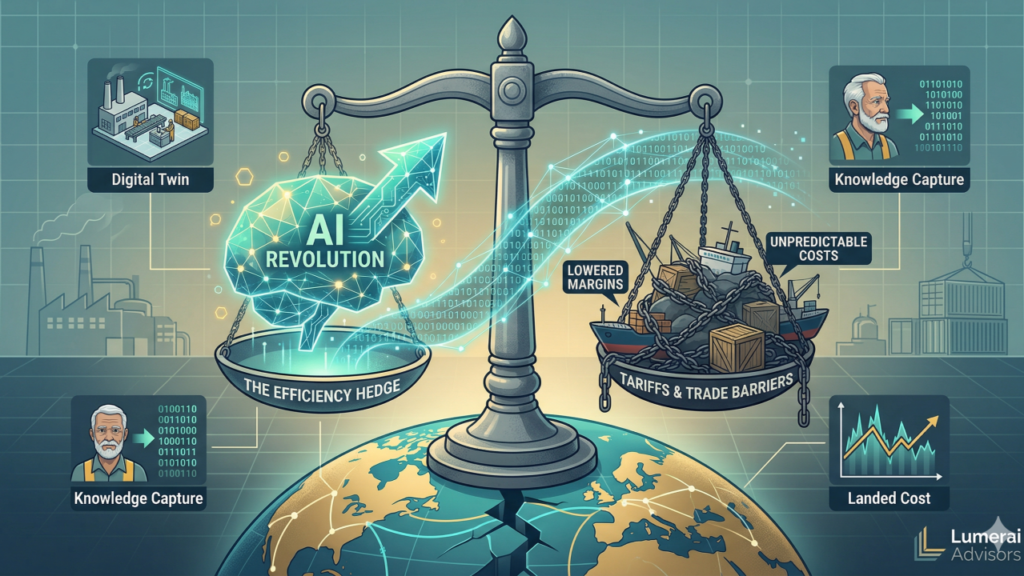
The Efficiency Hedge: Why Tariffs are Quietly Accelerating the AI Revolution For decades, the manufacturing playbook was simple: chase the lowest labor cost across the globe. But as we move through 2026, that playbook has been shredded. Between the sweeping “Liberation Day” tariffs of 2025 and the ongoing restructuring of global trade, the “landed cost” of goods has become a moving target. At Lumerai Advisors, we are seeing a fascinating paradox. While trade barriers were designed to protect domestic industry, their primary side effect has been a massive, forced acceleration of Artificial Intelligence. In a high-tariff environment, AI is no longer a “future tech” experiment—it has become a financial hedge. The “Double Squeeze” of 2026 U.S. manufacturers are currently navigating a “double squeeze.” According to recent National Association of Manufacturers (NAM) reports, 93% of leaders now agree that America’s industrial advantage depends entirely on intelligent systems. Why? Because the 2025–2026 tariff landscape has acted as a “tax on inefficiency.” When input costs rise by 15-20% due to trade duties, you can no longer afford the “hidden taxes” of unplanned downtime, bloated inventory, or supply chain opacity. The most resilient firms aren’t just raising prices; they are using AI to “engineer out” the waste that trade policy has “engineered in.” 1. The Math of Mitigation: From Prediction to Action When replacement parts for your specialized machinery are 20% more expensive due to trade barriers, breaking a component prematurely is a failure of fiscal policy as much as maintenance. Leading firms are moving beyond simple “Predictive Maintenance” into Agentic Maintenance. In 2026, we are seeing a shift where AI doesn’t just alert a manager to a vibration—it autonomously generates a repair plan, checks the current “landed cost” of the spare part, and schedules the fix during the lowest-cost energy window. The ROI is clear: AI-driven stability can reduce downtime by 30–50%, effectively neutralizing the margin hit from tariffed materials. 2. The Death of the Spreadsheet: AI “Control Towers” The 2025–2026 trade environment has created what analysts call “sourcing paralysis”—a state where firms are too afraid to move their supply chains but too squeezed to stay put. The antidote is the AI Control Tower. Leading manufacturers are deploying federated data architectures that monitor geopolitical shifts in real-time. These systems use “digital twins” to simulate thousands of “what-if” scenarios. If a new trade restriction is flagged at a specific port, the AI calculates the exact point where “near-shoring” to Mexico or Canada becomes more cost-effective than absorbing the duty. It allows leaders to pivot their logistics in 24 hours rather than 24 weeks. 3. The Human Factor: Capturing Institutional Knowledge As 2026 sees record-high retirements of skilled Baby Boomer technicians, AI is acting as a “Knowledge Bridge.” By capturing the tacit knowledge of departing experts into large language models (LLMs) and agentic workflows, mid-market firms are allowing younger, tech-savvy workers to perform at expert levels from day one. This augmentation—not replacement—is what allows a leaner workforce to manage more complex, regionalized operations without a proportional increase in headcount. The Lumerai Perspective: Illuminating the Path Forward At Lumerai Advisors , we believe that tariffs are the “why,” but AI is the “how” for the next era of American industrial leadership. The question for 2026 is no longer “How do we avoid tariffs?” but “How do we use technology to make tariffs irrelevant?” The winners of 2027 and beyond will be those who treat data as “industrial capital”—investing in the digital infrastructure today to ensure they aren’t out-competed tomorrow. The 2026 AI-Readiness Checklist Is your operation prepared for a high-tariff, high-tech world? Audit your “AI-Readiness” with these five critical markers: [ ] Data Orchestration: Are your OT (floor) and IT (office) data streams unified, or are they trapped in “silos” that prevent real-time decision-making? [ ] Landed-Cost Visibility: Can your system calculate the impact of a 10% tariff shift on a specific SKU in under 60 seconds? [ ] Predictive Baseline: Is at least 40% of your critical machinery monitored by sensors that feed into an AI-driven failure model? [ ] Human-in-the-Loop Governance: Do you have a clear framework for when an AI “Agent” can make a sourcing decision versus when it must escalate to a human? [ ] Knowledge Capture: Do you have a digital process for capturing the “hidden expertise” of your retiring workforce?