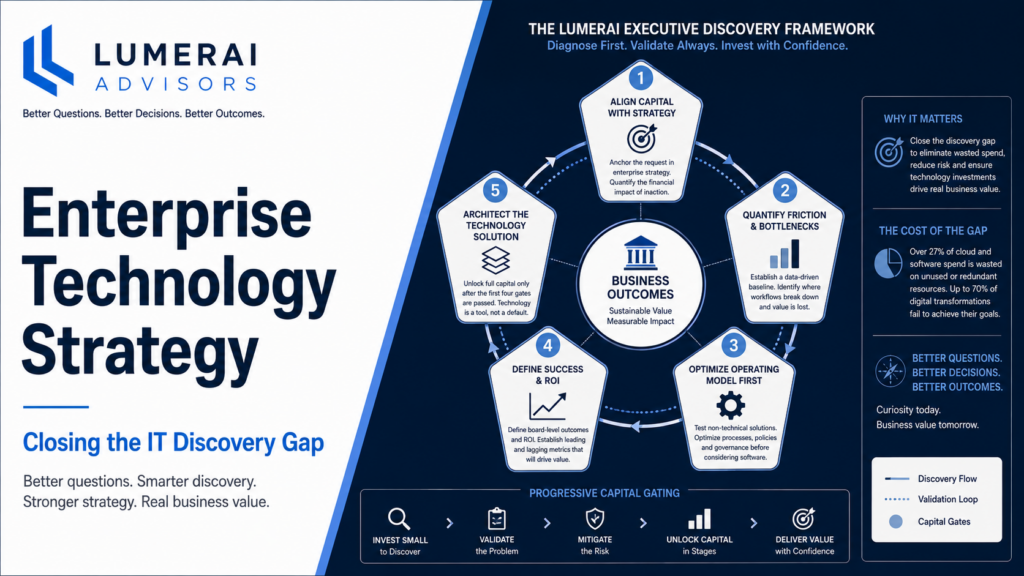
Enterprise Technology Strategy: Closing the IT Discovery Gap
Enterprise technology investments often fail long before a single line of code is written or a software vendor is selected. The structural breakdown happens silently in the transition between identifying an operational friction point and proposing a technology solution.
In my previous piece, The Missing Stage in Every Technology Investment, I outlined how organizations consistently collapse problem discovery into immediate project execution. This second article explores that failure: The Discovery Gap.
Organizations often believe technology investments fail during implementation. In reality, many fail months earlier. They fail during discovery, when assumptions are accepted as facts and proposed solutions are mistaken for business requirements. That is the Discovery Gap.
In our work advising enterprise boards and private equity operating partners, the Discovery Gap typically manifests when an organization mistakes a technology request for a strategic business need. To close this gap and protect capital allocation, enterprise leaders must transition away from passive requirements gathering toward a disciplined, data-driven discovery process.
The Capital Failure of Traditional Procurement
Traditional procurement processes were designed to compare solutions, not validate problems. They excel at evaluating vendors once an organization has already decided what it wants to buy. What they rarely challenge is whether the organization should be buying that solution at all.
A business unit submits a request for a new platform, and the IT organization immediately begins gathering requirements.
This legacy approach asks:
- What software do you want to use?
- What features do you need?
- Who needs access?
This approach turns technology teams into order-takers. It assumes the initial software requested is the correct solution to the underlying business problem. By skipping the diagnostic phase entirely, organizations spend millions automating fundamentally broken workflows. Is IT’s role to provide what is being asked for or delivering what the company needs?
The macroeconomic cost of this gap is staggering. Contemporary enterprise data from Gartner indicates that over 27% of cloud and software spend is completely wasted on unutilized or redundant resources. Furthermore, McKinsey research shows that up to 70% of digital transformations fall short of their goals due to organizational and process misalignments.
Unlike standard Business Requirements Documents (BRDs) or Agile User Stories, which merely log and format user desires, true enterprise technology strategy requires a framework that interrogates the business context before capital is deployed.
The Lumerai Executive Discovery Framework
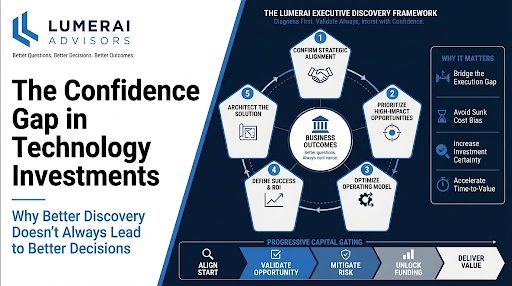
The Lumerai Executive Discovery Framework reverses the traditional procurement paradigm. It introduces a disciplined, five-stage diagnostic process designed to validate the business opportunity, map the operating model, and challenge assumptions before any software alternatives are evaluated.
Crucially, the framework introduces a financial model of Progressive Capital Gating. Rather than funding a major initiative based on unverified assumptions, organizations allocate minimal capital during initial discovery and incrementally unlock funding as risks are mitigated and the problem becomes clearer.
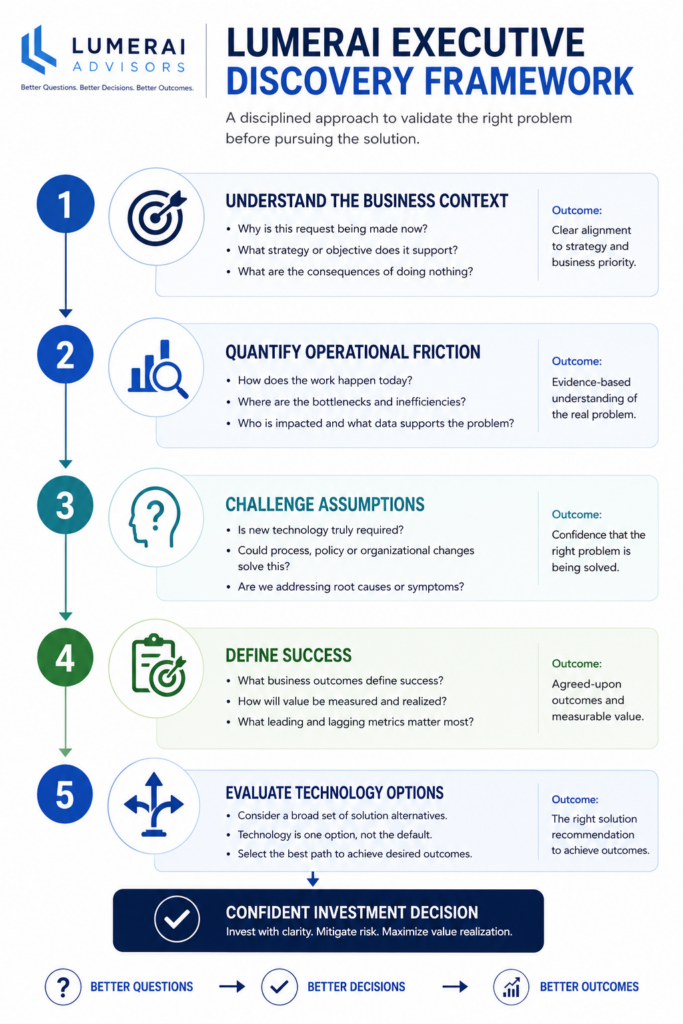
Stage 1: Aligning Capital with The Enterprise Strategy
Before discussing software, or software features, leaders must anchor the request in the overall corporate strategy. Capital allocation at this initial gate is limited strictly to validation with a small investment.
- Why is this technology request being made right now?
- What specific enterprise strategy does it enable?
- What are the quantifiable financial consequences if nothing changes?
Stage 2: Quantifying Operational Friction and Bottlenecks
Establish an objective, data-driven baseline. Investment decisions must rely on operational data rather than anecdotal sentiment from business leaders.
- How does the workflow actually happen today?
- Where are the core bottlenecks and efficiency leaks?
- Who experiences them, and what specific systems data supports the problem?
Stage 3: Optimizing the Corporate Operating Model over Software
This is the critical inflection point where the framework diverges from traditional IT procurement. Capital is seed-funded to test non-technical fixes, focusing on corporate governance, and process optimization. This stage requires a cross-functional steering committee to formally sign off on process optimization before any software evaluation.
- If we prohibited ourselves from buying new technology, how else could we solve this problem?
- Could the issue be resolved through process optimization, policy shifts, or structural change?
- Are we solving root causes or merely masking surface-level symptoms?
Stage 4: Defining Board-Level Success Metrics and ROI
Value must be quantified before vendor conversations begin. This stage establishes the precise leading and lagging metrics that will govern the final investment business case.
- What explicit business outcomes define project success?
- How will Value Realization be calculated?
- What specific metrics matter most?
Stage 5: Architecting the Technology Solution
Only after passing the first four gates is the full capital expenditure (CapEx) budget unlocked. Technology enters the conversation not as a default starting point, but as a calibrated tool.
Executive Reality: The AI Customer Service Trap
To see the Lumerai Executive Discovery Framework in practice, consider a common modern scenario: A business leader requests an advanced Generative AI solution to automate customer service.
The instinctive response from a traditional IT organization is to immediately evaluate AI platforms, compare LLM accuracy rates, and calculate software licensing costs.
A discovery-led approach asks entirely different questions:
- Why are customers contacting support in the first place?
- What types of inquiries are most common?
- Are these inquiries caused by product complexity, unclear documentation, disconnected internal systems, or inefficient processes?
If data reveals that 70 percent of customer inquiries stem from inaccurate billing statements or confusing corporate cancellation policies, implementing an AI chatbot does not solve the root issue. It simply automates customer frustration at scale.
The superior investment is to redesign the billing workflow and clarify customer communications. Once the underlying process is effective, AI can be introduced to enhance an already optimized experience.
The technology choice hasn’t changed. The definition of the problem has. And with it, the likelihood of realizing meaningful business value.
Better Decisions Begin with Better Questions
To shift your organizational culture toward a discovery-led mindset, leadership must change the vocabulary of technology procurement.
💡 The Lumerai Shift
- Instead of asking:What software should we buy?
- Ask: What business capability are we trying to improve?
- Instead of asking:Which cloud provider or infrastructure should we use?
- Ask: What business outcomes require a change in our infrastructure?
- Instead of asking:Should we implement AI in this department?
- Ask: Which specific operational decisions would benefit most from better insights or automation?
- Instead of asking:Which ERP system should we select?
- Ask: What core operational capabilities must the business achieve over the next five years to maintain a competitive advantage?
Conclusion
Organizations often believe technology investments begin with selecting vendors, issuing RFPs, or evaluating software demos. In reality, successful digital transformations begin much earlier.
They begin with curiosity.
The enterprises that consistently realize the highest ROI from their technology investments are not those with the largest budgets or the newest platforms. They are the ones willing to spend the necessary time understanding the problem before pursuing the solution. The quality of every technology investment is ultimately determined by the quality of the questions that precede it. Better decisions begin with better questions.
Technology should be the last answer we evaluate, not the first.
Executive FAQ
What is the difference between business discovery and requirements gathering?
Traditional requirements gathering accepts a technology request as a given and logs the features users want. The Lumerai Executive Discovery Framework challenges the initial request, utilizing diagnostic frameworks to find the root business problem before evaluating any software options.
Why do enterprise technology investments fail to deliver ROI?
Gartner indicates that over 27% of cloud and software spend is completely wasted on unutilized or redundant resources. Furthermore, McKinsey research shows that up to 70% of digital transformations fall short of their goals due to organizational and process misalignments. This failure occurs because organizations suffer from a “Discovery Gap,” automating broken operational processes instead of aligning technology with verified business strategies. Paving the cow path.
How does Progressive Capital Gating reduce technology investment risk?
Progressive Capital Gating allocates minimal capital to early diagnostic stages (Stages 1 and 2). Full project funding is withheld and released incrementally only after the business problem is quantified, non-technical solutions are ruled out, and success metrics are explicitly defined.
Questions Every Board Should Ask
- What business problem are we solving?
- What evidence validates that problem?
- Have non technology alternatives been considered?
- How will success be measured?
- What assumptions remain untested?