This is an expanded version of an article originally published on CIO.com. Reprinted with permission. © Foundry, Inc., 2026. All rights reserved. [https://www.cio.com/article/4168935/your-operating-model-is-the-real-legacy-system.html]
Enterprise modernization isn’t failing because technology is outdated. It’s failing because the enterprise is still operating on a legacy decision model.
For the past decade, enterprise modernization has been framed as a technology problem. Legacy systems. Technical debt. Monoliths that need to be broken apart and moved to the cloud.
Those investments matter. But they rarely address the actual constraint.
In many organizations, technology is capable of moving faster than the enterprise itself.
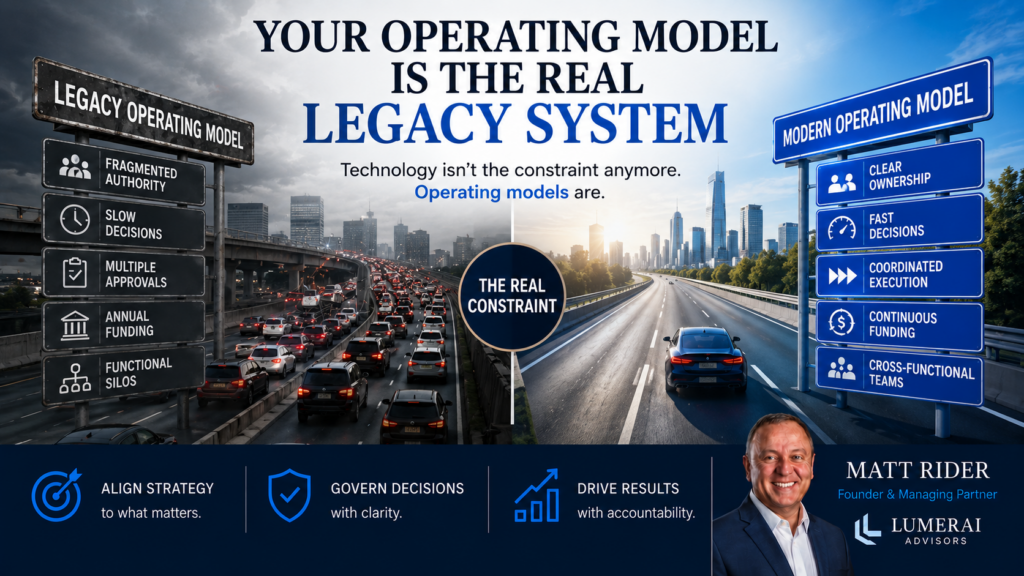
The operating model has become the real legacy system.
That framing may be convenient, but it is also incomplete. Technology has advanced dramatically. Cloud platforms, APIs, automation, AI, and modern engineering practices have given organizations unprecedented technical capability. Yet many enterprises continue to struggle to translate those investments into faster execution, better decisions, and measurable business outcomes.
The reason is increasingly clear. In most organizations, technology isn’t the constraint. The operating model is.
The Real Constraint Is Decision Latency
You can see it in how decisions do or don’t move.
A product team identifies an opportunity. It makes its way through architecture review, risk, finance, legal, compliance, and multiple layers of approval. Each step is rational on its own. Each exists for a legitimate reason. Collectively, however, they create latency. By the time a decision is made, the opportunity has changed.
It’s worth pausing on that word legitimate. Most of this friction wasn’t installed by accident. Approval layers, architecture review boards, and risk sign-offs typically exist because an earlier version of the organization got burned: a compliance failure, a botched integration, a vendor risk nobody caught in time. Governance is, in effect, institutional memory. The problem isn’t that governance exists. It’s that most organizations never revisit which decisions actually warrant that level of scrutiny and which don’t, so a $50,000 vendor renewal and a $50 million platform migration move through the same gauntlet.
This is rarely identified as the primary issue. It gets labeled as “complexity,” “organizational maturity,” or simply “the cost of operating at scale.” But the pattern is remarkably consistent. The system isn’t slow because the technology can’t move. It’s slow because the organization can’t decide, or, more precisely, hasn’t decided, which decisions deserve deliberation and which deserve delegation.
Most modernization programs focus on replacing systems of record. They invest in platforms, APIs, cloud infrastructure, developer tooling, and application modernization. The expectation is that once the technology is updated, the business will naturally become faster and more adaptive.
But the underlying decision structure remains unchanged. Funding is still annual and project-based. Authority is still fragmented across functions. Accountability is distributed in ways that make outcomes ambiguous. Risk is still evaluated in isolation rather than in the context of business intent.
The organization integrates modern technology into its traditional operating model, resulting in predictable outcomes. While teams can move quickly in isolated pockets, overall speed does not improve, and enterprise-wide decisions continue to be delayed. As a result, the organization may seem more active, but it is not necessarily more effective.
MIT’s Center for Information Systems Research (MIT CISR) has documented this fragmentation directly. Its research on componentized organizations found that as the digital economy accelerates the pace of business, companies need to redesign their people, processes, and technology to facilitate speed and identified rethinking accountability, not adding new layers of oversight, as the key lever (MIT CISR, “The Digital Operating Model: Building a Componentized Organization”).
Organizations routinely measure modernization through cloud adoption, deployment frequency, application retirement, or engineering velocity. Far fewer measure how long it takes the enterprise to recognize an opportunity, make a cross-functional decision, establish clear ownership, and execute with confidence. McKinsey’s research on this exact gap found that only 37 percent of executives believe their organizations make decisions that are both fast and good and that speed and quality are not actually a trade-off, since faster decisions tend to be higher-quality ones (McKinsey, “Decision making in the age of urgency”).
Increasingly, that decision cycle, not the technology stack itself, is becoming the true determinant of competitive advantage.
Modern Technology Cannot Fix a Legacy Operating Model
In practice, the operating model defines how work gets prioritized, how decisions are made, and how tradeoffs are resolved. It determines whether the organization can convert technology capability into business results.
When that model is misaligned, even well-executed technology initiatives underdeliver. You can see this most clearly in cross-functional decisions. A customer experience initiative spans multiple systems, business units, and risk domains. Each group operates with its own objectives, constraints, funding model, and measures of success. No single decision-maker owns the tradeoffs across the entire initiative.
As a result, decisions are escalated, deferred, or negotiated one function at a time. Nothing breaks. But very little moves with intent.
The common response is to add another steering committee, another governance checkpoint, or another approval layer. Those changes may improve oversight, but they seldom improve throughput. The organization becomes more controlled without becoming more responsive. That’s not an argument against governance; it’s an argument for designed governance, calibrated to the actual risk and reversibility of each decision, rather than governance that grows by accretion every time something goes wrong.
What it looks like when this actually gets fixed
Allstate’s Claims division offers a concrete example of a company redesigning the decision layer rather than the technology layer. In 2021, Claims set out to simplify operations and deliver more frictionless digital experiences to customers. Rather than starting with a new platform, the organization redesigned decision rights: operational authority was pushed down to durable, cross-functional teams built around strategic objectives, replacing a traditional project-based way of working rooted in prescriptive annual plans with a continuous, iterative process (MIT CISR, “Allstate’s Digital Operating Model: Think Big, Act Small”).
The technology stack Claims used wasn’t the differentiator. The decision architecture was. Teams that had previously waited on annual planning cycles and cross-functional sign-off could now resolve customer and business problems continuously because the organization had explicitly reassigned decision-making authority.
That’s the pattern worth studying, not because Allstate is unique, but because it’s replicable. The fix wasn’t a platform migration. It was a governance redesign.
Why AI Exposes the Problem Rather Than Solves It
This dynamic becomes even more visible as organizations adopt AI.
Generative AI can summarize information, identify patterns, draft content, and accelerate individual tasks. Agentic AI extends that capability further by coordinating activities across systems and executing work with limited human intervention.
Neither changes how an enterprise makes decisions. An autonomous agent can recommend an action. It cannot resolve competing business priorities. It cannot assign accountability where none exists. It cannot reconcile conflicting incentives across functions. Those decisions remain organizational, not technological.
MIT CISR’s 2025 research on enterprise IT operating models in the AI era makes the same point from the infrastructure side: an effective operating model in the AI era has to enable an enterprise’s most valuable components to innovate and scale the use of data and AI, while simultaneously managing the new risks AI introduces — cyber threats, privacy exposure, supplier dependency, and competitive disruption from AI-native entrants (MIT CISR, “Enterprise IT Operating Models in the AI Era”). The technology doesn’t manage those risks on its own. The operating model has to be built to do it.
MIT Sloan Management Review’s research, produced with Tata Consultancy Services, goes a step further and issues something closer to a warning. As AI systems move from advising decisions to actively shaping the options leaders consider, the researchers found that if leaders do not explicitly assign decision rights in these AI-enabled systems, the systems will assume them by default (MIT Sloan Management Review and TCS, “The Changing Role of AI in Decision-Making”). In other words, ambiguity in decision rights doesn’t stay neutral once AI is embedded in the workflow. Something will fill the vacuum — and it may not be a person.
As AI becomes embedded in core business processes, the quality of enterprise decisions becomes more important, not less. Organizations with clear authority, well-defined governance, and aligned incentives will see AI amplify those strengths. Organizations operating through fragmented ownership and slow decision cycles will find that AI exposes those weaknesses just as efficiently.
The technology is not determining the outcome. The operating model is.
Two Companies, Same Stack, Different Outcomes
This is the paradox many CIOs are now navigating. Technology has advanced to the point where it can support far more adaptive and responsive organizations. Infrastructure scales on demand. Development cycles have shortened. AI can automate work that only recently required human expertise.
Yet many enterprises continue to struggle with the same organizational bottlenecks they faced a decade ago.
The constraint has shifted. It is no longer found primarily in applications or infrastructure. It exists in the way decisions move through the enterprise.
That shift also explains why comparisons between companies in the same industry can be misleading. Two organizations may run similar technology stacks, rely on the same cloud providers, and invest comparable amounts in modernization. Their outcomes can be dramatically different. One consistently moves from strategy to execution. The other spends months aligning stakeholders before meaningful work begins.
The technology is often comparable. The operating model is not.
What Leaders Should Assess Next
Modernization initiatives often begin with an assessment of applications, infrastructure, and technical debt. Those are necessary exercises, but they are no longer sufficient. Executive teams should spend equal time evaluating how decisions move through the organization and equal discipline distinguishing between decisions that genuinely warrant deliberation and those that don’t.
Questions worth asking include:
- Where do enterprise decisions consistently slow down, and is that friction protecting the business or just protecting the status quo?
- Who has clear authority to make cross-functional tradeoffs?
- Does the funding model accelerate change or reinforce organizational silos?
- Is governance helping the business move with confidence, or adding friction without improving outcomes?
- Does accountability align with business results, or is ownership dispersed across multiple functions?
Technology investments can only move as quickly as the operating model that governs them.
The Next Legacy System
For years, modernization has focused on replacing aging applications and reducing technical debt. That work remains important. But the constraints facing most enterprises have changed.
Cloud platforms have matured. Modern engineering practices are no longer experimental. AI continues expanding what technology can accomplish. Yet many organizations still struggle to move with speed and consistency because their operating models were designed for a different era. It reflects assumptions about hierarchy, funding, governance, and risk that made sense when change was slower and technology evolved on multi-year cycles.
Those assumptions now shape the pace of execution more than the technology itself. Organizations can modernize every major platform in their portfolio and still find themselves waiting on the same approvals, navigating the same organizational boundaries, and resolving the same ownership questions.
The organizations that separate themselves over the next decade will not necessarily invest more in technology than their competitors. They will make better decisions faster, with clearer ownership and stronger alignment between business strategy and execution, and, as Allstate’s Claims division showed, they’ll get there by redesigning decision rights before redesigning the platform.
Modern technology deserves a modern operating model. Until enterprises redesign how authority, accountability, and decisions flow, every modernization initiative will continue to inherit the limitations of yesterday’s organization.
The real legacy system is no longer the technology. It is the operating model.
Frequently Asked Questions
What is a legacy operating model? A legacy operating model is the collection of governance processes, funding mechanisms, decision rights, and organizational structures that determine how work gets prioritized and executed. While technology may evolve rapidly, these organizational structures often remain unchanged, creating friction that limits the value of modernization efforts.
Why do modernization programs fail even after major technology investments? Many organizations modernize applications, migrate to the cloud, and adopt Agile practices without changing how enterprise decisions are made. When governance, accountability, and funding models remain unchanged, technology improvements rarely translate into better business outcomes.
What is decision latency? Decision latency is the time required for an organization to recognize an opportunity, evaluate tradeoffs, secure approvals, and act. As technology accelerates, decision latency increasingly becomes the primary constraint on enterprise performance.
Why does AI make operating model problems more visible? AI can accelerate analysis, automate workflows, and support execution, but it cannot resolve unclear authority or fragmented accountability. Research from MIT Sloan Management Review, produced with Tata Consultancy Services, found that when leaders don’t explicitly assign decision rights in AI-enabled systems, those systems assume them by default, turning an unresolved governance gap into an active design liability rather than a background risk. Organizations with effective operating models will see AI amplify their strengths, while those with legacy decision structures will find that AI exposes existing organizational weaknesses just as efficiently.
Does this mean governance and approval layers are the problem? Not inherently. Most governance exists for legitimate reasons: a past compliance failure, an integration that went wrong, a risk that wasn’t caught in time. The issue isn’t that oversight exists; it’s that oversight is rarely recalibrated once it’s in place. A routine vendor renewal and a multimillion-dollar platform migration often move through the same review process, even though they carry entirely different levels of risk. The fix is designed for governance approval and scrutiny, scaled to the actual stakes of the decision, not the removal of governance altogether.
Where should CIOs focus modernization efforts? Most modernization efforts still begin with applications and infrastructure. CIOs should continue evaluating those, but they should also examine how decisions move across the enterprise. CIOs should understand whether governance is calibrated to the risk and reversibility of each decision, and whether accountability aligns with business outcomes.
The modern CIO is no longer a technologist – they’re an architect of enterprise decisions.