Why Better Discovery Doesn’t Always Lead to Better Decisions
The Confidence Gap in Technology Investments
Technology investment decisions rarely fail because organizations lack information.
They fail because organizations often mistake more information for greater decision confidence. By the time a technology initiative reaches executive leadership, months of work have often been completed. Business cases have been drafted. Requirements have been documented. Vendors have been shortlisted. Demonstrations have been conducted. Scorecards have been completed.
Research from organizations such as Gartner and McKinsey has consistently highlighted the difficulty organizations face in translating major technology and transformation investments into expected business value.
Despite months of rigorous preparation, executive leadership is frequently left asking the exact same fundamental question:
“How do we know this is the right investment?”
That is the Confidence Gap: the distance between having enough information to make a technology decision and having enough evidence to make a confident decision about business outcomes.
In the first article of this series, I argued that organizations often solve the wrong problem because they skip structured discovery. In the second article, I introduced the Lumerai Executive Discovery Framework, a disciplined approach to validating business opportunities before evaluating technology solutions.
Discovery improves the quality of the problem definition. It does not, by itself, guarantee the quality of the investment decision. Transforming discovery into realized value requires structured executive decision governance.
When Good Analysis Produces Poor Decisions
One of the most persistent misconceptions in enterprise IT strategy is the belief that more analysis produces better decisions. It does not.
During enterprise software evaluations, organizations routinely generate an extraordinary amount of analysis and documentation:
- Feature comparison matrices expanding to hundreds of line items.
- Vendor demonstrations that often showcase ideal scenarios.
- Complex financial projection models based on unverified operational assumptions.
Ironically, this abundance of data frequently induces decision paralysis rather than strategic clarity. Executives become overwhelmed by competing departmental priorities, conflicting vendor claims, and technical minutiae.
As a result, executive discussions regress from strategic outcome validation to tactical feature grading, pricing negotiations, and deployment timelines. Technology selection becomes the primary objective, while business value realization fades into the background.
Confidence Is an Executive Asset
Enterprise technology investments are rarely approved simply because a vendor offers the longest feature list. Successful investments are approved when leadership establishes high decision confidence that the deployment will produce its intended business outcomes.
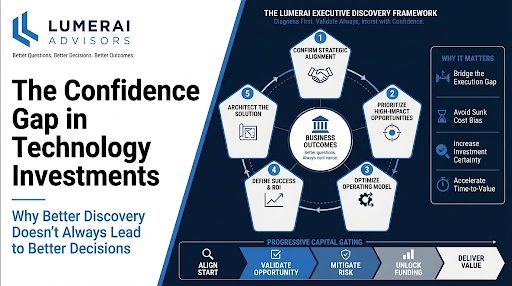
Executive decision confidence relies on validating five fundamental governance questions:
- Strategic Alignment: Does this investment directly advance our enterprise strategic priorities?
- Problem Validation: Have we verified the root business problem rather than a surface symptom?
- Objective Alternatives: Have credible non-technology or alternative architectural paths been objectively evaluated?
- Risk Quantification: Do we fully understand the operational, execution, and cybersecurity risks?
- Value Measurability: Can we explicitly define, measure, and govern success metrics post-implementation?
When these questions are answered with evidence rather than vendor assumptions, governance transitions from passive procurement to active strategic leadership.
The Lumerai Executive Decision Framework
The primary objective of the Lumerai Executive Decision Framework is not to select software. Its objective is to identify the investment decision that yields the highest confidence of achieving target business outcomes.
The framework evaluates major capital investments across six progressive decision gates:
Stage 1: Validate Strategic Alignment
Establish whether the initiative directly accelerates enterprise revenue, cost efficiency, or competitive differentiation. Initiatives lacking clear strategic alignment should not advance to subsequent investment gates, regardless of technical capability.
Stage 2: Define Decision Criteria
Before engaging vendors, leadership establishes non-negotiable success criteria driven strictly by operational imperatives. Business outcomes drive technology selection—never the reverse.
Stage 3: Evaluate Solution Architecture
Assess integration complexity, scalability, security posture, and operating model alignment. Technology is evaluated as a capability enabler within the broader ecosystem.
Stage 4: Assess Enterprise Risk
Evaluate operational, financial, vendor stability, cybersecurity, and organizational change risks collectively rather than in isolation.
Stage 5: Compare Future Scenarios
Test how candidate solutions perform across distinct future business scenarios—such as rapid scaling, M&A integration, regulatory shifts, and emerging AI capabilities.
Stage 6: Establish Decision Confidence
Final investment sign off should occur only when the evidence demonstrates that the business problem has been validated, alternatives have been objectively evaluated, risks are understood, and clear value realization metrics have been established.
Confidence does not mean certainty. No major technology investment comes with certainty. It means leadership understands the evidence, the assumptions, the risks, the alternatives, and the expected outcomes well enough to make a defensible decision.
Five Biases That Can Distort Technology Decisions
Even disciplined organizations are susceptible to cognitive bias.
Five biases appear repeatedly during enterprise technology evaluations:
- Anchoring – The first proposed solution becomes the baseline against which every alternative is compared.
- Vendor Familiarity – Established relationships often create a perception of lower risk even when better alternatives exist.
- Confirmation – Evaluation teams unconsciously seek evidence supporting their preferred solution while discounting contradictory information.
- Sunk Cost – Organizations continue investing in existing platforms simply because previous investments were significant.
- Demonstration – Visually impressive product demonstrations are mistaken for long term business value.
Recognizing these biases does not eliminate them. The objective of governance is to make them visible, challenge their influence, and ensure that major investment decisions are ultimately supported by evidence rather than assumption.
Executive Example
Consider an enterprise modernizing its service architecture following a structured discovery phase. Three finalists remain:
Vendor A: May create the greatest long term capability, but introduces significant organizational and implementation risk.
Vendor B: May offer the strongest operational fit, but requires a higher initial investment.
Vendor C: May produce the strongest financial case today, but could constrain future growth through customization requirements.
All three can satisfy the requirements. The decision therefore cannot be resolved by requirements compliance alone.
Which investment gives us the greatest confidence that we will achieve the business outcomes we defined?
Under the Lumerai Executive Decision Framework, the decision shifts from “Which platform scores highest?” to “Which capital allocation provides the highest decision confidence for our strategic outcomes?” By evaluating each vendor against future operating scenarios and risk tolerances, leadership converts an ambiguous software comparison into a confident strategic decision.
Better Decisions Require Better Governance
Technology investments should never be authorized simply because a platform tops a feature matrix.
They should be authorized because executive leadership has evidence based confidence that the investment aligns with strategic objectives, addresses a validated business problem, appropriately manages enterprise risk, and establishes a credible path to measurable economic value.
True decision confidence is not executive intuition. It is the outcome of disciplined decision architecture.
Conclusion
Technology investment decisions are often portrayed as exercises in software selection.
In reality, they are exercises in executive judgment regarding business outcomes.
Organizations that consistently outperform their peers are not necessarily better at evaluating technology. They are better at making decisions.
They understand that every technology investment is ultimately a business decision supported by technology, not the other way around.
Discovery identifies the right problem.
Decision making determines the right investment.
Execution delivers the solution.
Value realization measures success.
Confidence is the connective tissue between them.
Only when all four are connected does technology become a strategic advantage.
Organizations do not invest in technology for its own sake. They invest capital to create better business outcomes with confidence.
Better discovery helps organizations understand the problem. Better decision architecture helps leadership determine whether the investment is worth making.