
Cloud Repatriation: Why Companies Are Moving Workloads Back from the Cloud

From Cloud-First to Cloud-Smart For more than a decade, enterprise technology strategy was dominated by a simple directive: move to the cloud. Today, many organizations are discovering that cloud adoption and cloud optimization are not the same thing. As a result, a growing number are reevaluating where workloads should reside, leading to a trend commonly called cloud repatriation or cloud exit. Here are some of the most-cited recent statistics: That does not mean companies are abandoning the cloud entirely. Most are moving toward hybrid architectures, keeping some workloads in public cloud while bringing others back to private infrastructure or colocation facilities. Executive Takeaways Why are cloud migration rollbacks happening? Cost Overruns Many organizations discovered that: Several surveys cite cost optimization as the #1 driver. Well-known examples: In our experience, organizations often underestimate cloud operating costs because they evaluate migration costs but fail to model long term consumption patterns, storage growth, and data egress charges. Data Sovereignty and Compliance Regulated industries increasingly want tighter control over: This is particularly strong in Europe, finance, healthcare, and government sectors. Security and Operational Control Some organizations feel they lost visibility or governance in highly distributed cloud environments. Vendor Lock-in Concerns Companies worry about dependence on a single hyperscaler, with proprietary services, and the potential of escalating pricing. Hybrid and multicloud strategies are often attempts to reduce this dependency. Despite this, cloud spending is still growing. Public cloud spending continues to rise, SaaS adoption remains extremely high, and most enterprises are becoming “cloud-smart,” not anti-cloud. The current enterprise pattern is usually: In other words, the market has shifted from “move everything to the cloud”, to “place each workload where it economically and operationally fits best.” Cloud adoption for many workloads is still the right answer, but companies need to conduct detailed diligence on what gets moved and more importantly, how the variable spend model gets managed. At Lumerai Advisors, we use the Lumerai Cloud Placement Framework to help executives evaluate hybrid architecture and workload placement decisions. For private equity-backed organizations, workload placement decisions increasingly affect EBITDA performance, making cloud economics a business strategy issue rather than simply a technology decision. The Lumerai Cloud Placement Framework When evaluating cloud placement decisions, we assess workloads across four dimensions: Dimension Key Question Cost Predictability Can workload consumption be forecast accurately enough to benefit from cloud economics? Performance Requirements Does latency, throughput, or workload intensity justify dedicated infrastructure? Data Sensitivity Do regulatory, security, or data sovereignty requirements necessitate greater control? Business Agility Does the workload require speed, scalability, and flexibility to support growth and innovation? The goal is not to determine whether cloud is good or bad, but to determine which environment delivers the best economic and operational outcome for each workload. Cloud repatriation should not be viewed as a reversal of cloud strategy, but as the natural maturation of enterprise workload placement decisions. The future is not cloud-first or cloud-exit. The future is cloud-smart. The organizations that create the most value will be those that place every workload in the environment that delivers the best combination of performance, economics, security, and agility. Sources and References
The Machine That Changed Everything and What We Can Learn From It
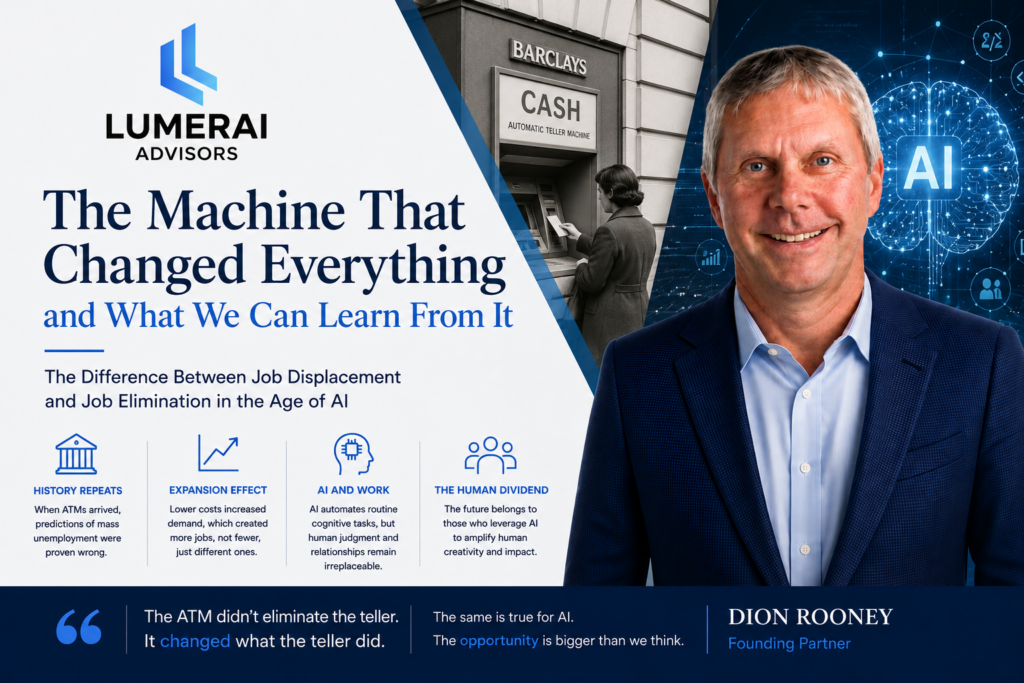
The Difference Between Job Displacement and Job Elimination As artificial intelligence reshapes the modern workplace, leaders should remember an important lesson from technology history: automation often changes jobs more than it eliminates them. Executive Takeaways A Machine Arrives It was 1967, and a London bank called Barclays quietly installed a strange new device in its Enfield branch. Customers could insert a coded paper voucher, and the machine would dispense cash no teller required. The Automated Teller Machine had arrived. The reaction was predictable: The story was persuasive and easy to grasp, yet as time would reveal entirely wrong. The Numbers Tell a Different Story Between 1970 and 2010, the number of ATMs in the United States grew from essentially zero to well over 400,000. Over that same period, the number of bank tellers in America did not shrink. It grew from approximately 300,000 to over 550,000. How is that possible? The answer lies in a dynamic that technology critics routinely underestimate. When automation reduces the cost of a service, demand for that service expands, and that expanded demand requires more human labor. ATMs made it dramatically cheaper for banks to operate a branch. With lower overhead costs, banks opened more branches in more locations — particularly in smaller communities and suburbs that had never had convenient banking access before. Each branch still needed human staff. Not just tellers, but loan officers, financial advisors, relationship managers, and customer service representatives handling the complex transactions that machines couldn’t resolve. The ATM didn’t eliminate the teller. It changed what the teller did. “The ATM didn’t eliminate the teller. It changed what the teller did freeing humans to focus on judgment, relationships, and complexity.” Displacement vs. Elimination This is not to say automation is painless, individual tellers who lost their jobs to ATMs faced real hardship. Communities where bank branches consolidated experienced genuine disruption. The macro outcome, more jobs overall, offered little comfort to the person who lost a specific job in a specific town in a specific year. But the ATM story illustrates a distinction that is critical to understanding technological change, the difference between displacement and elimination. Jobs are displaced constantly by technology. Roles shift, skills become obsolete, industries restructure. What history consistently shows is that elimination the permanent net reduction in human employment is far rarer than the headlines suggest. The pattern repeats across sectors: Enter Artificial Intelligence Which brings us to the present moment. Artificial intelligence, particularly the large language models and generative tools that have captured global attention since 2022 is being greeted with the same mix of wonder and dread that met the ATM in 1967. The scale, however, feels different. While the ATM automated a narrow physical task (dispensing cash), AI can automate cognition itself: writing, analysis, coding, legal reasoning, medical diagnosis, creative work. If machines can think, the concern goes, what is left for humans to do? It is a serious question that deserves a serious answer and the ATM offers the beginning of one. What AI is demonstrably doing right now is automating the routine, predictable, high-volume cognitive tasks. These are the intellectual equivalents of dispensing cash. “What AI automates today are the routine cognitive tasks the intellectual equivalent of dispensing cash. What remains is judgment, creativity, and human connection.” What it is not doing, at least not yet, is replacing the judgment-intensive, relationship-dependent, contextually complex work that defines the most valuable human contributions in virtually every field. The Lumerai Expansion Effect Step Outcome Automation reduces cost Services become more affordable Lower cost increases demand More customers can access the service Increased demand expands human work New roles and opportunities emerge Human work shifts upward People focus on judgment, relationships, and complexity The ATM lesson also points to something AI optimists cite but skeptics tend to dismiss, the expansion effect. When a capability becomes cheaper and more accessible, demand for it and for everything adjacent to it tends to grow dramatically. Legal advice has historically been expensive enough that most individuals and small businesses simply go without it. If AI makes quality legal guidance affordable at scale, the number of people seeking legal counsel may multiply many times over. Lawyers may find their practices transformed, but the total demand for legal expertise could increase substantially rather than contract. The same logic applies to medicine, financial planning, software development, education, and virtually any knowledge-intensive field. AI acts as a force multiplier, enabling practitioners to serve more clients, take on more complex cases, and focus their energy where human insight genuinely differentiates outcomes. For executives, the implication is clear. The primary question is not which jobs AI will eliminate. It is how AI will reshape the economics of work within your industry. Organizations that focus solely on headcount reduction may capture short term savings. Organizations that redesign work around AI may create entirely new sources of growth. Warning Signs You’re Viewing AI Through the Wrong Lens Your AI business case is built entirely on labor reduction. You measure AI success only through cost savings. Workforce planning discussions focus on positions rather than capabilities. No one has defined how roles will evolve after AI deployment. Training budgets decrease while AI spending increases. What History Doesn’t Guarantee History is instructive, but it isn’t deterministic. There are meaningful differences between the ATM era and the AI era that warrant genuine concern. The Human Dividend The ATM story offers valuable insight into what AI displacement might look like. The bank teller who survived the ATM era was not the one who competed with the machine at its own game. It was the one who leaned into what machines could not replicate, customer service, trust, judgment, and the capacity to understand a customer’s full financial picture and respond with genuine, personalized guidance. The workers who will thrive in an AI-integrated economy are likely those who make a similar pivot. Not competing with AI on speed or information retrieval, but leveraging AI as a tool to free up time and cognitive bandwidth