
The Architecture of Authority: Why AI Is Reshaping Enterprise Leadership

For decades, the enterprise power dynamic was absolute and unchallenged: systems provided the data, and humans provided the judgment. Organizations termed themselves “data-driven” if an executive glanced at a dashboard before making a call, but the dashboard was a passive participant. It never actually changed who held the steering wheel or who was accountable when things went wrong. Technology was a silent partner—a repository of record that executed instructions only after the human “go” signal was given. That boundary has not just blurred; it is being erased. We are moving from an era of “Systems of Record” to an era of “Systems of Action,” and most organizations are fundamentally unprepared for the shift in authority that follows. The challenge isn’t the technology itself; it’s that we are attempting to run 21st-century intelligence on top of 20th-century governance. The End of the Dashboard Era The newest generation of AI has moved beyond recommending a course of action to initiate it. This is the critical pivot point where “support” becomes “participation”. In many modern enterprise stacks, the machine is already making high-stakes calls in milliseconds—isolating network devices, blocking multi-million-dollar transactions, or rerouting global shipments—often before a human analyst even sees an alert. When a system functions at this speed, the traditional “human-in-the-loop” model becomes a bottleneck or, in some cases, a myth. At this point, the system is no longer informing a decision; it is determining the outcome. This creates an immediate crisis for traditional governance. Most corporate frameworks are built on a 1990s-era assumption: that humans make judgments and systems implement them. When the system itself begins to determine what happens next, the separation between decision-making and execution—the very foundation of corporate oversight—becomes impossible to maintain. The Conflict of Logic vs. Intuition The most overlooked risk in AI implementation isn’t a technical failure—it’s the moment of disagreement. What happens when a machine’s data-driven recommendation contradicts a veteran manager’s years of intuition? In a traditional hierarchy, the senior leader wins by default. But in an AI-integrated environment, that “win” might come at the cost of operational speed or accuracy. Conversely, if the machine wins, who owns the liability? In regulated industries, these aren’t just philosophical debates; they carry significant legal and operational consequences. A system that blocks a transaction or flags a customer is taking an action that has traditionally required a signature and a clear chain of custody. If we haven’t designed the “Decision Architecture” to handle these conflicts, we aren’t innovating; we are simply creating a new type of organizational chaos. Decision Architecture: The Invisible Layer As decisions begin to emerge from within the technology itself, the structure of decision-making becomes an architectural question, not just a management one. This is the concept of Decision Architecture: the intentional design of how authority flows between people and software. Historically, authority evolved through hierarchy: information flowed up, and decisions moved back down through operational silos. Core platforms, like ERP systems, were built specifically to reinforce this “step-by-step” approval logic. These designs work perfectly when systems are executing predictable transactions. But they fail when an intelligent layer begins to evaluate context and trigger responses across those same processes. The friction we are seeing today isn’t a technical glitch; it is an organizational collision. Decisions are bypassing the management chain entirely and emerging from the “intelligence layer” of the stack. Without dedicated architecture to govern this flow, the CIO is no longer managing a technical stack—they are managing a fragmented, automated bureaucracy. The Danger of Accidental Authority Perhaps the greatest risk to the modern enterprise is “Accidental Authority.” This happens when AI capabilities are developed in isolated silos—one team building a fraud model, another implementing automated customer service, and a third deploying AI-driven cybersecurity. Each of these teams is essentially handing over “micro-slices” of corporate authority to different algorithms, often without a central registry of what decisions have been automated. Without coordinated architecture, you wake up to a fragmented environment where your systems have inconsistent levels of authority, lack oversight, and offer no clear way to override them when they go off the rails. We must stop building AI as a series of features and start building it as a unified decision-making ecosystem. The Practitioner’s Mandate: Designing for Authority For the modern CIO, the challenge is no longer the deployment of AI; it is the management of authority. The most dangerous path is allowing this authority to emerge accidentally, hidden within isolated teams or embedded deep inside individual platforms. To lead this transition, technology leaders must move toward three strategic imperatives: From Tool to Participant The organizations that survive this shift will be the ones that stop viewing AI as just another tool in the shed and start viewing it as an active participant in the business. The role of the leader is no longer to “sign off” on the data, but to architect the logic that governs the machine’s behavior. Success in the AI era won’t belong to the companies with the fastest algorithms or the biggest data lakes. It will belong to the leaders who treat decision-making as something that must be intentionally designed, rather than something that happens by accident as a byproduct of new technology. Frequently Asked Questions How is AI changing corporate hierarchy? Artificial intelligence is reducing the need for organizations to rely solely on traditional management layers to coordinate work and distribute information. As AI systems become capable of analyzing data, recommending actions, and executing routine decisions, authority increasingly shifts from information control to judgment, governance, and accountability. Organizations will need to redesign leadership structures to ensure humans remain responsible for strategic direction and oversight. What is the Architecture of Authority? The Architecture of Authority is the framework that defines how decisions are made, delegated, governed, and monitored within an organization. In the age of AI, it extends beyond traditional reporting structures to include intelligent systems that participate in decision-making. A well-designed Architecture of Authority ensures AI augments human judgment without weakening accountability or governance. Will AI
The question isn’t whether your organization will be transformed by AI. That ship has sailed.
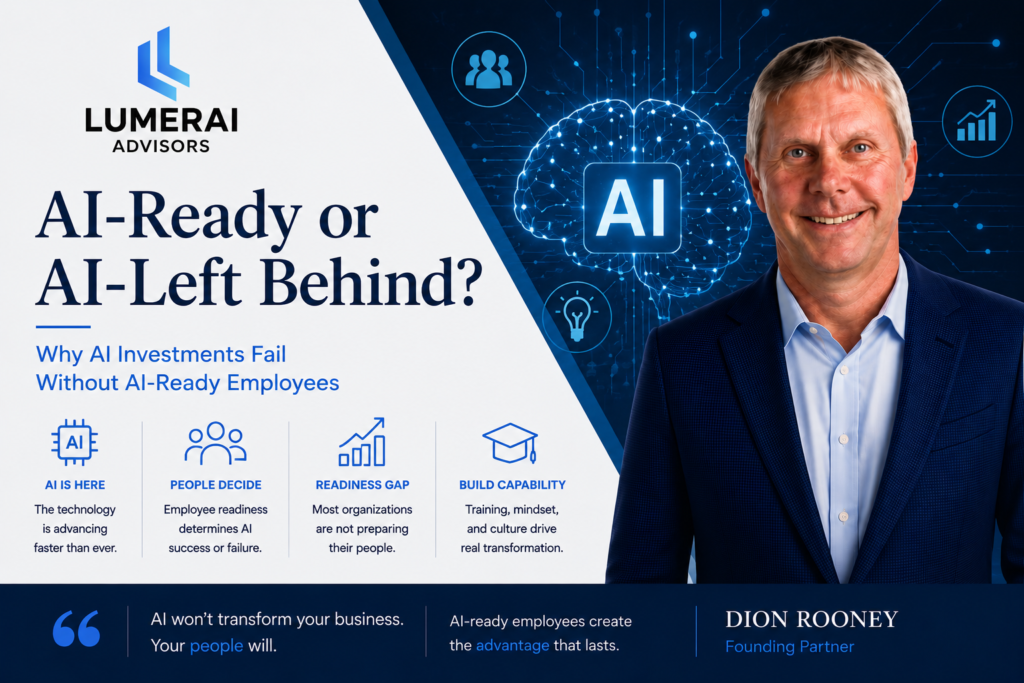
The question is whether your workforce will become a competitive advantage in an AI-powered economy or whether AI will simply expose capability gaps that already exist. Your AI strategy is only as strong as the people expected to execute it. Most organizations are measuring the wrong thing. They track AI licenses, adoption, training completion rates, and prompt engineering workshops. Yet despite billions of dollars invested in AI, only a small percentage of organizations are realizing meaningful business value. The reason is simple. AI transformation is not primarily a technology problem. It is a workforce capability problem. The question leaders should be asking is not whether employees can use AI. It is whether they can make better decisions because of it. Do your people actually know how to work in an AI-powered world? Not “have they attended a webinar” or “did we roll out Copilot.” I mean: do they fundamentally understand how to think alongside AI, direct it, interrogate its outputs, and apply judgment where the machine falls short? That’s a very different bar — and most organizations have no honest answer. Executive Takeaways The Numbers Are Damning The data is in, and it’s unambiguous. According to IDC, 94% of CEOs and CHROs identify AI as their top in-demand skill for 2025, yet only 35% of leaders feel they’ve actually prepared their employees for AI-driven roles. Meanwhile, a 2026 DataCamp/YouGov survey of 500+ enterprise leaders found that 59% admit their organization has an AI skills gap, even though most are already spending on AI tools. Think about that: majority investment, minority readiness. PwC’s 2025 AI Jobs Barometer adds another dimension: AI-exposed roles are evolving 66% faster than other positions and command a 56% wage premium. That means the gap isn’t just an operational inconvenience — it’s a competitive liability that compounds every quarter you don’t address it. We’ve Been Asking the Wrong Question Most workforce AI assessments are built around the wrong mental model. They ask: “Can this person use the AI tool?” That’s like evaluating a surgeon by whether they can hold a scalpel. The right question is: “Can this person make better decisions because of AI?” Working effectively in an AI world requires a fundamentally different skill architecture than what most job descriptions, competency models, and performance reviews are built to measure. It’s not about prompt engineering. It’s about something deeper. The World Economic Forum’s Future of Jobs Report puts it plainly: employers anticipate that 40% of core skills will change by 2030. Not augmented — changed. That’s not a training program. That’s a reinvention of what “qualified” means. What “AI-Ready” Actually Looks Like After 35 years leading technology transformation across global retailers, manufacturers, and PE-backed companies, I’ve seen many skill paradigm shifts. This one is different in a critical way, it cuts across every function, every level, and every geography simultaneously. True AI readiness requires capabilities across three dimensions, yet most organizations focus exclusively on the first. The Lumerai AI Readiness Model Level 1: Tool Fluency Can employees effectively use AI tools? Level 2: Critical Reasoning Can they challenge and validate AI outputs? Level 3: Human Edge Can they apply uniquely human judgment, creativity, and leadership? BCG research found that companies successfully addressing AI talent shortfalls achieve 2.3x faster AI adoption and 67% higher AI ROI. The skill assessment isn’t a HR box to check, it’s a value creation lever. Warning Signs Your Workforce Isn’t AI Ready Why Most Assessments Miss the Mark Here’s the uncomfortable truth, most organizations are confusing activity with capability. Deploying Copilot is not an AI strategy. Sending people to a LinkedIn Learning course is not workforce transformation. And asking employees to self-report AI comfort level is not an assessment. The DataCamp report reveals the paradox in stark terms, most enterprises are offering some form of AI training, yet only 35% have a mature, workforce-wide upskilling program. The organizations with that mature program are nearly twice as likely to report significant AI ROI. The rest are spending money and just making noise. Effective assessment requires measuring against a defined target, not a generic “AI skills” list, but a role-specific, business-context-specific model of what AI-assisted performance actually looks like in your environment. A Framework Worth Building If you’re serious about knowing where your workforce stands, here’s where to start: Map your role exposure: Not every role is equally disrupted or equally enabled by AI. Start with a realistic heat map of AI exposure across your organization — which roles are most automatable, which are most augmentable, and which create the highest risk if AI is used without adequate oversight. Define role-specific AI competency profiles: A CFO who needs to interrogate AI-generated financial models requires a different skill profile than an operations manager using AI for demand forecasting. Generic frameworks produce generic results. Assess with scenarios, not surveys: Self-assessment is unreliable for novel skill domains. Scenario-based evaluations present a realistic AI-assisted decision situation worth observing. Close the loop with your technology roadmap: Your AI skills strategy needs to anticipate where your tools are heading, not just where they are today. Agentic AI is arriving faster than most teams realize. If your workforce isn’t prepared to work alongside autonomous AI agents, you’ll be wasting time and money rebuilding capability. The Leaders Who Act Now Will Define the Gap McKinsey estimates that 88% of organizations now use AI in at least one business function. Only 1% have achieved true AI maturity. The distance between those two numbers is, in large part, a human capability problem. The CEOs and CIOs who understand that AI tools without AI-ready people produce expensive mediocrity will act differently in 2026. They’ll treat workforce AI assessment not as a one-time initiative, but as an ongoing strategic process as embedded in their operating rhythm as financial reviews and technology audits. The question isn’t whether your organization will be transformed by AI. That ship has sailed. The question is whether your workforce will become a competitive advantage in an AI-powered economy or whether AI will
AI Is Turning Technical Debt Into Strategic Debt
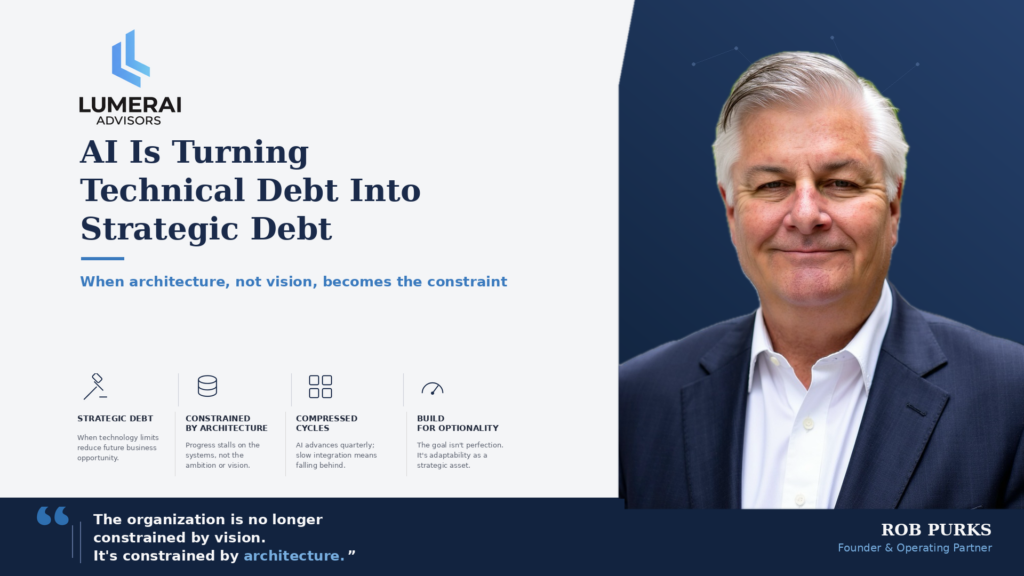
For years companies have accumulated Technical Debt. With the introduction of AI, Technical Debt is impeding your strategy to leverage the benefits of AI – this creates Strategic Debt.
Cloud Repatriation: Why Companies Are Moving Workloads Back from the Cloud
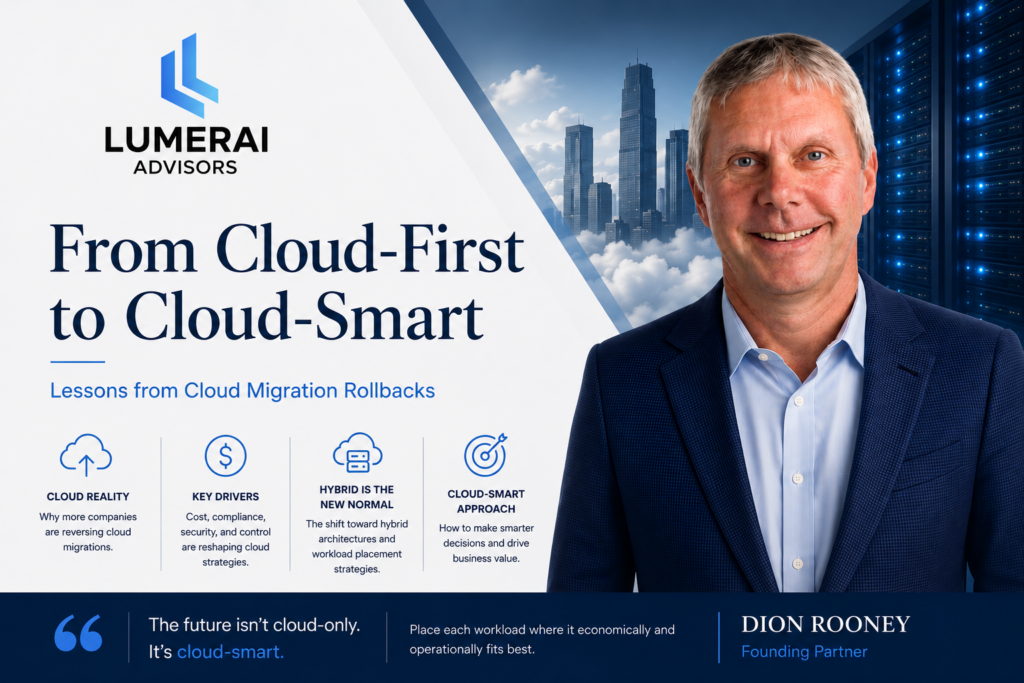
From Cloud-First to Cloud-Smart For more than a decade, enterprise technology strategy was dominated by a simple directive: move to the cloud. Today, many organizations are discovering that cloud adoption and cloud optimization are not the same thing. As a result, a growing number are reevaluating where workloads should reside, leading to a trend commonly called cloud repatriation or cloud exit. Here are some of the most-cited recent statistics: That does not mean companies are abandoning the cloud entirely. Most are moving toward hybrid architectures, keeping some workloads in public cloud while bringing others back to private infrastructure or colocation facilities. Executive Takeaways Why are cloud migration rollbacks happening? Cost Overruns Many organizations discovered that: Several surveys cite cost optimization as the #1 driver. Well-known examples: In our experience, organizations often underestimate cloud operating costs because they evaluate migration costs but fail to model long term consumption patterns, storage growth, and data egress charges. Data Sovereignty and Compliance Regulated industries increasingly want tighter control over: This is particularly strong in Europe, finance, healthcare, and government sectors. Security and Operational Control Some organizations feel they lost visibility or governance in highly distributed cloud environments. Vendor Lock-in Concerns Companies worry about dependence on a single hyperscaler, with proprietary services, and the potential of escalating pricing. Hybrid and multicloud strategies are often attempts to reduce this dependency. Despite this, cloud spending is still growing. Public cloud spending continues to rise, SaaS adoption remains extremely high, and most enterprises are becoming “cloud-smart,” not anti-cloud. The current enterprise pattern is usually: In other words, the market has shifted from “move everything to the cloud”, to “place each workload where it economically and operationally fits best.” Cloud adoption for many workloads is still the right answer, but companies need to conduct detailed diligence on what gets moved and more importantly, how the variable spend model gets managed. At Lumerai Advisors, we use the Lumerai Cloud Placement Framework to help executives evaluate hybrid architecture and workload placement decisions. For private equity-backed organizations, workload placement decisions increasingly affect EBITDA performance, making cloud economics a business strategy issue rather than simply a technology decision. The Lumerai Cloud Placement Framework When evaluating cloud placement decisions, we assess workloads across four dimensions: Dimension Key Question Cost Predictability Can workload consumption be forecast accurately enough to benefit from cloud economics? Performance Requirements Does latency, throughput, or workload intensity justify dedicated infrastructure? Data Sensitivity Do regulatory, security, or data sovereignty requirements necessitate greater control? Business Agility Does the workload require speed, scalability, and flexibility to support growth and innovation? The goal is not to determine whether cloud is good or bad, but to determine which environment delivers the best economic and operational outcome for each workload. Cloud repatriation should not be viewed as a reversal of cloud strategy, but as the natural maturation of enterprise workload placement decisions. The future is not cloud-first or cloud-exit. The future is cloud-smart. The organizations that create the most value will be those that place every workload in the environment that delivers the best combination of performance, economics, security, and agility. Sources and References
The Tech Leaders First 100 Days
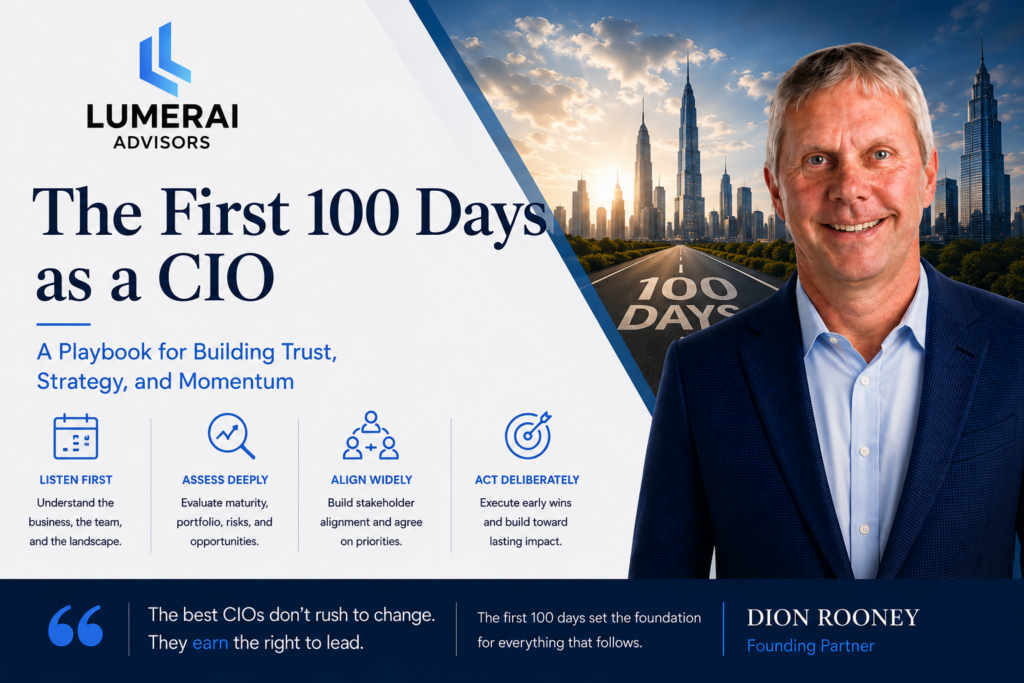
The first 100 days of a new IT leadership role are a critical window. This playbook breaks down how to assess your team, identify the right opportunities, review the portfolio, and build a strategy that earns trust and sets the stage for lasting impact. You have been handed the keys. New title, new organization, new expectations, and a clock already running. Whether you are stepping into a CIO role for the first time or taking the helm of a technology function at a company you are still learning, the first 100 days are crucial. Those first 100 days are all about learning what the organization needs most, and positioning yourself and your team to deliver it. This is not a sprint, it is a structured reconnaissance. The leaders who move fastest in their first months are often the ones who stumble hardest by month six. The ones who invest early in listening, assessing, and aligning, deliberately and without ego, are the ones who build the foundation for durable change. The first 100 days are not about what you know. They are about learning what the organization most needs, and earning the right to change it. Executive Takeaways The Lumerai CIO First 100 Days Framework Phase Focus Objective Days 1-30 Listen & Learn Understand the organization before making changes Days 31-60 Assess & Prioritize Evaluate team, portfolio, and opportunities Days 61-90 Align & Act Build stakeholder alignment and begin execution Days 91-100 Commit & Communicate Finalize roadmap and establish accountability The most successful CIOs resist the urge to prove themselves immediately. Instead, they follow a structured progression from understanding to assessment, alignment, and execution. Section 1: Assessing Team Maturity Your team is your first and most important operating context. The tech team’s maturity is critical and that team must provide near flawless execution before you have earned the right to drive the organization where it needs to go. Now is the time to engage them and fairly assess the current maturity and the path to improve. You need an honest picture of where it actually stands, not where it thinks it stands, and not where your predecessor reported it to be. The Lumerai Team Maturity Model Team maturity is not simply a question of technical skill. It encompasses four overlapping dimensions: A technically brilliant team that cannot align to business priorities is just as limiting as a business-savvy team that cannot execute. The most capable IT organizations are both. Team maturity is a stronger predictor of transformation success than technical capability alone. How to Conduct the Assessment Resist the temptation to deploy a formal survey. The data gathered through direct conversation in the first 30 days is richer and more revealing than any survey. Structure your early 1:1s around a consistent set of open questions: Suggested Questions for Early 1:1s: Listen for patterns across these conversations. Recurring themes about process gaps, leadership behaviors, budget constraints, or talent deficits are more diagnostic than any individual answer. Maturity Levels: A Practical Framework Once you have completed your listening tour, work with your direct reports to score the organization across the maturity levels. The goal is not to render a verdict, it is to create a shared baseline that informs your strategy. Your first 100 days should give you enough data to know where you are and your first year’s strategy should have a clear line of sight to where you are going. Section 2: Identifying Strategic Needs and Opportunities Every new leader’s arrival creates an inflection point where people are more open to change. Your job in the first 100 days is to identify the best opportunities before the window closes and the organization settles back into its existing patterns. Quick Wins versus Long-Term Plays Not all opportunities are created equal. One of the most common mistakes new IT leaders make is chasing a large, visible transformation initiative in their first months before they have earned the trust or gathered the context to sustain it. A far more durable approach is to sequence deliberately: Where to Look for Opportunities The highest-value opportunities tend to cluster in a small number of recurring patterns: The highest-leverage opportunities are rarely technical. They are cultural, the invisible friction that slows decisions, creates rework, and keeps good people from doing their best work. Section 3: Navigating Your Own Assimilation The most overlooked dimension of a new leader’s first 100 days is internal. How you show up, how quickly you build trust, and how effectively you read the political and cultural landscape of your new organization will determine how much of your actual agenda you get to execute. The Assimilation Traps Experienced leaders fall into predictable patterns when they are new. Recognizing them in advance is the first step to avoiding them: The Four Assimilation Traps to Avoid: With your new team, a facilitated new leadership assimilation exercise can dramatically speed up the “getting to know each other” process. Warning Signs Your First 100 Days Are Going Off Track Building Trust Across Stakeholder Groups Your stakeholder map in the first 100 days should include at least four distinct constituencies, each with different needs, different definitions of success, and different levels of trust to build: The Working and Listening Tour In your first 30 days, conduct a structured listening tour across the organization. This is not a performance review of the IT function, it is your chance to understand the business through the eyes of the people it serves. Walk the walk and learn how the business operates and how technology either supports or hinders those processes. Work in a plant, warehouse, store of function to learn the end to end of the business. What you will learn will shape every strategic decision you make in the coming months. Section 4: Conducting a budget and ecosystem review A portfolio review is one of the most important and most frequently skipped activities in a new leader’s first 100 days. It is the process of systematically inventorying and evaluating every active
The Machine That Changed Everything and What We Can Learn From It
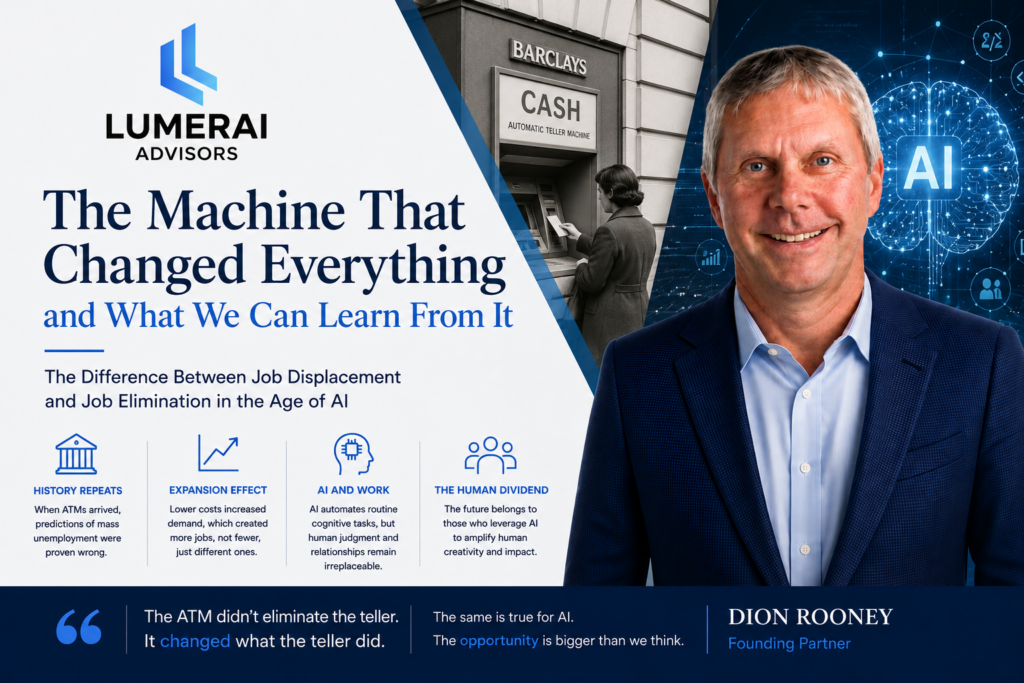
The Difference Between Job Displacement and Job Elimination As artificial intelligence reshapes the modern workplace, leaders should remember an important lesson from technology history: automation often changes jobs more than it eliminates them. Executive Takeaways A Machine Arrives It was 1967, and a London bank called Barclays quietly installed a strange new device in its Enfield branch. Customers could insert a coded paper voucher, and the machine would dispense cash no teller required. The Automated Teller Machine had arrived. The reaction was predictable: The story was persuasive and easy to grasp, yet as time would reveal entirely wrong. The Numbers Tell a Different Story Between 1970 and 2010, the number of ATMs in the United States grew from essentially zero to well over 400,000. Over that same period, the number of bank tellers in America did not shrink. It grew from approximately 300,000 to over 550,000. How is that possible? The answer lies in a dynamic that technology critics routinely underestimate. When automation reduces the cost of a service, demand for that service expands, and that expanded demand requires more human labor. ATMs made it dramatically cheaper for banks to operate a branch. With lower overhead costs, banks opened more branches in more locations — particularly in smaller communities and suburbs that had never had convenient banking access before. Each branch still needed human staff. Not just tellers, but loan officers, financial advisors, relationship managers, and customer service representatives handling the complex transactions that machines couldn’t resolve. The ATM didn’t eliminate the teller. It changed what the teller did. “The ATM didn’t eliminate the teller. It changed what the teller did freeing humans to focus on judgment, relationships, and complexity.” Displacement vs. Elimination This is not to say automation is painless, individual tellers who lost their jobs to ATMs faced real hardship. Communities where bank branches consolidated experienced genuine disruption. The macro outcome, more jobs overall, offered little comfort to the person who lost a specific job in a specific town in a specific year. But the ATM story illustrates a distinction that is critical to understanding technological change, the difference between displacement and elimination. Jobs are displaced constantly by technology. Roles shift, skills become obsolete, industries restructure. What history consistently shows is that elimination the permanent net reduction in human employment is far rarer than the headlines suggest. The pattern repeats across sectors: Enter Artificial Intelligence Which brings us to the present moment. Artificial intelligence, particularly the large language models and generative tools that have captured global attention since 2022 is being greeted with the same mix of wonder and dread that met the ATM in 1967. The scale, however, feels different. While the ATM automated a narrow physical task (dispensing cash), AI can automate cognition itself: writing, analysis, coding, legal reasoning, medical diagnosis, creative work. If machines can think, the concern goes, what is left for humans to do? It is a serious question that deserves a serious answer and the ATM offers the beginning of one. What AI is demonstrably doing right now is automating the routine, predictable, high-volume cognitive tasks. These are the intellectual equivalents of dispensing cash. “What AI automates today are the routine cognitive tasks the intellectual equivalent of dispensing cash. What remains is judgment, creativity, and human connection.” What it is not doing, at least not yet, is replacing the judgment-intensive, relationship-dependent, contextually complex work that defines the most valuable human contributions in virtually every field. The Lumerai Expansion Effect Step Outcome Automation reduces cost Services become more affordable Lower cost increases demand More customers can access the service Increased demand expands human work New roles and opportunities emerge Human work shifts upward People focus on judgment, relationships, and complexity The ATM lesson also points to something AI optimists cite but skeptics tend to dismiss, the expansion effect. When a capability becomes cheaper and more accessible, demand for it and for everything adjacent to it tends to grow dramatically. Legal advice has historically been expensive enough that most individuals and small businesses simply go without it. If AI makes quality legal guidance affordable at scale, the number of people seeking legal counsel may multiply many times over. Lawyers may find their practices transformed, but the total demand for legal expertise could increase substantially rather than contract. The same logic applies to medicine, financial planning, software development, education, and virtually any knowledge-intensive field. AI acts as a force multiplier, enabling practitioners to serve more clients, take on more complex cases, and focus their energy where human insight genuinely differentiates outcomes. For executives, the implication is clear. The primary question is not which jobs AI will eliminate. It is how AI will reshape the economics of work within your industry. Organizations that focus solely on headcount reduction may capture short term savings. Organizations that redesign work around AI may create entirely new sources of growth. Warning Signs You’re Viewing AI Through the Wrong Lens Your AI business case is built entirely on labor reduction. You measure AI success only through cost savings. Workforce planning discussions focus on positions rather than capabilities. No one has defined how roles will evolve after AI deployment. Training budgets decrease while AI spending increases. What History Doesn’t Guarantee History is instructive, but it isn’t deterministic. There are meaningful differences between the ATM era and the AI era that warrant genuine concern. The Human Dividend The ATM story offers valuable insight into what AI displacement might look like. The bank teller who survived the ATM era was not the one who competed with the machine at its own game. It was the one who leaned into what machines could not replicate, customer service, trust, judgment, and the capacity to understand a customer’s full financial picture and respond with genuine, personalized guidance. The workers who will thrive in an AI-integrated economy are likely those who make a similar pivot. Not competing with AI on speed or information retrieval, but leveraging AI as a tool to free up time and cognitive bandwidth