I have priced enterprise software and I have bought it, and the argument I had with myself across the table took about a decade to resolve.
At the Irvine Company I was buying real estate software while the industry moved off user-based pricing. At MRI Software I was setting the metrics. Lease for commercial, unit for residential, square foot or contract elsewhere. Whatever countable thing drove the customer’s value became the metric, wherever the product allowed.
That transition is finished now. Value-based pricing is the market expectation in real estate software, and the vocabulary is settled enough that a buyer can read a quote and know what it means. AI pricing has none of that yet.
Every vendor has a pricing metric, because every vendor has to bill on something. Only some of them have a value metric, which is a pricing metric that also tracks what the customer is getting. An entire vertical worked out the difference, agreed on it, and named the results. Buyers compare quotes. Vendors explain their pricing in one sentence.
The AI pricing market has not reached step one. It has not reached step one on what you are actually buying, either.
The vendors cannot pick one AI pricing model either
Salesforce runs six prices and Microsoft runs four
Salesforce’s Agentforce pricing page, as it stood at the end of July, offers two consumption meters and four per-user price points. Flex Credits at five hundred dollars per hundred thousand, where a standard action draws twenty credits. Conversations at two dollars each. Then per-user pricing that runs from five dollars a month to five hundred and fifty, depending on what it includes.
Flex Credits and Conversations cannot run in the same org, so a buyer picks a meter and lives inside it. Unused credits do not roll over.
One product. One page. Six prices and three ways to pay for them.
Microsoft lists four ways to pay on a single page. Copilot at thirty dollars per user per month. Copilot Studio credit packs at two hundred dollars a month for twenty-five thousand credits, sold tenant-wide rather than per seat. A pay-as-you-go meter. And a pre-purchase plan of prepaid credits.
Microsoft describes the charge in its own words: whenever an action or response is completed by an agent, a varying number of Copilot Credits will be billed depending on the specific usage.
That is the vendor telling you, on the pricing page, that the bill is not predictable.
Salesforce goes further and uses the language of value directly. Its page says Flex Credits align cost to the business value your AI agents create, and that your investment aligns to the value delivered rather than the number of interactions.
A credit measures an action. Salesforce defines what counts as an action, its platform executes them, and the customer pays per action. The word value is doing work the metric cannot.
Oracle went the other direction, announcing twenty-two Fusion Agentic Applications in March and stating that its AI Agent Studio is available at no additional cost. Underneath that there is a separately priced SKU for running custom agentic applications in production. Free is the entry, not the whole shape.
Sierra prices per resolution, which is the only genuine attempt at a value metric in this group. It publishes no pricing page, no tiers and no rates.
The metric that comes closest to passing all three tests is the one nobody quotes a price for.
Which is the second half of the bargain real estate made. Named metrics were necessary and not sufficient. What made the trade work was that the numbers were published, so a buyer walking into a renewal knew the market rate. A metric nobody quotes delivers value to the vendor and nobody else.
Comparing two approaches
Narrow it to two vendors that genuinely compete, and watch what a buyer has to do.
First they pick which Salesforce meter to model. Conversations or Flex Credits, and the choice binds the whole org. Getting it right means forecasting how many actions an average conversation will consume, on their own data, before the agent is live. Twenty actions is the crossover where the two meters cost the same.
Then they need a number from Sierra, which arrives at the end of a sales cycle attached to a contractual definition of a resolution written for that deployment.
Only then can they compare a forecast they built themselves against a rate they negotiated, using a resolution rate neither vendor will commit to.
The honest bake-off, between two direct competitors selling the same thing, has no arithmetic in it. There is a forecast, a negotiation, and a hope. And hope is not a strategy.
What separates a pricing metric from a value metric
Three tests: counted, controlled, and tracking the customer’s value
Tokens are countable. So are conversations. Countable is the low bar, and clearing it is what makes something billable rather than useful.
The real bar is higher. A customer should not have to invent a metric in order to buy a product. Every business already counts the things its economics run on, and has since before the vendor arrived. The vendor is not introducing a new unit of economic reality. It is attaching a price to one that already exists.
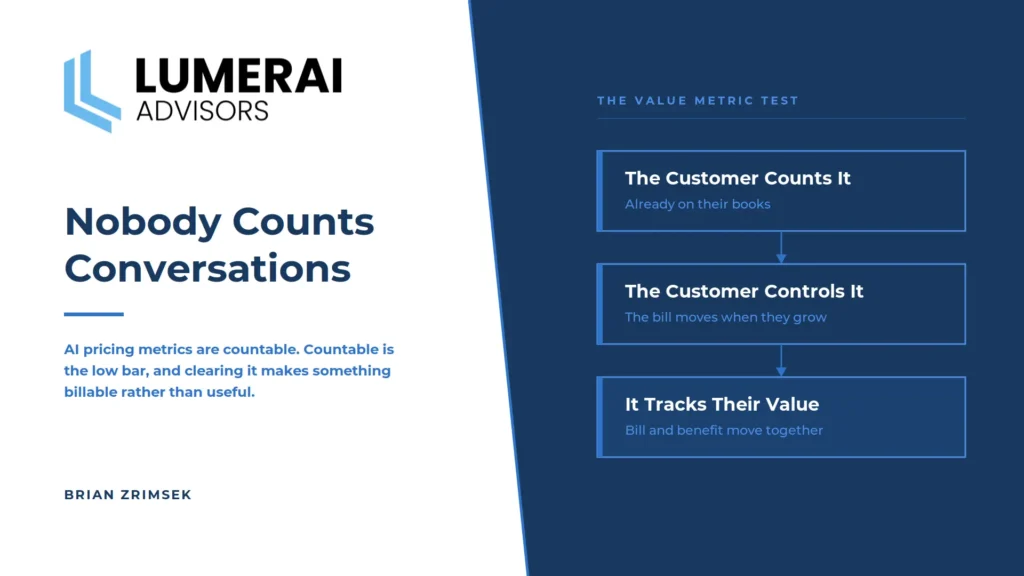
A pricing metric becomes a value metric when it passes three tests at once. Call it the value metric test.
The customer already counts it. The number exists on their books for reasons that predate the software.
The customer controls it. Units arrive through acquisition or development. Leases get signed. When the bill moves, it moves because the business chose to grow.
It tracks the customer’s value. More units means more of the work the software does. The bill and the benefit move together, which is the whole argument for value-based pricing.
Run them through those tests. Per token. Per conversation. Per action. Per user. Per resolution. Bundled with the license.
None of them passes all three.
Plenty of businesses count conversations. Contact centers have for decades. What none of them do is treat a conversation as a unit of economic value. It is an activity count. Nobody budgets on it.
Nobody controls token consumption either. The model decides how many tokens a task takes, so a more verbose version costs more for identical work. You can improve a process and pay more for it.
Per resolution is the only one of those that seriously attempts the value side, and it deserves the credit. It also puts the vendor in the position of grading its own homework on what counts as resolved.
Telecom similarly evolved for thirty years
Minutes and texts metered the carrier’s costs, and then they stopped
Long distance was billed by the minute, because circuits were scarce and minutes were what a carrier’s costs were made of. Text messages were billed one at a time, because they rode a signalling channel the carrier had already built.
Every one of those charges metered something expensive for the seller. Not one of them metered anything a customer wanted more or less of. So customers counted. They watched the clock on long distance calls. They rationed texts.
Then it stopped. Unlimited did not win on price, and the carriers did not stop metering because bandwidth got free. It won because it ended the counting, and the market followed.
The result is on your phone bill right now, and the line item that used to bill for minutes does not exist.
Tokens are minutes. They meter the vendor’s cost of goods and nothing else. Conversations are text messages: a pricing metric that exists because it is easy to bill, and nothing more than that.
The trade buyers are being asked to make
What a buyer gives up, and what real estate got in return
Here is the part I got wrong for a while, sitting in the buying seat.
User-based pricing has one real virtue: headcount is a number the buyer sets. You know it a year out. You can defend it in a budget, and you can reap the benefits of efficiency, because automating a process cuts seats and the savings land on your side of the table. Moving to value-based pricing means giving that up, and it took the real estate market years to accept the trade.
What made it acceptable was the other side of the bargain. Real value metrics, named. Published benchmarks. Two vendors quoting per unit per year compare line by line, and a buyer could walk into a renewal knowing what the market rate was.
The AI market is asking for the same concession and offering none of that in return. No agreed metric. No benchmark. No way to know whether two dollars a conversation is expensive, because there is nothing to hold it against.
That is not an AI pricing problem. It is a market maturity problem. If it follows the earlier pattern, it resolves slowly, through buyers refusing to sign things they cannot compare.
Two questions for the vendor
What the metric costs when the agent is wrong, and what else you could pay on
Every vendor will quote you a metric. Run the test on it, then ask two questions.
Ask what the metric costs you when the agent is wrong.
Per conversation, you pay for the failure and then pay a person to fix it. Per token, a chattier model version raises your bill for identical output. Per user, you pay for people whether or not they are the ones doing the work. Per resolution, the vendor bears more of the cost, which helps explain why that model prices higher and why the definition of resolved repays a close reading. Bundle it with the license and you pay in the currency of not being able to leave.
Then ask the second question, which is the one that actually moves a negotiation.
Can you price this on something I already count?
Your business still counts what it counted before. Leases. Units. Square feet. Contracts. Claims. Tickets. Loans. Those numbers did not stop existing because the work behind them got automated, and they remain an honest measure of the economic activity the software supports.
Watch which vendors can answer that and which ones explain why their metric is better. The answer tells you whether you are buying a product with a business model or a metering scheme with a product attached. No question in an AI pricing conversation is more useful.
Where this ends
Two exits, and why domain expertise decides which vendors take the second
The special counting stops. Businesses will always count things, and the ones worth counting were already counted before any vendor arrived. What ends is the separate tally kept only because a bill demands it.
There are two ways out and the market has already shown you both.
One is unlimited, or close enough. Bundle the agents into the license and stop asking the customer to count. Oracle took that direction in March. It reads as generosity. It is the same move as unlimited calling: end the counting, take the customer, absorb the variance yourself and price it into the base.
The other is repricing onto something the customer already counts. Per lease. Per unit. Per claim. Per loan. That is where real estate software landed, and it is the road the AI market has not seriously walked down yet.
That road requires more domain expertise than most of these vendors have. Pricing by lease means knowing what a lease is worth to the customer. Pricing by claim means knowing an insurer’s book. A value metric is domain-specific by definition, and a vendor selling into twelve industries has twelve metrics to learn.
Per token requires none of that. The same metric works everywhere, which is exactly its appeal and exactly its defect.
IDC has put a date on part of it. In its FutureScape predictions it says that by 2028 pure seat-based pricing will be obsolete as agents replace manual repetitive tasks, forcing seventy percent of vendors to refactor their value proposition into new models.
Both Salesforce and Microsoft have added per-user options for agents in the last year. The metric IDC expects to disappear is the one vendors reached for when consumption pricing proved too hard to forecast.
That is a market trying two directions at once, which is what the end of a pricing era looks like from the inside.
I would not bet on tokens and conversations surviving this either. They are minutes and texts, and we know how that went.
What I would do in the meantime is stop signing multi-year commitments denominated in a pricing metric that may not survive the next stage of the market, and start asking every vendor in the process whether they can price on something your business already counts, the same question your own business case should be answering and usually isn’t.
Vendors who can answer are further along than they are letting on. The rest are telling you where their costs sit.
Brian Zrimsek has occupied all four seats in enterprise software: advisor at Big Six consultancies, analyst at Gartner, client at Irvine Company, and provider at MRI Software. He is the Enterprise Software and Commercial Real Estate Specialist for Lumerai Advisors. Advisor, analyst, client, provider. He writes at The Four Seats.