
For PE Operating Partners: the AI-era liability hiding inside every portfolio company’s tech stack, invisible to diligence until it’s already yours.
By Rob Purks, Founder and Operating Partner, Lumerai Advisors
The tech diligence came back clean. SOC 2 current, licenses reconciled, infrastructure spend in line with the model. On paper, the platform company was exactly what the thesis assumed – a solid operational base to build the value creation plan on top of.
Four months into a hold, that gap stops being abstract. The automation initiative the plan counted on stalls – not because the AI model is bad, but because nobody can trust the data feeding it, no one owns the pipeline, and half the “adoption” the seller showed you was employees quietly using personal tools that leave the moment they do. That is Governance Debt. And by the time you see it, you already own it.
The Blind Spot Standard Diligence Was Never Built to Find
Governance Debt is the accumulated liability a company takes on when it deploys AI faster than it governs it: ungoverned pilots, shadow model usage, and unowned data pipelines that no one is accountable for. Like technical debt, it compounds quietly. Unlike technical debt, it does not show up in a code review or a cost audit – because it is behavioral, not architectural.
That distinction is the whole problem for diligence. Standard tech due diligence is built to inspect things that are static and auditable: infrastructure, licenses, security posture, spend. You take a point-in-time snapshot and verify it. Governance Debt is neither static nor auditable that way. It is additive -accumulating every week through pilots that never got governed, models that never got owned, and AI tools employees adopted without anyone sanctioning them. A snapshot taken on diligence day captures none of it, because the debt lives in behavior and accountability gaps, not in the systems inventory.
So the diligence report is not wrong. It is answering a different question than the one your return actually depends on.
Why This Is an ROI Problem, Not a Risk Problem
Risk language undersells it. This is not a tail risk that might cost you – it is a discount already priced into the return, whether or not it appears in your model. The mechanism is simple arithmetic against a finite clock.
PitchBook and BCG put average private equity hold periods at roughly 5.8 to 7.1 years. Against that window, AI initiatives that require 12 to 18 months to reach production – if they reach it at all – consume a meaningful slice of the value creation runway before delivering a dollar. When the underlying data and governance foundation cannot support the build, that timeline does not hold. It slips, or the initiative is abandoned, and the efficiency gain your model underwrote never materializes.
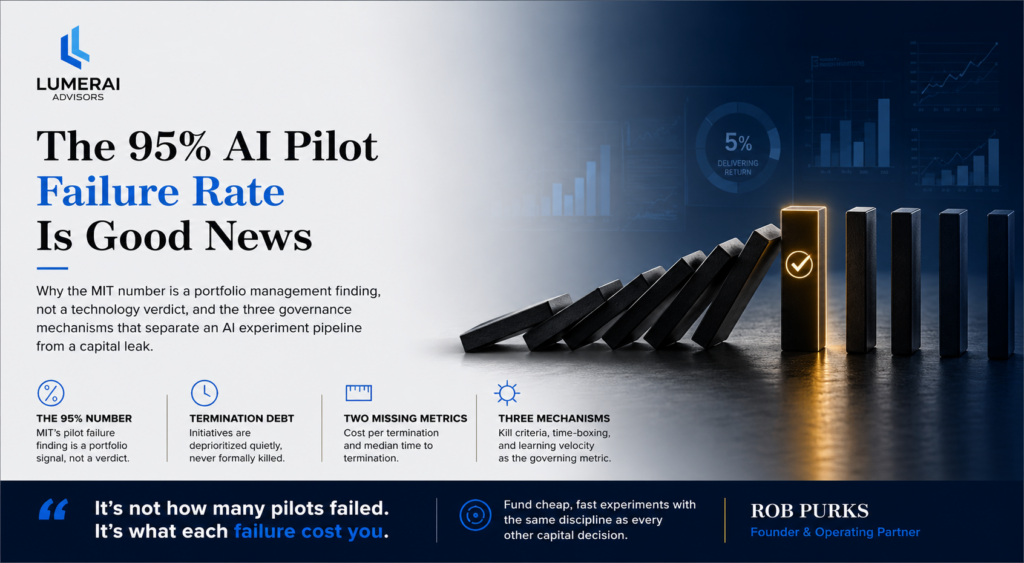
The base rates are sobering. MIT’s NANDA initiative, in its 2025 State of AI in Business study, found that roughly 95% of enterprise generative AI pilots deliver no measurable impact on the P&L – only about 5% achieve real revenue acceleration. That is the outcome distribution across an estimated $30 to $40 billion in enterprise AI investment. And critically, MIT traced the failures not to weak models but to enterprise conditions set before the model was ever built fragmented, ungoverned production data and no clear owner after deployment.
Read that against your hold clock and the ROI logic is unavoidable. You are underwriting AI-driven gains on a foundation that, in 95% of cases, cannot deliver on the timeline your return requires. The Governance Debt is the reason the foundation cannot – and you paid for the gains at close.
Four Questions Your Diligence Should Be Asking – and Usually Isn’t
Governance Debt can be incorporated into diligence. It just requires questions aimed at ownership and behavior rather than inventory. Each of these maps to one of the failure conditions MIT identified – reframed as something you can ask before you close.
- Who owns each AI model and data pipeline after deployment?
MIT found that a defining failure condition is that no one owns the model once it is live. Ask for the named accountable owner – a person, not a team – for every AI system and the data feeding it. If the answer is vague, the debt is already there.
- Can the data team define the top five KPIs and show they agree on each?
Ask the data leaders to define the five metrics that matter most, show where each is sourced, and demonstrate that every function agrees on the definition. If that takes more than an afternoon or surfaces disagreement, the data estate is fragmented – and any AI deployed on it will amplify the fragmentation, not the value.
- What is the real inventory of AI tools in use – including the ones IT never sanctioned?
MIT’s research documented a shadow AI economy in which employees at more than 90% of firms use personal AI tools even when official pilots fail. That usage looks like adoption in a demo and evaporates at close, because it was never owned or governed. Ask what employees are actually using, not what the company licensed.
- Was the workflow ever redesigned to use the AI output – or just bolted on?
A pilot that produces output nobody’s process is built to act. Ask to see where an AI output changed a decision or a workflow in production. If the process still runs exactly as it did before, the pilot is not value – it is Governance Debt wearing a demo’s clothing.
Reframe It as Underwriting Discipline
Catching Governance Debt before close is not a compliance chore. It is an underwriting input. If the debt is real, it changes the price you should pay or the plan you should build – you can discount the entry, extend the timeline, or budget the remediation into the value creation plan from day one. Miss it, and you discover the discount after you have already paid full price, with the hold clock running.
There is an optimistic corollary. Governance Debt is not destiny – it is able to assessed, remediated and priced correctly, a source of edge over the buyer who never thought to look. The firms that win the next cycle of AI-driven value creation will not be the ones with the best thesis. They will be the ones who knew what the diligence report left out.
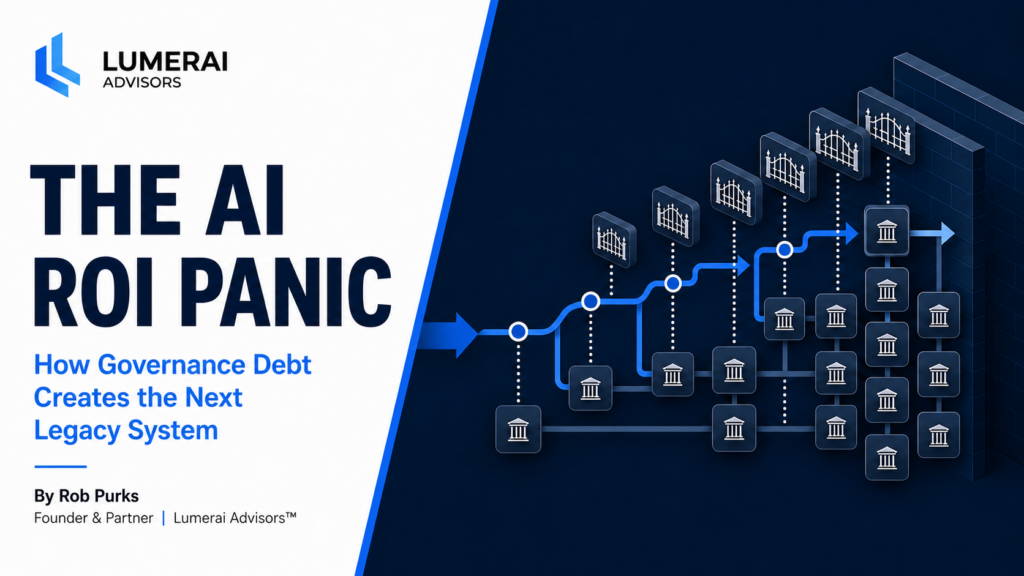
Related reading: The AI ROI Panic Is About to Create the Next Legacy System – where I first defined Governance Debt and why the rush to show AI ROI is building tomorrow’s legacy systems.
Frequently Asked Questions
What is Governance Debt in AI due diligence?
Governance Debt is the accumulated liability a company takes on when it deploys AI faster than it governs it – ungoverned pilots, shadow model usage, and unowned data pipelines. In a due diligence context, it is the AI-related risk that standard technical diligence cannot see, because it lives in ownership and behavior gaps rather than in the systems inventory a point-in-time audit captures.
Why does ungoverned AI reduce portfolio company ROI?
Value creation plans increasingly underwrite AI-driven efficiency gains, but those gains assume a governed data and ownership foundation that can support the build. When that foundation is missing, initiatives slip or fail – MIT found roughly 95% of enterprise AI pilots deliver no P&L impact – while the hold clock keeps running, eroding the return that was priced at close.
How can Operating Partners diligence AI governance before a deal closes?
Ask ownership-and-behavior questions rather than inventory questions: who owns each model and pipeline after deployment, whether the data team agrees on core KPI definitions, what AI tools employees actually use (including unsanctioned ones), and whether workflows were redesigned to act on AI output or merely bolted on.
Is AI Governance Debt fixable after acquisition?
Yes. It is remediable and priced correctly it can be an advantage. The debt can be worked down – but it is far cheaper to price and plan for before close than to discover mid-hold.
#PrivateEquity #ValueCreation #AIGovernance #DueDiligence #OperatingPartners