
The Hidden Risk of AI: Building Transformation Programs for a Future That May Not Exist
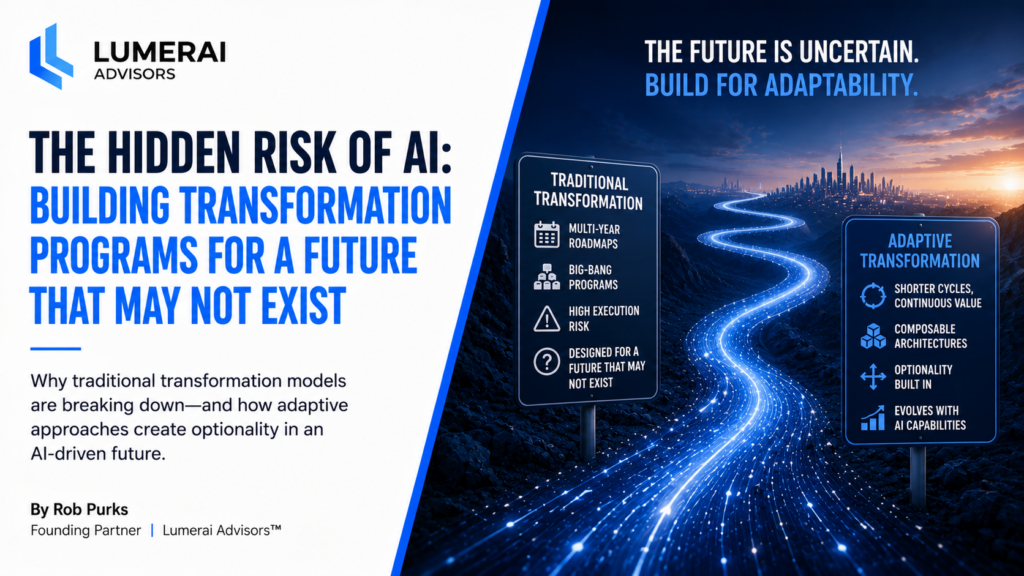
For decades, enterprise transformation followed a familiar model: define a future state, build a multi-year roadmap, and execute with discipline. That model is now under pressure—not because transformation is no longer necessary, but because the assumptions behind it are rapidly breaking down. Large transformation programs rely on a core premise: that we can reasonably predict the future operating model. In an AI-driven environment, that premise is increasingly fragile. Capabilities are evolving faster than planning cycles, and organizations are designing multi-year programs against a moving target. McKinsey & Company has highlighted that while generative AI could create significant economic value, organizations are capturing impact fastest through incremental deployment embedded in existing workflows, not large, monolithic transformations. Value is emerging in shorter cycles, not long-duration bets. At the same time, execution risk was already high. Boston Consulting Group estimates that 70% of digital transformations fail to meet their objectives, even in more stable environments. AI does not reduce that risk—it amplifies it. But there is a more fundamental issue emerging—one that is still underappreciated. We are designing transformation programs without a clear understanding of what AI will actually be capable of in two to three years. This introduces a new form of exposure. Not just whether a program will be delivered successfully, but whether it is solving the right problem at all. Entire layers of functionality being built today—workflow orchestration, decision support, even elements of system integration—may be simplified, automated, or eliminated as AI capabilities mature. The risk is no longer just execution failure. It is design risk leading to solution irrelevance. Programs that are delivered on time, on budget, and exactly as designed—but no longer aligned with the business or technology landscape by the time they go live. This is why we are seeing leading organizations shift away from “big-bang” transformation toward more adaptive models. Composable architectures, incremental modernization, and shorter investment cycles are becoming the preferred approach—not as a compromise, but as a strategic response to uncertainty. The question is no longer, “What should our business look like in five years?” It is, “How do we remain adaptable over the next five quarters?” For CEOs, CIOs, and private equity leaders, this has direct implications for capital allocation and risk management. Transformation programs must be structured with optionality—designed to evolve as capabilities evolve, rather than locking into a fixed future state. In many cases, the right answer is not to stop transformation—but to deconstruct it. Rob Purks is a Founding Partner at Lumerai Advisors, a technology strategy advisory firm. Lumerai Advisors provides an unbiased perspective which is not influenced by vendor relationships. With over 150 years of CIO and technology experience, the founding partners bring an honest and complete perspective on technology strategies and challenges. #Telecom #DigitalTransformation #PrivateEquity #ITStrategy #CIO #EnterpriseArchitecture #OPEX #AI #Cloud Lumerai Advisors
The AI ROI Panic Is About to Create the Next Legacy System
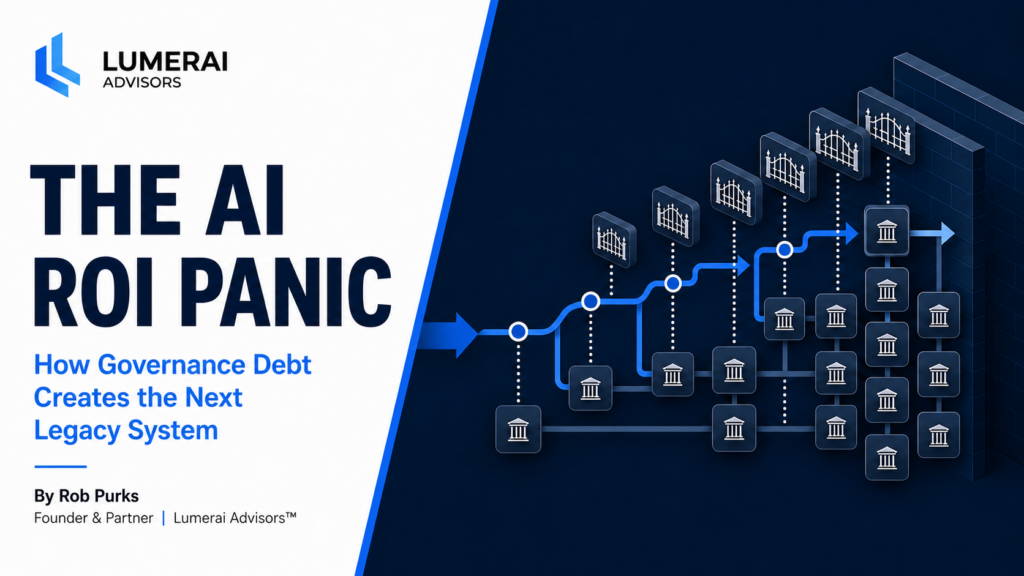
By Rob Purks, Founding & Operating Partner, Lumerai Advisors There is a quiet panic spreading through boardrooms right now, and it has nothing to do with whether AI works. It has to do with whether anyone can prove it. The numbers behind that panic are real. Hyperscalers are on track to spend roughly $675 billion on AI infrastructure this year alone. Meanwhile, MIT’s Project NANDA found that 95% of enterprise AI pilots deliver no measurable P&L impact. S&P Global reported that 42% of companies abandoned most of their AI initiatives last year which is more than double the rate of the year before. Forrester is now predicting a market correction with enterprises deferring a quarter of their planned 2026 AI spend into 2027. Even the debt markets have weighed in: Citi identified a measurable credit spread penalty for companies classified as AI adopters without evidence of return. Spending without proof is now literally priced into the cost of capital. I am not here to argue with the data. The data is right. I am here to argue with the response. Key Takeaways The Control Reflex: Why AI Governance Backfires When boards see numbers like these, they react the way boards have always reacted: with control. AI steering committees and per-use-case business cases. ROI attestation before funding. Approval gates between pilot and production. Governance councils that meet monthly to review initiatives that move weekly. Every one of these mechanisms is individually defensible. That is exactly what makes them dangerous. I have spent my career on both sides of this dynamic, as a CIO running technology for telecom operators in Latin America, and later advising enterprises on transformation at Accenture, IBM, and Ericsson. And I can tell you what happens next, because I have watched it happen with every major technology wave: the control structure built to manage today’s uncertainty becomes tomorrow’s constraint. It outlives the problem it was created to solve. Nobody is ever promoted for dismantling a governance committee. I learned this the hard way by inheriting the aftermath of one. At a Latin American operator a major CRM transformation had been put in front of a review board and killed on grounds that were individually hard to argue with: the projected budget was steep, the internal skills weren’t fully in place, and the business wasn’t deemed ready. Every objection was reasonable. The board did exactly what it was designed to do. And while we sat on a defensible “not yet” a competitor moved, modernized its customer platform, and took ground we never fully recovered. The control worked perfectly. The company lost anyway. That is the trap: the most dangerous governance failures don’t look like failures at all, they look like prudence. We have seen this exact movie before. Cloud and agile both promised speed. In most enterprises they delivered something closer to “the same speed with more meetings.” The technology arrived, the operating model absorbed it, neutralized it, and carried on. The gains didn’t disappear, they were quietly strangled by slow decisions and diffused accountability. The ROI panic is now rebuilding that machinery, at speed, with the best of intentions. Except this time there is a difference that should worry every executive: when the constraint is a legacy system you can eventually migrate off it. When the constraint is a legacy operating structure there is no migration project. It just becomes how the company works. I call this Governance Debt: the accumulated drag of controls that outlast the uncertainty they were built to manage. Like technical debt it compounds quietly and like technical debt the interest is paid in speed. The Wrong Diagnosis: It’s Not an AI Adoption Problem Here is the tell that we are solving the wrong problem. In one of the most striking findings of this cycle 97% of executives report personally benefiting from AI yet only 29% see significant organizational ROI. Read that gap carefully. It is not an adoption problem. It is not a model-quality problem. And it is emphatically not a control problem. It is a compounding problem. Value is being created at the level of individuals and teams and the organization has no mechanism to aggregate it, redirect it, or build on it. Adding oversight to that situation does not create compounding. It adds friction to the one place value actually exists. Look at what the successful 29% actually have in common: AI tied to revenue outcomes, business teams owning the workflows, and the whole effort treated as organizational redesign rather than technology deployment.[1] Notice what is not on that list: more approval gates. The organizations seeing returns did not out-govern their peers. They out decided them. What to Build Instead: A Velocity-First AI Operating Model If the answer isn’t heavier oversight, what is it? Three structural moves none of which require a committee: Replace approval gates with kill cycles. Don’t make initiatives prove their worth before they start, make them prove it on a clock. Every AI initiative launches with pre-agreed kill criteria and a fixed time box. The discipline shifts from “may we begin?” to “did we learn enough to continue?” That is governance measured in velocity, not meetings. Measure ROI at the portfolio level, not the use case. Demanding a business case from every individual experiment guarantees you will only fund the safe, incremental, and ultimately unimportant. Venture and private equity investors figured this out decades ago: the portfolio carries the math so the individual bets can take real risk. It is the same logic that drives value creation across a portfolio of companies, you manage the aggregate, not the average. Boards should hold leadership accountable for portfolio-level return and learning rate, not for the survival of any single pilot. Put a sunset clause on every control. Any governance mechanism created to manage AI uncertainty should carry an expiration date and a renewal test: what decision did this body accelerate this quarter? If the honest answer is none, it isn’t governing, it’s accumulating. This is how you keep
The 95% AI Pilot Failure Rate Is Good News
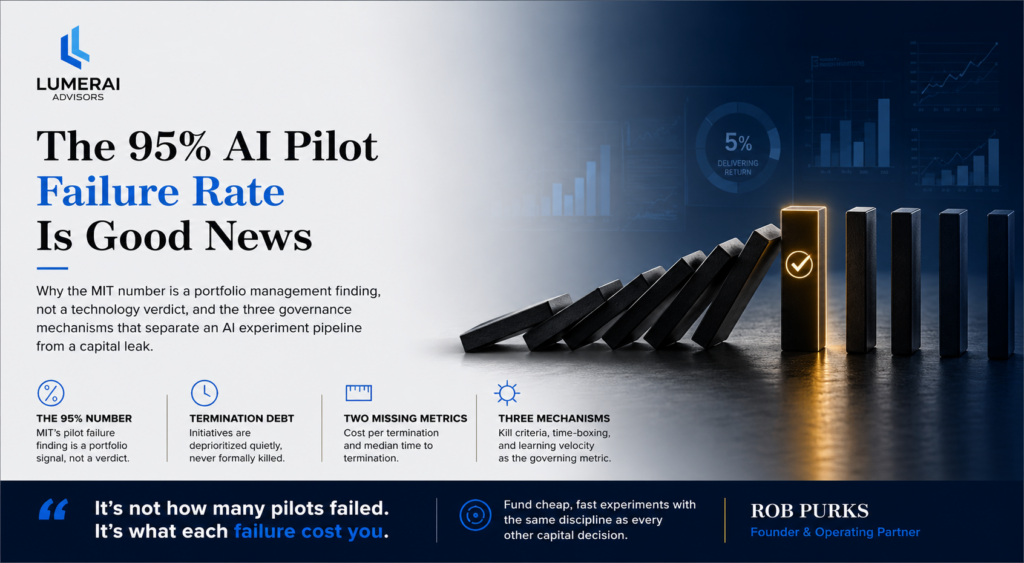
Why the MIT number is a portfolio management finding, not a technology verdict, and the three governance mechanisms that separate an AI experiment pipeline from a capital leak.