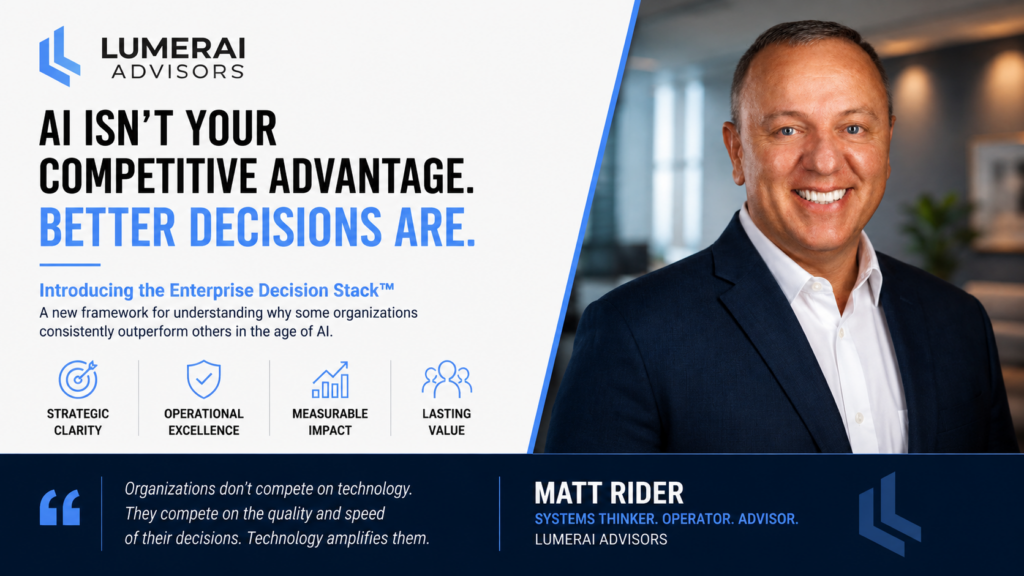
Introducing the Enterprise Decision Stack™, a new framework for understanding why some organizations consistently outperform others in the age of AI.
Executive Summary
The Enterprise Decision Stack™ is a strategic framework that explains why organizations compete on the quality and speed of their decisions—not technology alone. It illustrates how business strategy, operating models, governance, trusted data, enterprise applications, automation, AI, and agentic execution build on one another to create sustainable competitive advantage.
Every board meeting seems to include AI.
Every strategy session includes AI.
Every technology conference promises that AI will redefine your business.
And every vendor seems convinced that the next model, platform, or agent will finally unlock transformational value.
Yet despite unprecedented investment, many organizations are struggling to produce meaningful business outcomes.
The common explanation is that the technology isn’t mature enough.
I don’t believe that’s the problem.
I believe we’re asking AI to solve problems that were never technology problems to begin with.
Why Do Smart Companies Keep Making Bad Technology Decisions?
Over the past three decades, I’ve had the opportunity to lead technology organizations through cloud migrations, digital transformations, operating model redesigns, large-scale modernization programs, regulatory remediation, mergers and acquisitions, automation initiatives, and now AI adoption.
The industries, companies, and technologies were different.
The pattern wasn’t.
The organizations that succeeded weren’t necessarily the ones with the largest budgets, the newest technology, or the most ambitious roadmaps.
They were the ones that consistently made better decisions.
That may sound obvious, but it’s remarkable how often we overlook it.
I’ve seen organizations spend hundreds of millions modernizing technology while leaving decision-making untouched. They implemented new ERP platforms but kept the same governance. They migrated to the cloud but preserved the same organizational bottlenecks. They deployed automation without simplifying the processes being automated. Today, many are racing to implement AI while the underlying conditions that limited every previous transformation remain unchanged.
AI didn’t create those problems.
It’s simply exposing them faster than ever before.
Organizations Don’t Compete on Technology
Here’s the conclusion I’ve reached after years of watching transformation efforts succeed and fail.
Organizations don’t compete on technology. They compete on the quality and speed of their decisions.
Technology matters.
Great architecture matters.
Data matters.
AI absolutely matters.
But none of those create competitive advantage on their own.
Technology doesn’t create better organizations.
It amplifies the organizations that already exist.
If decision-making is slow, AI accelerates slow decisions.
If governance is unclear, AI increases the scale of uncertainty.
If data is fragmented, AI generates more confident answers from incomplete information.
On the other hand, organizations with clear strategy, disciplined governance, trusted data, and strong operating models tend to realize value from new technology far more quickly.
Not because the technology is better.
Because the organization is.
Introducing the Enterprise Decision Stack™
As I reflected on this pattern, I realized I was looking at the same problem through different lenses over and over again.
Eventually, those observations began to form a simple framework.
I call it the Enterprise Decision Stack™.
At first glance, it looks like a technology model.
It isn’t.
It’s an organizational capability model.
It illustrates the layers that determine whether technology investments create sustainable business value or simply become the next transformation initiative that fails to meet expectations.
Enterprise Decision Stack™
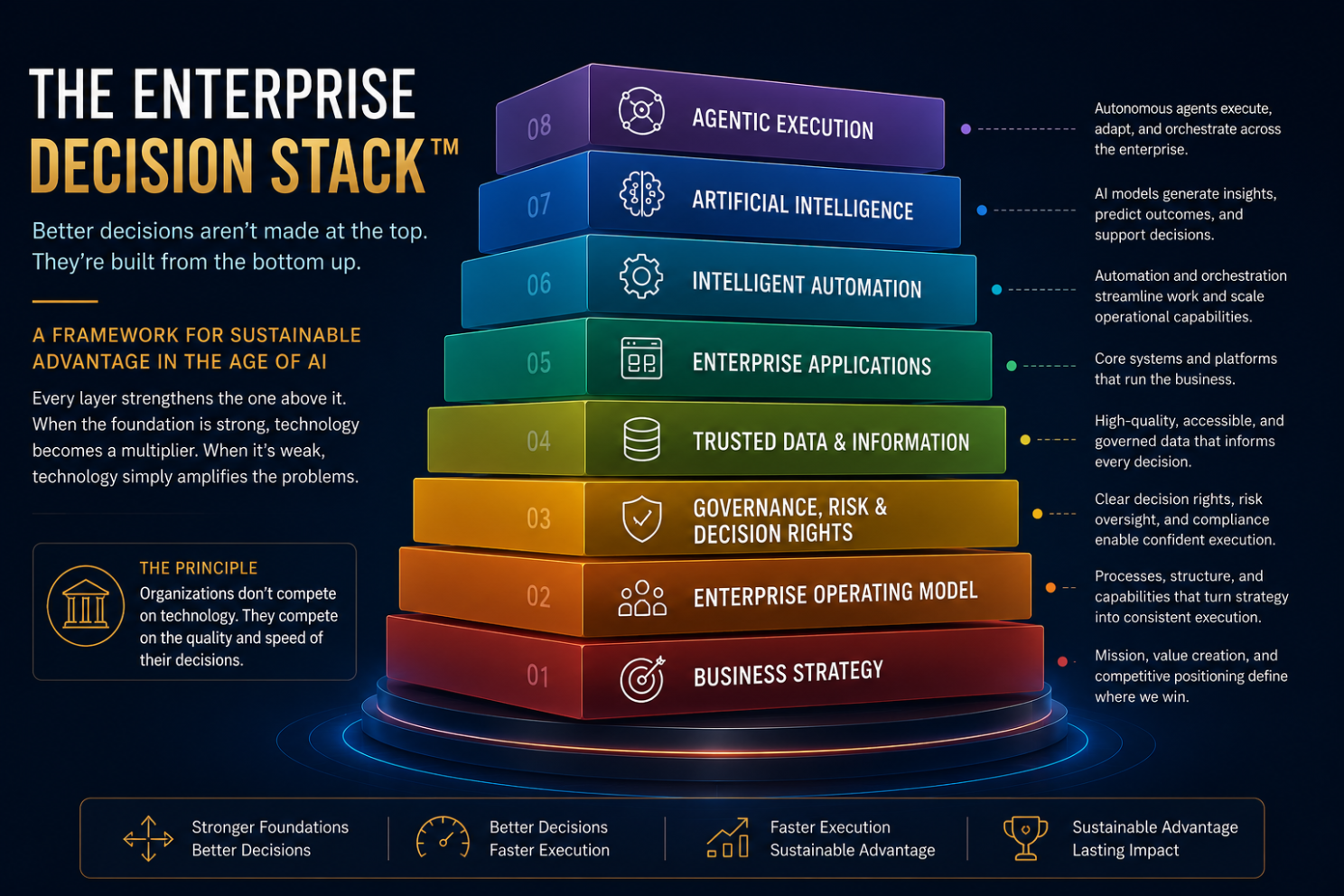
Every layer depends on the integrity of the layer beneath it.
The organizations creating lasting advantage aren’t building from the top down.
They’re building from the bottom up.
Business Strategy
Every transformation begins with a simple question.
Where are we trying to create value?
Without strategic clarity, technology becomes a collection of disconnected projects. Teams optimize locally while the organization struggles to move in a common direction.
Technology cannot compensate for the absence of strategy. Read that again.
Enterprise Operating Model
Strategy defines where an organization wants to go.
The operating model determines how it gets there.
This is where decision ownership, accountability, organizational structure, business capabilities, and core processes come together.
Many transformation efforts stall here—not because the technology is wrong, but because the organization isn’t designed to execute consistently.
Governance, Risk & Decision Rights
This layer often receives less attention than it deserves.
Good governance isn’t bureaucracy.
It’s clarity.
Who owns the decision?
Who is accountable?
How is risk evaluated?
What happens when priorities conflict?
Organizations with mature governance move faster because people understand how decisions are made.
Organizations without it spend valuable time debating authority instead of solving problems.
Trusted Data & Information
Every executive wants better AI.
What they actually need is better information.
Data isn’t valuable because it feeds algorithms.
It’s valuable because it improves judgment.
When information is inconsistent, incomplete, or poorly governed, every layer above it becomes less effective.
Enterprise Applications
Applications operationalize the business.
Core banking platforms.
ERP systems.
CRM.
Loan origination systems.
Supply chain platforms.
These aren’t simply software products.
They’re how an organization executes its strategy every day.
When applications reinforce well-designed business capabilities, they become accelerators.
When they reinforce poor processes, they institutionalize inefficiency.
Intelligent Automation
Automation increases speed.
It doesn’t create wisdom.
Automating inefficient work simply allows organizations to make the same mistakes more quickly.
The greatest value comes when automation removes friction from well-designed decisions, not when it attempts to compensate for poor ones.
Artificial Intelligence
AI is one of the most powerful technologies many of us will see during our careers.
But AI should not be viewed as the foundation of transformation.
It’s an amplifier.
Organizations with disciplined governance, trusted data, and effective operating models tend to realize extraordinary value.
Organizations lacking those capabilities often discover that AI magnifies existing weaknesses.
The technology isn’t failing.
The organization is revealing itself.
Agentic Execution
This is where the conversation is rapidly heading.
Autonomous agents capable of planning, coordinating, and executing work across the enterprise.
It’s exciting.
It’s also why the layers beneath become even more important.
As autonomy increases, so does the importance of decision quality.
Organizations won’t simply automate work.
They’ll automate judgment.
That’s a very different responsibility.
What This Means for Financial Services
Financial services has always understood something many industries are only beginning to appreciate.
Every important decision carries consequences.
Credit decisions.
Fraud decisions.
Risk decisions.
Compliance decisions.
Operational resilience.
Model governance.
These disciplines weren’t created to slow organizations down.
They exist because trust is the foundation of the industry.
AI doesn’t eliminate that responsibility.
It raises the standard.
The institutions that succeed won’t be those deploying the most AI.
They’ll be the ones that integrate AI into organizations already built on disciplined decision-making.
What This Means for Private Equity
Private equity has traditionally evaluated operational maturity through financial performance, leadership capability, market position, and execution.
I believe there’s another lens worth considering.
Before asking which ERP to implement, which AI platform to deploy, or which cloud provider to select, there’s a more fundamental question.
Can this organization consistently make good decisions at scale?
If the answer is no, every technology investment becomes harder than it needs to be.
If the answer is yes, technology becomes a multiplier instead of a rescue plan.
Looking Beyond AI
I don’t believe history will remember this era simply as the beginning of enterprise AI.
I think it will be remembered as the moment organizations were forced to confront how they actually make decisions.
For years, technology has allowed companies to work faster.
AI is asking whether they’re working smarter.
That’s a much harder question.
The organizations that outperform over the next decade won’t necessarily deploy the most AI.
They’ll build organizations capable of making consistently better decisions.
Frequently Asked Questions
What is the Enterprise Decision Stack™?
The Enterprise Decision Stack™ is a framework that explains why technology initiatives succeed or fail. Rather than focusing on individual technologies, it illustrates how business strategy, operating models, governance, data, enterprise applications, automation, AI, and agentic execution build on one another to create sustainable competitive advantage.
Why does the Enterprise Decision Stack™ place AI near the top instead of the foundation?
Many organizations begin their transformation with AI. The framework argues that AI is an amplifier, not a foundation. Without a clear strategy, effective operating model, disciplined governance, and trusted data, AI tends to magnify existing organizational weaknesses rather than solve them.
How is the Enterprise Decision Stack™ different from a technology architecture?
Technology architectures describe how systems interact.
The Enterprise Decision Stack™ describes how organizational capabilities support decision quality. It is a business and operating model framework rather than an infrastructure model.
How can executives use the Enterprise Decision Stack™?
Executives can use the framework to evaluate transformation readiness, identify foundational gaps before investing in new technology, and prioritize improvements that increase the likelihood of successful modernization and AI adoption.
Why is decision quality becoming more important with AI?
As organizations automate more work and introduce increasingly autonomous AI systems, the quality of the decisions being automated becomes a competitive differentiator. Organizations with disciplined decision-making processes are more likely to realize value while reducing operational and regulatory risk.
Is the Enterprise Decision Stack™ only applicable to financial services?
No.
Although highly relevant to regulated industries such as banking and insurance, the framework applies to any organization pursuing enterprise transformation, AI adoption, operational modernization, or digital strategy.
What comes after the Enterprise Decision Stack™?
The Enterprise Decision Stack™ is the first model in a broader body of work exploring enterprise decision systems. Future frameworks will examine how decisions flow through organizations, how decision quality compounds over time, and how executives can assess organizational decision maturity.