
The Rise of Systems of Judgment: Why AI Requires a New Enterprise Architecture
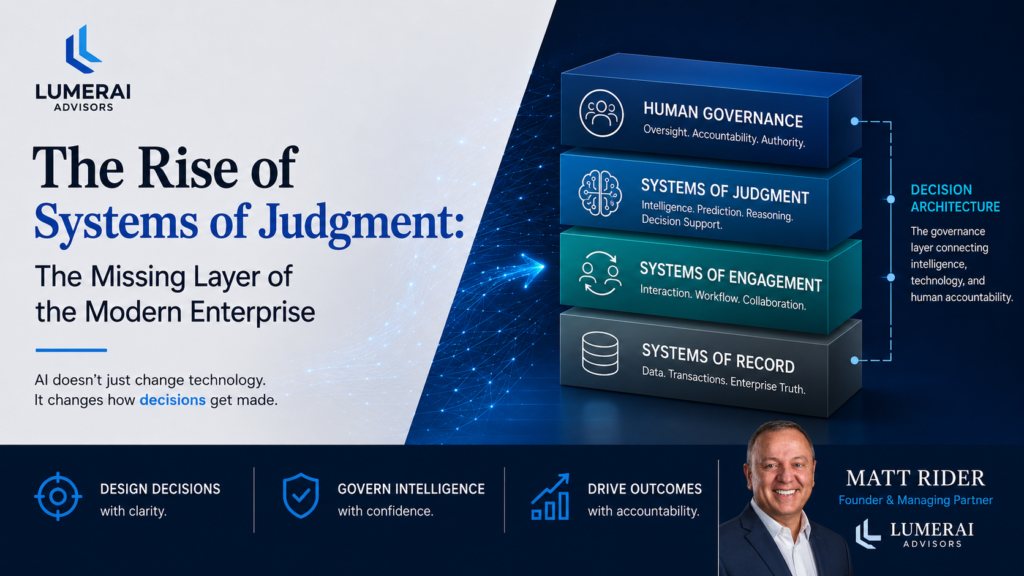
Every enterprise today is racing to deploy artificial intelligence. Yet most organizations are attempting to insert intelligent systems into an architecture that was never designed for machine-assisted decision making. The result is growing uncertainty not about technology, but about authority, accountability, and governance. For decades, enterprise technology architecture has been organized around two foundational layers: systems of record and systems of engagement. Together, they have shaped enterprise technology strategy, digital transformation, and operating models for more than two decades. Artificial intelligence introduces a third architectural layer that fundamentally changes this model. I call these Systems of Judgment. They represent the emergence of Enterprise Decision Architecture, the discipline of designing how intelligence participates in enterprise decisions while preserving accountability, governance, and human oversight. Organizations that recognize this shift early will build AI into the fabric of the enterprise responsibly. Those that do not risk creating faster systems with less clarity over who ultimately owns the decisions those systems influence. The Evolution of Enterprise Architecture For decades, enterprise technology architecture has been understood through two primary lenses. Systems of Record Systems of record manage the authoritative data that underpins the enterprise financial ledgers, customer records, inventory systems, loan platforms, ERP environments, and transaction processing systems. These platforms are built for accuracy, durability, compliance, and consistency. They preserve the organization’s institutional memory and establish a single source of truth. Systems of Engagement As digital transformation accelerated, organizations introduced systems of engagement. Customer portals, mobile applications, collaboration platforms, CRM solutions, workflow engines, and employee experience platforms made it possible to interact with customers and coordinate work in ways traditional transactional systems were never designed to support. Together, systems of record and systems of engagement have defined enterprise IT strategy for more than twenty years. Artificial intelligence changes that architecture. The Rise of Systems of Judgment AI does not simply process information. It interprets information. Unlike traditional enterprise systems, AI evaluates probabilities, recognizes patterns, generates recommendations, prioritizes alternatives, and increasingly initiates actions. That is a fundamentally different responsibility. These are Systems of Judgment. Rather than storing data or facilitating interactions, they participate directly in enterprise decision-making. Examples already exist across nearly every industry. A credit risk model evaluates the probability of default before recommending whether to approve a loan. A fraud detection platform determines whether a transaction should proceed or be blocked. An AI copilot recommends operational changes in response to supply chain disruptions. A predictive maintenance engine determines when expensive equipment should be serviced before failure occurs. In each case, the software is no longer simply processing transactions. It is exercising delegated judgment. When software begins participating in judgment, enterprise architecture must evolve accordingly. From Technology Architecture to Decision Architecture Traditional enterprise systems were deterministic. Given identical inputs, they consistently produced identical outputs. Their responsibility was to execute predefined business logic: process a transaction, update a record, or trigger a workflow. AI-driven systems operate differently. They interpret uncertainty. They evaluate probabilities. They recommend actions that may vary depending on context. That means organizations are no longer designing only technology architectures. They are designing decision architectures. This distinction matters because decisions carry accountability in ways transactions never have. The Decision Stack As intelligent systems mature, enterprise architecture naturally evolves into a layered decision model. Systems of RecordAuthoritative data, transactional integrity, compliance, and institutional memory. Systems of EngagementCustomer experiences, employee interactions, collaboration, and workflow coordination. Systems of JudgmentIntelligence, prediction, reasoning, recommendations, prioritization, and decision support. Human GovernanceExecutive oversight, escalation paths, accountability, risk management, ethics, regulatory compliance, and final authority. Each layer performs a distinct role. The effectiveness of the enterprise increasingly depends on how clearly organizations define the boundaries between automated judgment and human judgment. Today, many organizations have invested heavily in AI while giving comparatively little attention to designing those boundaries. Figure 1. The Enterprise Decision Stack Enterprise AI does not replace existing technology architecture; it extends it. Systems of Judgment introduce a new architectural layer between enterprise data and executive oversight, requiring organizations to intentionally design how intelligence, automation, and human accountability work together. Governance Becomes the Critical Design Challenge As organizations adopt AI-assisted decision making, the central challenge shifts from model accuracy to decision governance. As illustrated in the Enterprise Decision Stack, Systems of Judgment occupy a unique position between enterprise operations and executive oversight. Their value comes not simply from generating recommendations, but from enabling organizations to determine when decisions should be automated, when they should be escalated, and who ultimately remains accountable. Every enterprise must answer several fundamental questions. These are not technology questions. They are enterprise governance questions. Consider a global financial institution processing millions of transactions every day. If an AI-powered fraud engine automatically declines thousands of customer transactions, the organization has delegated judgment, not merely automation. If those decisions prove incorrect, responsibility cannot belong to the algorithm. It belongs to the enterprise that designed the governance model around it. Similarly, if an AI model prioritizes customers, allocates resources, or recommends operational changes across multiple business units, leadership must define who validates those recommendations before execution and how exceptions are managed. Governance, not model sophistication, ultimately determines whether AI creates enterprise value or enterprise risk. Implications for CIO Leadership The emergence of Systems of Judgment significantly expands the role of the modern CIO. Historically, technology executives were measured primarily by platform reliability, scalability, security, availability, and cost efficiency. Those responsibilities remain essential. But AI introduces an entirely new leadership obligation. Technology leaders must now help design the flow of decisions through the enterprise. That includes establishing: Increasingly, CIOs are not simply architects of technology. They are architects of enterprise decision systems. Why This Matters for Every Enterprise Artificial intelligence will continue becoming more capable. Models will improve. Automation will expand. Agentic AI will increasingly coordinate complex work across multiple systems. But the long-term competitive advantage will not come from deploying more models. It will come from designing better systems for governing how those models participate in enterprise decisions. Organizations that intentionally build Systems of Judgment into their enterprise
Moving From Pilot Purgatory to Autonomous Operations: The New Genetic Code of Manufacturing
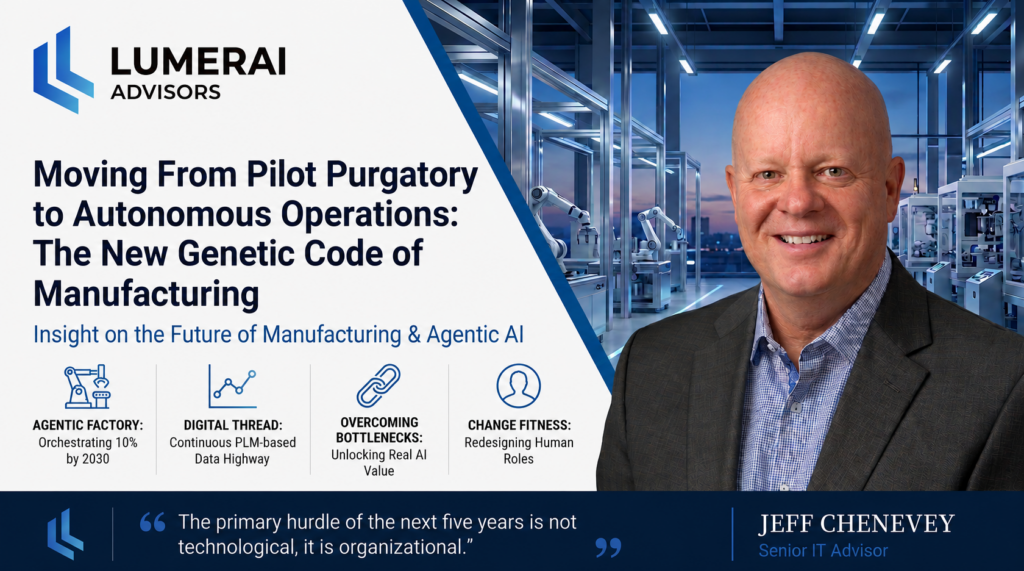
Manufacturing has spent the last five years proving AI works. The next five years will determine whether it creates a competitive advantage. Most manufacturers are no longer asking whether AI belongs in the factory. They’re asking how quickly they can move beyond isolated pilots toward autonomous operations without compromising safety, quality, or resilience. The companies that answer that question first won’t simply become more efficient. They’ll fundamentally redesign how manufacturing operates. Over the next five years, technology will not just change how factories operate; it will rewrite the genetic code of the manufacturing enterprise. At Lumerai Advisors, when we counsel C-suite executives navigating this shift, we emphasize three structural pillars that will separate the legacy operators from the “Frontier Firms.” The Shift from Automation to Autonomy In our work with clients, we are seeing a move beyond static automation to Agentic AI – semiautonomous AI agents capable of interacting, reasoning, and adapting to execute multi-step processes across distributed environments. Consider this stark shift: Gartner reports that while semiautonomous AI agents orchestrated roughly 2% of key production, quality, and maintenance use cases in early 2026, by 2030, they will orchestrate 10% of these core operations, with humans retaining final veto and approval power. Instead of a dashboard alerting a plant manager to a supply chain bottleneck, an agentic workflow will automatically recalculate material requirements, interface with procurement agents, adjust shop-floor schedules, and re-optimize energy use in real time. The factory floor is evolving from a collection of automated machines into a self-orchestrating ecosystem. The Power of the Software-Defined Product and the Digital Thread For decades, hardware design dictated software deployment. Today, the most forward-thinking manufacturers are flipping the script by adopting a “shift-left” strategy, decoupling hardware from software to enable fully parallel development. Gartner notes that manufacturers utilizing this software-defined architecture are seeing a massive acceleration in innovation, including up to a 40% reduction in time-to-market for complex mechatronic products. Organizations with an integrated Digital Thread create a continuous flow of trusted operational data across engineering, manufacturing, quality, and supply chain. That data becomes the foundation for AI agents capable of making faster, more informed decisions. Warning Signs You’re Not Ready for Autonomous Operations AI pilots remain isolated. Manufacturing and IT operate separately. Data quality is inconsistent. AI governance has not been defined. Legacy ERP limits integration. Plant managers don’t trust AI recommendations. ROI comes from individual projects rather than enterprise transformation. The Lumerai Change Fitness Framework As I often tell our clients at Lumerai Advisors, the primary hurdle of the next five years is not technological, it is organizational. Recent Harvard Business School insights highlight that the true differentiator in this era is “change fitness.” When AI moves into core workflows, it shifts the human role from manual execution to strategic oversight and critical thinking. If leaders focus strictly on first-order efficiency gains, they risk alienating their workforce and stripping meaning from the shop floor. To thrive in the upcoming half-decade, manufacturing executives must pivot from process optimization to fundamental process redesign. We recommend using the Lumerai Change Fitness Framework: Unifying the Data Foundation: Building an API-first, contextualized data thread that bridges IT (Information Technology) and OT (Operational Technology). Establishing Rigorous Governance: Defining explicit levels of AI agency and establishing ironclad safety guardrails. Cultivating AI Literacy: Actively modeling AI experimentation from the top down, transforming the factory floor into a continuous learning system. The Executive Imperative Technology is no longer the primary constraint. Leadership is. The manufacturers that outperform over the next decade won’t necessarily have better AI models. They’ll have better governed data. Better integrated systems. Better prepared workforces. Better executive alignment. The next generation of manufacturing will not be defined by who buys the most AI. It will be defined by who redesigns work, data, and decision-making around it. Autonomous operations are no longer a distant vision. They are becoming the new operating model. The organizations that build the data foundation, governance, and workforce capabilities today will define manufacturing leadership for the next decade. At Lumerai Advisors, we call this building organizational Change Fitness. In our experience, technology evolves quickly. Organizations do not. Competitive advantage belongs to those who prepare both. #Manufacturing #ArtificialIntelligence #Industry40 #DigitalTransformation #ExecutiveLeadership #LumeraiAdvisors
The Architecture of Authority: Why AI Is Reshaping Enterprise Leadership

For decades, the enterprise power dynamic was absolute and unchallenged: systems provided the data, and humans provided the judgment. Organizations termed themselves “data-driven” if an executive glanced at a dashboard before making a call, but the dashboard was a passive participant. It never actually changed who held the steering wheel or who was accountable when things went wrong. Technology was a silent partner—a repository of record that executed instructions only after the human “go” signal was given. That boundary has not just blurred; it is being erased. We are moving from an era of “Systems of Record” to an era of “Systems of Action,” and most organizations are fundamentally unprepared for the shift in authority that follows. The challenge isn’t the technology itself; it’s that we are attempting to run 21st-century intelligence on top of 20th-century governance. The End of the Dashboard Era The newest generation of AI has moved beyond recommending a course of action to initiate it. This is the critical pivot point where “support” becomes “participation”. In many modern enterprise stacks, the machine is already making high-stakes calls in milliseconds—isolating network devices, blocking multi-million-dollar transactions, or rerouting global shipments—often before a human analyst even sees an alert. When a system functions at this speed, the traditional “human-in-the-loop” model becomes a bottleneck or, in some cases, a myth. At this point, the system is no longer informing a decision; it is determining the outcome. This creates an immediate crisis for traditional governance. Most corporate frameworks are built on a 1990s-era assumption: that humans make judgments and systems implement them. When the system itself begins to determine what happens next, the separation between decision-making and execution—the very foundation of corporate oversight—becomes impossible to maintain. The Conflict of Logic vs. Intuition The most overlooked risk in AI implementation isn’t a technical failure—it’s the moment of disagreement. What happens when a machine’s data-driven recommendation contradicts a veteran manager’s years of intuition? In a traditional hierarchy, the senior leader wins by default. But in an AI-integrated environment, that “win” might come at the cost of operational speed or accuracy. Conversely, if the machine wins, who owns the liability? In regulated industries, these aren’t just philosophical debates; they carry significant legal and operational consequences. A system that blocks a transaction or flags a customer is taking an action that has traditionally required a signature and a clear chain of custody. If we haven’t designed the “Decision Architecture” to handle these conflicts, we aren’t innovating; we are simply creating a new type of organizational chaos. Decision Architecture: The Invisible Layer As decisions begin to emerge from within the technology itself, the structure of decision-making becomes an architectural question, not just a management one. This is the concept of Decision Architecture: the intentional design of how authority flows between people and software. Historically, authority evolved through hierarchy: information flowed up, and decisions moved back down through operational silos. Core platforms, like ERP systems, were built specifically to reinforce this “step-by-step” approval logic. These designs work perfectly when systems are executing predictable transactions. But they fail when an intelligent layer begins to evaluate context and trigger responses across those same processes. The friction we are seeing today isn’t a technical glitch; it is an organizational collision. Decisions are bypassing the management chain entirely and emerging from the “intelligence layer” of the stack. Without dedicated architecture to govern this flow, the CIO is no longer managing a technical stack—they are managing a fragmented, automated bureaucracy. The Danger of Accidental Authority Perhaps the greatest risk to the modern enterprise is “Accidental Authority.” This happens when AI capabilities are developed in isolated silos—one team building a fraud model, another implementing automated customer service, and a third deploying AI-driven cybersecurity. Each of these teams is essentially handing over “micro-slices” of corporate authority to different algorithms, often without a central registry of what decisions have been automated. Without coordinated architecture, you wake up to a fragmented environment where your systems have inconsistent levels of authority, lack oversight, and offer no clear way to override them when they go off the rails. We must stop building AI as a series of features and start building it as a unified decision-making ecosystem. The Practitioner’s Mandate: Designing for Authority For the modern CIO, the challenge is no longer the deployment of AI; it is the management of authority. The most dangerous path is allowing this authority to emerge accidentally, hidden within isolated teams or embedded deep inside individual platforms. To lead this transition, technology leaders must move toward three strategic imperatives: From Tool to Participant The organizations that survive this shift will be the ones that stop viewing AI as just another tool in the shed and start viewing it as an active participant in the business. The role of the leader is no longer to “sign off” on the data, but to architect the logic that governs the machine’s behavior. Success in the AI era won’t belong to the companies with the fastest algorithms or the biggest data lakes. It will belong to the leaders who treat decision-making as something that must be intentionally designed, rather than something that happens by accident as a byproduct of new technology. Frequently Asked Questions How is AI changing corporate hierarchy? Artificial intelligence is reducing the need for organizations to rely solely on traditional management layers to coordinate work and distribute information. As AI systems become capable of analyzing data, recommending actions, and executing routine decisions, authority increasingly shifts from information control to judgment, governance, and accountability. Organizations will need to redesign leadership structures to ensure humans remain responsible for strategic direction and oversight. What is the Architecture of Authority? The Architecture of Authority is the framework that defines how decisions are made, delegated, governed, and monitored within an organization. In the age of AI, it extends beyond traditional reporting structures to include intelligent systems that participate in decision-making. A well-designed Architecture of Authority ensures AI augments human judgment without weakening accountability or governance. Will AI
The question isn’t whether your organization will be transformed by AI. That ship has sailed.
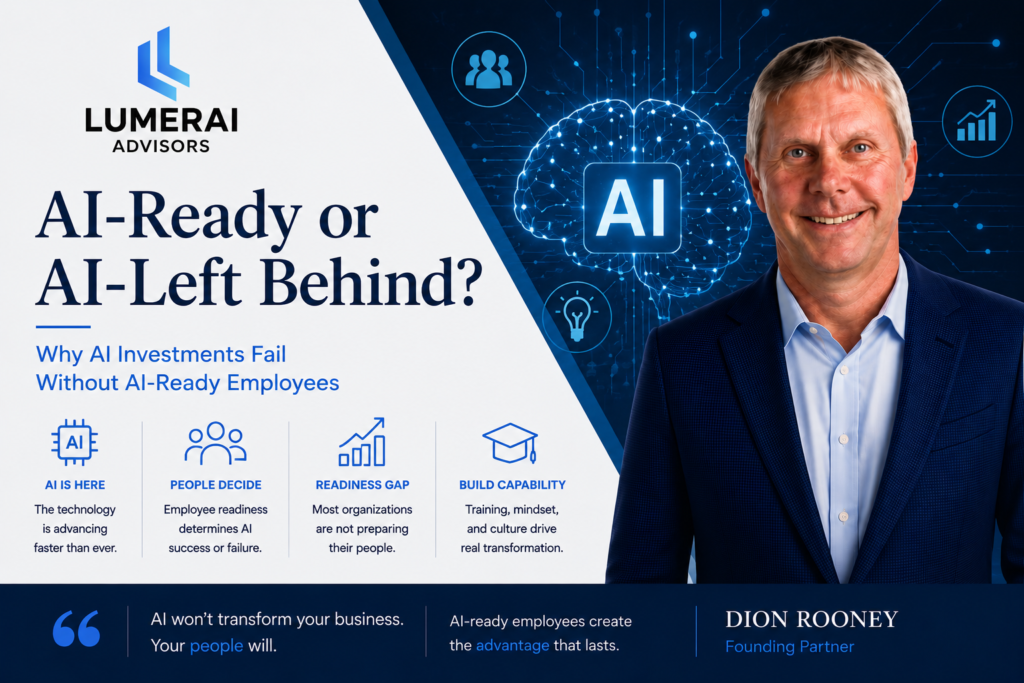
The question is whether your workforce will become a competitive advantage in an AI-powered economy or whether AI will simply expose capability gaps that already exist. Your AI strategy is only as strong as the people expected to execute it. Most organizations are measuring the wrong thing. They track AI licenses, adoption, training completion rates, and prompt engineering workshops. Yet despite billions of dollars invested in AI, only a small percentage of organizations are realizing meaningful business value. The reason is simple. AI transformation is not primarily a technology problem. It is a workforce capability problem. The question leaders should be asking is not whether employees can use AI. It is whether they can make better decisions because of it. Do your people actually know how to work in an AI-powered world? Not “have they attended a webinar” or “did we roll out Copilot.” I mean: do they fundamentally understand how to think alongside AI, direct it, interrogate its outputs, and apply judgment where the machine falls short? That’s a very different bar — and most organizations have no honest answer. Executive Takeaways The Numbers Are Damning The data is in, and it’s unambiguous. According to IDC, 94% of CEOs and CHROs identify AI as their top in-demand skill for 2025, yet only 35% of leaders feel they’ve actually prepared their employees for AI-driven roles. Meanwhile, a 2026 DataCamp/YouGov survey of 500+ enterprise leaders found that 59% admit their organization has an AI skills gap, even though most are already spending on AI tools. Think about that: majority investment, minority readiness. PwC’s 2025 AI Jobs Barometer adds another dimension: AI-exposed roles are evolving 66% faster than other positions and command a 56% wage premium. That means the gap isn’t just an operational inconvenience — it’s a competitive liability that compounds every quarter you don’t address it. We’ve Been Asking the Wrong Question Most workforce AI assessments are built around the wrong mental model. They ask: “Can this person use the AI tool?” That’s like evaluating a surgeon by whether they can hold a scalpel. The right question is: “Can this person make better decisions because of AI?” Working effectively in an AI world requires a fundamentally different skill architecture than what most job descriptions, competency models, and performance reviews are built to measure. It’s not about prompt engineering. It’s about something deeper. The World Economic Forum’s Future of Jobs Report puts it plainly: employers anticipate that 40% of core skills will change by 2030. Not augmented — changed. That’s not a training program. That’s a reinvention of what “qualified” means. What “AI-Ready” Actually Looks Like After 35 years leading technology transformation across global retailers, manufacturers, and PE-backed companies, I’ve seen many skill paradigm shifts. This one is different in a critical way, it cuts across every function, every level, and every geography simultaneously. True AI readiness requires capabilities across three dimensions, yet most organizations focus exclusively on the first. The Lumerai AI Readiness Model Level 1: Tool Fluency Can employees effectively use AI tools? Level 2: Critical Reasoning Can they challenge and validate AI outputs? Level 3: Human Edge Can they apply uniquely human judgment, creativity, and leadership? BCG research found that companies successfully addressing AI talent shortfalls achieve 2.3x faster AI adoption and 67% higher AI ROI. The skill assessment isn’t a HR box to check, it’s a value creation lever. Warning Signs Your Workforce Isn’t AI Ready Why Most Assessments Miss the Mark Here’s the uncomfortable truth, most organizations are confusing activity with capability. Deploying Copilot is not an AI strategy. Sending people to a LinkedIn Learning course is not workforce transformation. And asking employees to self-report AI comfort level is not an assessment. The DataCamp report reveals the paradox in stark terms, most enterprises are offering some form of AI training, yet only 35% have a mature, workforce-wide upskilling program. The organizations with that mature program are nearly twice as likely to report significant AI ROI. The rest are spending money and just making noise. Effective assessment requires measuring against a defined target, not a generic “AI skills” list, but a role-specific, business-context-specific model of what AI-assisted performance actually looks like in your environment. A Framework Worth Building If you’re serious about knowing where your workforce stands, here’s where to start: Map your role exposure: Not every role is equally disrupted or equally enabled by AI. Start with a realistic heat map of AI exposure across your organization — which roles are most automatable, which are most augmentable, and which create the highest risk if AI is used without adequate oversight. Define role-specific AI competency profiles: A CFO who needs to interrogate AI-generated financial models requires a different skill profile than an operations manager using AI for demand forecasting. Generic frameworks produce generic results. Assess with scenarios, not surveys: Self-assessment is unreliable for novel skill domains. Scenario-based evaluations present a realistic AI-assisted decision situation worth observing. Close the loop with your technology roadmap: Your AI skills strategy needs to anticipate where your tools are heading, not just where they are today. Agentic AI is arriving faster than most teams realize. If your workforce isn’t prepared to work alongside autonomous AI agents, you’ll be wasting time and money rebuilding capability. The Leaders Who Act Now Will Define the Gap McKinsey estimates that 88% of organizations now use AI in at least one business function. Only 1% have achieved true AI maturity. The distance between those two numbers is, in large part, a human capability problem. The CEOs and CIOs who understand that AI tools without AI-ready people produce expensive mediocrity will act differently in 2026. They’ll treat workforce AI assessment not as a one-time initiative, but as an ongoing strategic process as embedded in their operating rhythm as financial reviews and technology audits. The question isn’t whether your organization will be transformed by AI. That ship has sailed. The question is whether your workforce will become a competitive advantage in an AI-powered economy or whether AI will
The True Costs of Conflicted Technology Advice
Nobody hires a conflicted advisor on purpose. That’s what makes this problem sopersistent. The bias in technology advisory is rarely explicit. It doesn’t show up in disclosedarrangements or flagged footnotes. It’s baked into business models — into how analyst firms generate revenue, how consulting practices are structured, how expert networks source their rosters. The organizations making the largest technology decisions of their careers are, in most cases, operating on advice shaped by interests that are neversurfaced in the engagement letter. I’ve watched this play out from multiple vantage points: as a technology executive making the decisions, as an industry advisor observing where they go wrong, and as someone who spent years inside the systems that produce the advice. The cost is real. The mechanisms are specific. And the fact that most organizations have no way tomeasure it doesn’t mean it isn’t happening. How the Conflicts Actually Work Analyst firms — the Gartners and Forresters of the world- derive substantial revenuefrom the vendors they evaluate. Research sponsorships, paid briefings, event participation fees, and custom inquiry access. None of that necessarily produces a false recommendation. But it shapes what gets studied, which vendors appear incomparisons, and how risks and limitations are framed. The analysis that reaches atechnology executive is downstream of commercial relationships that the executive never sees. The consulting firms have a related but more expensive problem. McKinsey, Deloitte,KPMG — these are not bad organizations, but their economics are not aligned withindependent technology judgment. The advisory fees are modest relative to theimplementation revenues those recommendations generate. When the same firm advises you to modernize your ERP and then bids to deliver the modernization, that advice is inseparable from the revenue opportunity it creates. The account team isn’t corrupt; the structure is just compromised. Expert networks occupy a different category. The pitch is compelling: get access toexecutives who’ve done what you’re trying to do. In practice, the quality control is thin.Someone who held a CIO role five years ago, available for a 45-minute call with noongoing accountability, no organizational context, and no incentive beyond the hourlyfee — that is a long way from trusted advisory. It’s a useful data point at best.Organizations consistently confuse the two. None of these players is behaving badly within their own business models. That’sactually what makes the problem durable. The conflicts are structural, not ethical.Pointing that out is not a criticism of individuals. It’s a description of a market that has not produced what it pretends to produce. The Junior Leverage Problem There’s a second failure mode in traditional consulting that gets less attention than bias.But it probably destroys more value. The economics of major consulting firms require that senior partners stay thinly spread across many engagements. At the same time, the actual work is done by analysts and associates who are, by definition, early in their careers. This is not a secret — it’s the model. It works reasonably well for financial modeling, market sizing, and process documentation. It works poorly for the technology decisions that actually matter most.A 27-year-old with two years of consulting experience cannot tell you whether a vendor’s implementation partner has the depth to deliver a large-scale SAP transformation. They can’t read a cybersecurity posture and distinguish genuine riskmanagement from compliance theater. They can’t assess whether the IT leadershipteam of an acquisition target has the operational credibility to execute an integration ona private equity timeline. These aren’t things you can develop by reading about them. They come from having been accountable for the outcome under real conditions, fromHaving your career on the line when the go-live goes sideways. Organizations often accept the output of junior teams because recognizable firm brands staff the engagement, and the deliverables look thorough. Slide quality is not a proxy for judgment quality. The two are frequently inversely correlated. What Bad Advice Actually Costs The direct costs are visible in the wreckage: ERP transformations that deliver a fraction of projected ROI, AI programs that generate impressive demos and negligible operational impact, cybersecurity investments that check compliance boxes whileleaving material risks unaddressed. These failures are common enough that mosttechnology executives have lived through at least one. They tend to be attributed toexecution problems rather than advisory failures, which means the root cause doesn’t get fixed. The indirect costs are harder to measure but likely larger. When a technology initiative fails publicly, the damage to organizational credibility extends well beyond the project. The CIO or CISO whose reputation takes the hit. The board that loses confidence in the technology investment thesis. The talent that leaves because they were part of something that went badly wrong. These are real costs that don’t show up in thepost-mortem. The opportunity cost is the one that keeps me up at night. Every dollar consumed by avendor-mandated upgrade that didn’t need to happen is a dollar that didn’t go towardsomething that could have. The AI capabilities a competitor built while your budget wastied up in a migration. The operational technology investment that would have reduced costs 20% but kept getting deferred. The grid modernization project would have changed your competitive position in a market that’s moving faster than your planning cycle. These costs are invisible because they’re counterfactual. Nobody writes a post-mortemon the things that didn’t get built. But they accumulate, and the organizations thatconsistently make better technology decisions compound those advantages over time in ways that become very hard to close. What PE Firms Are Getting Wrong Private equity deserves its own section here because the stakes and the failure modes are specific. Technology due diligence in most PE transactions is still treated as a technical audit rather than a strategic risk assessment. The question being answered is “is the technology functional?” when the question that actually matters is “will this technologycreate or destroy value across the hold period?” Those are different questions withdifferent answers, and they require different expertise to assess. The integration execution risk in platform acquisitions is routinely underweighted. Bolt-on technology assessments frequently overlook the practical complexity of connecting systems across entities
The Efficiency Hedge: Why Tariffs are Quietly Accelerating the AI Revolution
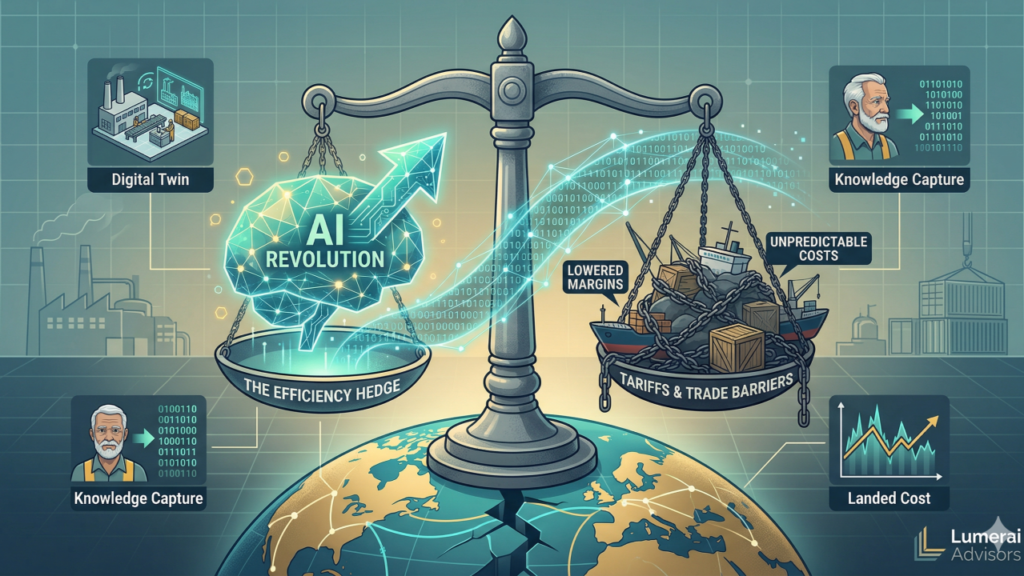
The Efficiency Hedge: Why Tariffs are Quietly Accelerating the AI Revolution For decades, the manufacturing playbook was simple: chase the lowest labor cost across the globe. But as we move through 2026, that playbook has been shredded. Between the sweeping “Liberation Day” tariffs of 2025 and the ongoing restructuring of global trade, the “landed cost” of goods has become a moving target. At Lumerai Advisors, we are seeing a fascinating paradox. While trade barriers were designed to protect domestic industry, their primary side effect has been a massive, forced acceleration of Artificial Intelligence. In a high-tariff environment, AI is no longer a “future tech” experiment—it has become a financial hedge. The “Double Squeeze” of 2026 U.S. manufacturers are currently navigating a “double squeeze.” According to recent National Association of Manufacturers (NAM) reports, 93% of leaders now agree that America’s industrial advantage depends entirely on intelligent systems. Why? Because the 2025–2026 tariff landscape has acted as a “tax on inefficiency.” When input costs rise by 15-20% due to trade duties, you can no longer afford the “hidden taxes” of unplanned downtime, bloated inventory, or supply chain opacity. The most resilient firms aren’t just raising prices; they are using AI to “engineer out” the waste that trade policy has “engineered in.” 1. The Math of Mitigation: From Prediction to Action When replacement parts for your specialized machinery are 20% more expensive due to trade barriers, breaking a component prematurely is a failure of fiscal policy as much as maintenance. Leading firms are moving beyond simple “Predictive Maintenance” into Agentic Maintenance. In 2026, we are seeing a shift where AI doesn’t just alert a manager to a vibration—it autonomously generates a repair plan, checks the current “landed cost” of the spare part, and schedules the fix during the lowest-cost energy window. The ROI is clear: AI-driven stability can reduce downtime by 30–50%, effectively neutralizing the margin hit from tariffed materials. 2. The Death of the Spreadsheet: AI “Control Towers” The 2025–2026 trade environment has created what analysts call “sourcing paralysis”—a state where firms are too afraid to move their supply chains but too squeezed to stay put. The antidote is the AI Control Tower. Leading manufacturers are deploying federated data architectures that monitor geopolitical shifts in real-time. These systems use “digital twins” to simulate thousands of “what-if” scenarios. If a new trade restriction is flagged at a specific port, the AI calculates the exact point where “near-shoring” to Mexico or Canada becomes more cost-effective than absorbing the duty. It allows leaders to pivot their logistics in 24 hours rather than 24 weeks. 3. The Human Factor: Capturing Institutional Knowledge As 2026 sees record-high retirements of skilled Baby Boomer technicians, AI is acting as a “Knowledge Bridge.” By capturing the tacit knowledge of departing experts into large language models (LLMs) and agentic workflows, mid-market firms are allowing younger, tech-savvy workers to perform at expert levels from day one. This augmentation—not replacement—is what allows a leaner workforce to manage more complex, regionalized operations without a proportional increase in headcount. The Lumerai Perspective: Illuminating the Path Forward At Lumerai Advisors , we believe that tariffs are the “why,” but AI is the “how” for the next era of American industrial leadership. The question for 2026 is no longer “How do we avoid tariffs?” but “How do we use technology to make tariffs irrelevant?” The winners of 2027 and beyond will be those who treat data as “industrial capital”—investing in the digital infrastructure today to ensure they aren’t out-competed tomorrow. The 2026 AI-Readiness Checklist Is your operation prepared for a high-tariff, high-tech world? Audit your “AI-Readiness” with these five critical markers: [ ] Data Orchestration: Are your OT (floor) and IT (office) data streams unified, or are they trapped in “silos” that prevent real-time decision-making? [ ] Landed-Cost Visibility: Can your system calculate the impact of a 10% tariff shift on a specific SKU in under 60 seconds? [ ] Predictive Baseline: Is at least 40% of your critical machinery monitored by sensors that feed into an AI-driven failure model? [ ] Human-in-the-Loop Governance: Do you have a clear framework for when an AI “Agent” can make a sourcing decision versus when it must escalate to a human? [ ] Knowledge Capture: Do you have a digital process for capturing the “hidden expertise” of your retiring workforce?
AI Is Turning Technical Debt Into Strategic Debt
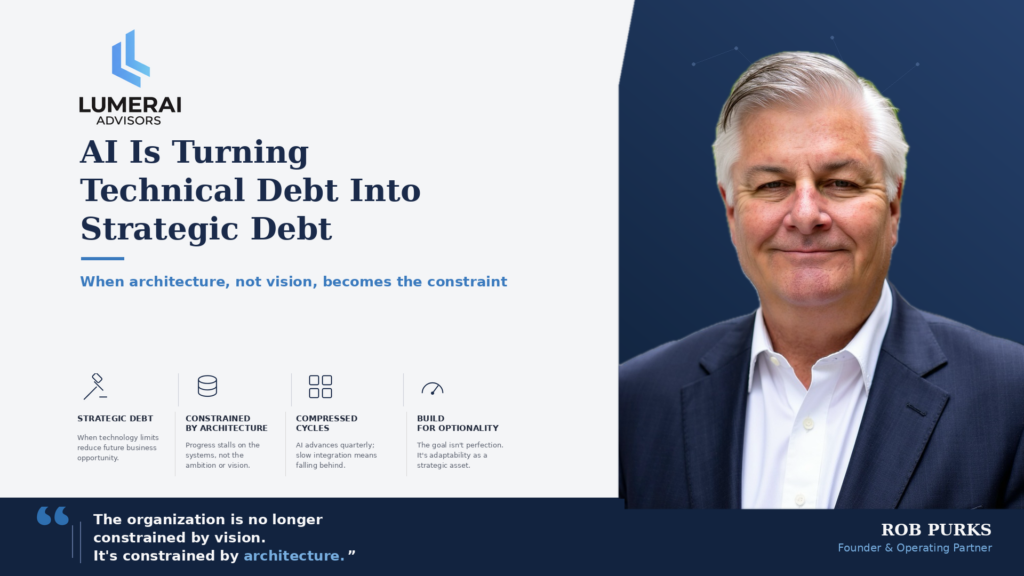
For years companies have accumulated Technical Debt. With the introduction of AI, Technical Debt is impeding your strategy to leverage the benefits of AI – this creates Strategic Debt.
A Survival Guide for Today’s Tech Leader
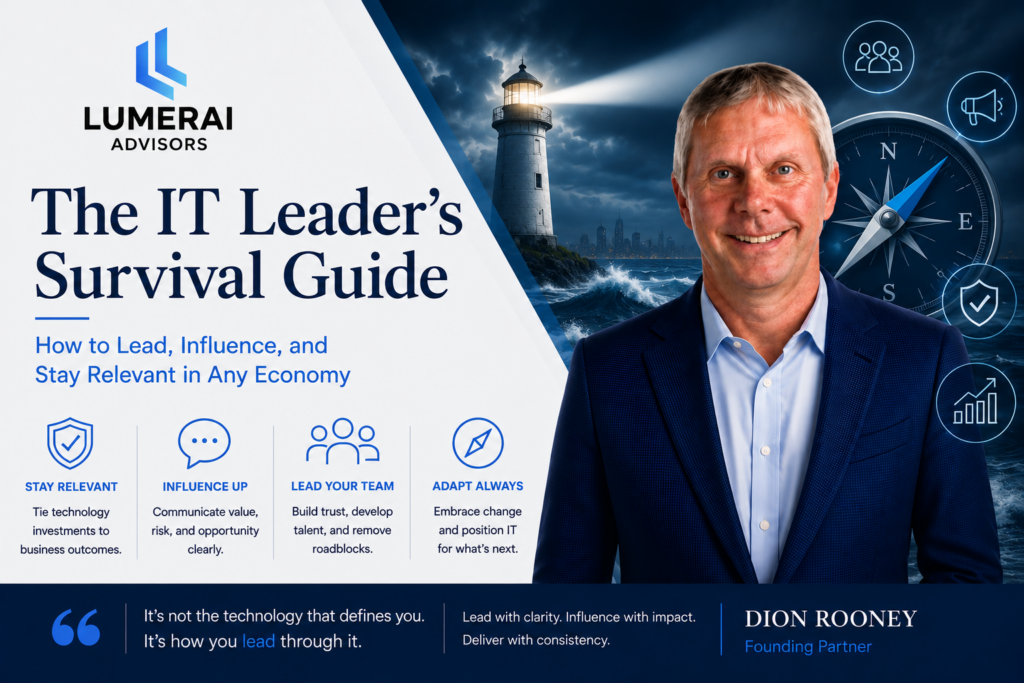
“The most dangerous place to be as a technology leader is surrounded by people who only agree with you.” The Clock Is Already Ticking If you are a CIO, the data on your tenure is sobering. The average CIO tenure now sits between 3 and 5 years, significantly shorter than CEOs and CFOs. The tenure is not just short, it is getting worse. According to the Nash Squared Digital Leadership Report, over 70% of CIOs have been in their positions for less than five years, with nearly 40% serving for two years or less. The Failure Rates Are Not Getting Better If tenure trends are troubling, the correlated project failure data is even more alarming. A Bain 2024 study puts failed business transformations at a staggering 88%. An MIT Project NANDA’s study found that after investing $30–40 billion in GenAI, 95% of businesses see little or no ROI. ERP implementations, often the centerpiece of a technology transformation, are especially brutal. Gartner estimates 70% of ERP projects fail to meet their objectives and 25% will fail catastrophically. The Echo Chamber Nobody Admits Exists Most major technology investment plans are built, reviewed, and approved by the same people who created them. Vendors have their own agenda. Consultancies have preferred platforms. Board members rarely have the technical depth to meaningfully challenge. No one in the room is truly incentivized to say “this will not work.” The Second Opinion Your Strategy Deserves Very few patients skip a second opinion before major surgery. The stakes are too high, and the consequences of a wrong call are too significant. When using a Generative AI Model to review content, which feedback personality do you really use? Do you want friendly or candid feedback? Why, then, do so many technology leaders approve $10M, $20M, or $50M transformation programs without a single independent voice in the room? An independent advisor does not replace your team or your consultants. They pressure-test the strategy, approach and plan. They identify the gaps your internal team is too close to see. They can benchmark your approach against what has actually worked at comparable organizations. Those independent advisors will provide you an unbiased read on feasibility before you stand up in front of your CEO or Board and stake your credibility on it. Most importantly, they are free to be honest with you. That isn’t something you can attain internally. The Conflict-of-Interest Problem with Traditional Advisors Not all advisors operate with equal independence. Large consultancies often have preferred vendor relationships that quietly shape their recommendations. Others avoid hard conversations simply to protect long-standing relationships. They know that delivering uncomfortable news risks the engagement and potentially vendor relationships. So the feedback gets softened, the risks get minimized, and the client believes they are receiving objective consultation when they are actually receiving managed guidance. A small boutique advisory firm is structurally better positioned to give you the truth. Fewer vendor entanglements, more accountability, and a business model built on your success rather than on hitting a vendor quota or preserving a relationship. Their reputation is the product, getting your recommendation right is the only incentive that matters. What Good Independent Advice Actually Looks Like You will know you have found the right advisor when they do several things most advisors do not: Give you a candid assessment of your current state versus where you think you are, including the uncomfortable parts. Red-team your strategy, arguing the case against your plan before your someone else does. Identify specific, actionable gaps, not a glossy report full of frameworks and 2×2 matrices. Benchmark your approach against real organizations, not vendor-sponsored research. Tell you when the timing is wrong, the data is not clean, the team is not ready, or the vendor is not the right fit, even when that is not what you want to hear. The relationship should be built on your success — not on the next engagement. The Cost of Not Getting a Second Opinion Once CIO credibility is lost, it is almost impossible to recover. Boards do not forgive a “we followed our vendor’s advice” excuse. Tenure data suggests you may only get one shot at this and if it goes sideways, the clock does not restart, it stops. The cost of an independent advisor is a rounding error against the risk of a failed implementation. The real question is not whether you can afford an independent voice, it is whether you will survive without one. The critical inquiry is not about the cost of securing an impartial perspective, but rather the risk of your continued viability without one. The Best Tech Leaders Do Not Go It Alone The best CIOs and CTOs are not the ones with all the answers. They are the ones who build the right conditions to find the right answers, which means surrounding themselves with people who are paid to be honest, not to be agreeable. Before you go into that board room, before you sign that software or implementation contract, before you stake your career on a plan you built inside a room full of people who need you to succeed, get an independent perspective. Echo chambers feel like alignment. Until the project fails, and they feel like something else entirely.
Aligning Technology Strategy with ESGObjectives

Aligning Technology Strategy with ESG Objectives Most ESG conversations in enterprise technology focus on what companies are building toward — renewable energy integration, AI-driven efficiency, decarbonization roadmaps. Fewer focus on what organizations are destroying in the process. Large-scale ERP migrations consume enormous resources, displace experienced teams, and generate emissions that never show up in sustainability reports. That gap deserves attention. ERP vendors have spent decades perfecting the art of manufactured urgency. End-of-support deadlines. Cloud migration mandates. “Strategic roadmap” language that obscures what customers are actually being asked to fund. For energy, utilities, and industrial companies carrying real ESG commitments alongside constrained IT budgets, the reflexive acceptance of vendor upgrade cycles is worth examining more critically. The Environmental Cost Nobody Accounts For A large ERP migration typically runs 18 to 36 months. During that period, the organization runs parallel systems — old and new — which can effectively double electricity consumption for extended stretches. Consultant teams fly in for workshops, go-live sprints, and hypercare support. The emissions from that travel are real, calculable, and almost never included in the upgrade business case. For companies that have made public Scope 3 commitments, this matters. Scope 3 covers indirect emissions across the value chain, and IT project activity is a legitimate contributor. The carbon footprint of a major implementation — consultant flights, parallel infrastructure, the organizational churn of managing two systems simultaneously — is not trivial. It just goes unmeasured because the conversation never starts there. Extending the life of existing enterprise software eliminates that footprint. A system already in production, already optimized, already running lean, does not carry those migration costs. That is a real environmental benefit — not a theoretical one. Companies serious about Scope 3 should be tracking it. The AI dimension adds another layer. Data centers running enterprise AI workloads draw heavily on electricity and water. As organizations scale inference and agentic AI applications, infrastructure costs grow. That is not an argument against AI investment — predictive maintenance, smart grid optimization, and real-time emissions monitoring all deliver genuine sustainability value. But it does mean the capital allocation question matters. An avoidable $30M ERP upgrade that consumes two years of IT bandwidth is a real opportunity cost against the AI capabilities that actually move emissions metrics. What Happens to the People IT moves fast and discards slowly. When a company replaces a core enterprise system, it is not just swapping software — it is displacing years of institutional knowledge. The finance analyst who spent eight years learning how the system was configured for the company’s specific processes. The IT team that built the integrations and kept them running. The workflow optimizations that took three years of refinement to get right. Those things do not transfer automatically to the new platform. Some of them disappear. The workforce disruption from large-scale migrations rarely shows up in ROI calculations, but it shows up clearly in culture, morale, and retention data in the years following go-live. Organizations that hold onto stable, well-optimized systems — and layer innovation on top rather than underneath — protect that institutional capital. They also free IT leadership to invest in the workforce development that actually matters: reskilling for AI and data roles, change management for operational technology, the human infrastructure that makes digital transformation stick. The capital freed by avoiding a major migration does not disappear. It can go into training programs, community energy initiatives, distributed energy resource platforms, or the operational technology upgrades that reduce real emissions in the field. A utility that makes that choice is making a better ESG investment than one that spent the same budget satisfying a vendor’s upgrade timeline. Governance Means Owning the Decision Here is the governance reality that most IT organizations do not say out loud: when 60 to 70 cents of every IT dollar goes to maintaining existing systems — vendor support, forced upgrades, unplanned migrations — that is not a strategy. It is a default. Someone else is setting the agenda. Strong technology governance starts with controlling the capital allocation. Organizations that extend enterprise software lifecycles through independent support and lifecycle optimization reclaim that control. They get to decide what gets funded and when, based on business priorities rather than vendor support schedules. That is a governance improvement with direct ESG consequences — because it means the capital can go where it should go. From a fiduciary standpoint, there is also a straightforward case for ESG ratings. Organizations that maximize the return on existing software investments, rather than retiring functional assets prematurely, earn credit for circularity and resource efficiency. That is not a side benefit — it is how lifecycle discipline gets scored. The governance risk argument runs the other direction too. Rushed migrations fail. Data integrity problems surface 18 months post-go-live. Business disruption from system transitions has derailed entire transformation programs. Those are governance failures with financial and reputational consequences. Avoiding them is not conservative — it is prudent. Boards are watching technology governance more closely now than they were five years ago. Cyber risk, AI oversight, regulatory scrutiny around data infrastructure — the bar has risen. CIOs who can demonstrate that they are making deliberate, strategic technology investments — not just responding to vendor pressure — are in a stronger position with their boards than those who cannot explain why the ERP migration consumed three years of IT capacity. The AI Infrastructure Trade-off The energy demands of enterprise AI are real and worth being direct about. Training frontier models is electricity-intensive. Running inference at scale — particularly for always-on agentic applications — requires persistent data center investment. Water consumption for cooling is a growing concern in regions already under pressure. For energy and utilities companies, this creates a tension that is not going away: sustainability commitments on one side, AI adoption imperatives on the other. The companies navigating this well are not trying to slow AI — they are funding it more intelligently. Stable core platforms that do not require constant reinvestment create the budget headroom