
From Systems of Record to Systems of Judgement
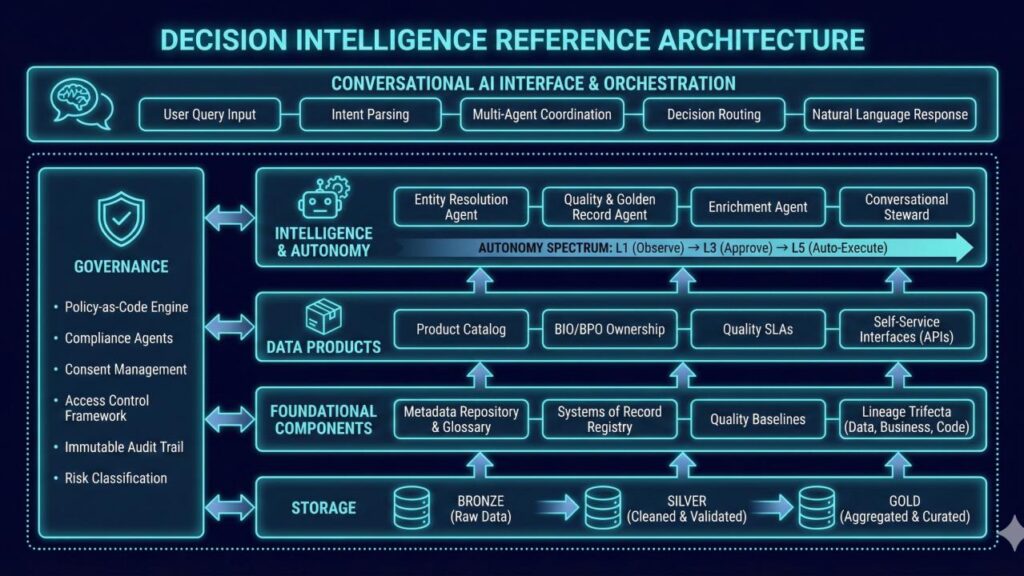
Why enterprise architecture must evolve in the AI era. Several years ago, I sat in a boardroom reviewing what was, at the time, the largest technology investment in the company’s history. A full-scale modernization of our core platform. The business case was disciplined and compelling: operational resilience, regulatory durability, scalability for growth, and long-term cost efficiency. The system of record that anchored the institution would be rebuilt for the future. It was the right decision. Three years later, the platform was stronger. Transaction integrity improved. Audit exceptions declined. Infrastructure stability increased. The ledger was clean, reconciled, and defensible. And yet, something important had not changed. Customer friction remained inconsistent. Cycle times remained uneven. Risk decisions varied across teams. Operational bottlenecks migrated upstream. We had modernized how the enterprise recorded transactions. We had not modernized how the enterprise made decisions. At the time, that felt like an execution gap. In retrospect, it was architectural. The Era of Systems of Record For decades, enterprise technology strategy revolved around systems of record. Core banking platforms. Loan origination engines. Servicing systems. Enterprise resource planning environments—policy administration systems. General ledgers. These systems are designed for determinism. They enforce rules, validate inputs, reconcile balances, and ensure compliance. They answer retrospective questions: What happened? Was it processed correctly? Is it compliant? Can we prove it under regulatory scrutiny? In financial services, healthcare, insurance, and other regulated industries, systems of record are existential. Without them, there is no institutional credibility. They are the foundation of trust. Over the past twenty years, billions of dollars have been invested in strengthening these systems. Legacy cores have been replaced or wrapped. Cloud migrations have accelerated. Data warehouses have become data lakes. Cyber resilience has improved materially. This work has been necessary. But it has also created an assumption: that once systems of record are modernized, performance will naturally follow. Increasingly, that assumption is flawed. Because competitive advantage has shifted away from how well institutions record transactions — and toward how well they decide before and after those transactions occur. The Quiet Rise of Systems of Judgment Artificial intelligence, machine learning, and advanced analytics have introduced a structurally different layer of enterprise capability. Not a replacement for systems of record, but something orthogonal to them. Call them systems of judgment. A system of judgment does not merely store or process transactions. It synthesizes structured and unstructured data, applies probabilistic reasoning, evaluates risk trade-offs, and produces contextualized recommendations. It may automate the decision entirely or augment a human operator. It learns from outcomes and refines future behavior. It answers forward-looking questions: Should we approve this borrower? Is this transaction anomalous? Which customers are at risk of attrition? Where is operational risk emerging? Which capital allocation will maximize risk-adjusted return? These are not deterministic questions. They are probabilistic. They involve uncertainty, trade-offs, and policy interpretation. Historically, this kind of judgment lived in committees, experienced operators, policy binders, and institutional memory. It was distributed, often inconsistent, and difficult to scale. Today, enterprises are encoding judgment into software. Underwriting engines incorporate machine learning models. Fraud detection systems monitor behavioral anomalies in real time. Marketing personalization engines predict engagement likelihood. Operations platforms prioritize work queues dynamically. Decision-making is becoming digital. That is a profound architectural shift. Why This Shift Is Different From Past Technology Waves Previous waves of enterprise modernization focused on automation and efficiency. The goal was to reduce manual effort, eliminate redundant systems, and improve transaction throughput. Systems of judgment change the locus of value. The economic impact of a marginal improvement in decision quality can far exceed the impact of transaction efficiency gains. Consider credit underwriting. A small improvement in risk prediction accuracy can materially reduce loss rates without constraining volume. In fraud detection, earlier identification of anomalous behavior can prevent outsized losses. In pricing, more precise elasticity modeling can enhance margin without sacrificing competitiveness. These are not back-office optimizations. They are drivers of return on equity. In other industries, the pattern holds. More accurate demand forecasting reshapes supply chains. More precise diagnostic support improves healthcare outcomes. Better risk scoring transforms insurance loss ratios. The enterprise that decides better — consistently, transparently, and at scale — gains a structural advantage. But here is the complication. Most organizations have not architected for this reality. The Governance Gap in the Age of AI Decision Systems In many large institutions today, systems of record are mature. Data governance functions are established. Model Risk Management frameworks exist, particularly in regulated sectors. Cybersecurity oversight is board-level. Yet systems of judgment are proliferating without equivalent architectural clarity. AI models are deployed across business units. Decision engines are layered on top of legacy systems. Data science teams operate semi-independently. Human override mechanisms vary by domain. Escalation paths are informal. The result is fragmented judgment. No single enterprise map shows how consequential decisions are made end-to-end. Few boards can articulate which decisions materially drive economic performance. Even fewer can explain how those decisions are governed collectively. This fragmentation introduces both risk and inefficiency. Without a coherent decision architecture, AI initiatives may: Produce inconsistent outcomes across business lines. Embed bias in ways that are difficult to detect. Create opaque decision chains that complicate regulatory defense. Allocate capital toward low-impact use cases while ignoring high-leverage domains. The issue is not that AI exists. The issue is that institutional judgment is not deliberately engineered. Systems of record were designed intentionally. Systems of judgment are emerging organically in many enterprises. That is not sustainable. From Technology Modernization to Decision Architecture To understand the architectural gap, it helps to distinguish between platform modernization and decision architecture. Platform modernization focuses on infrastructure: replacing legacy systems, migrating to the cloud, consolidating applications, improving performance, and resilience. Decision architecture focuses on how data flows into models, how models inform actions, how those actions are supervised, and how outcomes feed back into learning loops. Platform modernization is necessary for stability. Decision architecture is necessary for an advantage. In the AI era, these two domains must intersect. Systems of record provide