
The modern CIO is no longer a technologist — they’re an architect of enterprise decisions

For much of the last three decades, the CIO role has been defined by delivery: platforms implemented, systems stabilized, programs executed. Success was measured in uptime, milestones, and budget adherence. When things went wrong, the diagnosis was familiar — execution struggled, teams moved too slowly, or technology didn’t perform as expected. That framing is no longer sufficient. Most large-scale enterprise modernization efforts do not fail because teams cannot execute. They fail because the strategy and structural decisions were flawed from the start — and those flaws quietly harden long before delivery ever begins. In today’s enterprises, technology outcomes are rarely constrained by tools or talent. They are constrained by how clearly leaders define outcomes, how explicitly they make tradeoffs, and how intentionally they design the decision systems that translate strategy into action. That is why the modern CIO is no longer simply accountable for technology execution. They are increasingly accountable for the decision systems that determine whether transformation efforts ever translate into durable business value. I’ve come to believe this is the real evolution of the role. The modern CIO is no longer primarily a technologist. They are the architects of enterprise decisions. Where transformations actually fail I’ve been brought into many programs described as “behind schedule” or “underperforming delivery.” On the surface, they appear to be execution problems. Teams are busy. Roadmaps exist. Progress is tracked. Yet outcomes continue to disappoint. When you examine the root causes, the issues are rarely about effort or capability. They’re systemic. The same patterns appear again and again: No clear definition of business outcomes Competing priorities with no tradeoff discipline Governance models that reward activity instead of impact Operating models misaligned to how work is actually done Architecture decisions driven by politics rather than strategy Funding models that fracture accountability When these conditions exist, delivery does not experience random issues. It degrades predictably. Velocity slows. Dependencies multiply. Decision latency increases. Risk accumulates. Costs escalate. Credibility erodes. By the time leadership starts asking why execution is failing, the failure is already baked into the structure. This is where modernization efforts most often go wrong. Leaders declare a new strategy, but they leave the underlying decision architecture intact. Old governance models are asked to support new operating realities. Legacy funding structures are expected to enable adaptive delivery. Accountability remains fragmented while outcomes demand cohesion. Execution is then asked to compensate for design failure. It never does. Research published by McKinsey has consistently shown that organizational and operating model constraints — not technology — are among the primary reasons large transformations stall or reverse course. The more profound implication is often left unstated: if the constraint is structural, accelerating delivery without redesigning decision systems simply reveals the weakness more quickly. The CIO’s real leverage point Modern CIOs sit at a unique intersection of strategy, execution, and governance. They see where priorities collide, where accountability blurs, and where decisions stall under the weight of ambiguity. Historically, CIO influence was exercised through control of technology assets — budgets, platforms, architecture standards, and delivery capacity. Today, the CIO’s most consequential influence is exercised upstream of delivery, in how decisions are designed and governed. This is less visible work than a cloud migration or platform rollout, but far more determinative of outcomes. In practice, the CIO becomes responsible for orchestrating intelligence and ensuring that strategy is supported by structures capable of executing it. That requires deliberate design across several dimensions. Outcome clarity.What are we trying to achieve, and how will we know? If outcomes are vague, success becomes subjective and tradeoffs become political. Decision rights.Who decides what, and at what altitude? When decision ownership is implicit, authority defaults to whoever can delay the longest. Tradeoff discipline.When priorities conflict — and they always do — how does the organization decide? What data is required? Who arbitrates? How long does it take? Without a mechanism, alignment becomes theater. Governance that enables movement.Governance should resolve ambiguity, not preserve it. Committees that exist primarily to distribute blame will reliably slow progress. Operating model alignment.Declaring “product teams” does not create product accountability. If funding, incentives, and authority remain project-based, the operating model is performative. Sequencing and capacity management.Every organization has finite change capacity. Strategy without sequencing diverts leadership attention and creates the illusion of resistance, when the real issue is design failure. When these elements are intentionally designed, something important happens. Execution becomes less dependent on heroics. Teams stop waiting for permission to solve obvious problems. Leaders stop relitigating the same tradeoffs. Delivery begins to resemble a stable operating rhythm instead of a constant escalation. This is the CIO’s real leverage point. Not tooling. Not velocity. But decision integrity. What boards increasingly expect from cio leadership Boards and executive teams are beginning to recognize this shift, even if they don’t always articulate it in architectural terms. They rarely ask about specific platforms or methodologies. Instead, the questions sound like: Why does this initiative keep stalling at the same point? Who is accountable when priorities conflict? How do we know this risk is understood rather than deferred? What will break if we scale faster? Are we building durable capability or just shipping activity? These are not technical questions. They are governance and decision-design questions. Boards understand that digital transformation is no longer a discrete program. It is an ongoing operating reality. As a result, they are increasingly looking to the CIO not just for delivery competence but also for judgment—the ability to translate strategy into repeatable, governable execution. MIT Sloan Management Review has written extensively about the importance of explicitly designing decision rights and governance structures to sustain transformation outcomes. Organizations that do this well tend to move faster with less friction because ambiguity is no longer the default operating condition. This is why the modern CIO is increasingly viewed as a peer enterprise leader rather than a functional specialist. Boards do not need another executive who can “run IT.” They need an executive who can shape how the enterprise changes without losing control. The
Digital Employees Don’t Fail — Organizations Do: What AI Reveals About Leadership, Governance, and Operating Model Design
The uncomfortable truth about AI in the enterprise Artificial intelligence is no longer experimental. Digital employees now validate income data, monitor fraud, triage customer service interactions, orchestrate underwriting workflows, and generate decision support at scale. In many enterprises, AI is already embedded in the daily fabric of work. Yet performance varies wildly. Some organizations see measurable gains in speed, risk control, and cost efficiency. Others experience stalled pilots, inconsistent outputs, regulatory anxiety, and mounting skepticism from boards. When things falter, the conclusion is often predictable: The AI isn’t mature enough.The models need more training.The vendors overpromised. But in my experience leading large-scale modernization across regulated financial services organizations, digital employees rarely fail because of technology alone. They fail because the enterprise operating model was never designed to support them, as shown in the operating model comparison above. AI does not create disorder — it exposes it Large enterprises often function on accumulated adaptation. Processes evolve. Exception handling becomes normal. Decision rights blur. Accountability shifts subtly depending on urgency and politics. Human teams compensate for this ambiguity. Experience fills gaps. Informal networks route decisions. Leaders intervene when necessary. Digital systems cannot compensate. AI requires clarity. It requires explicit scope. It requires defined escalation paths and measurable outcomes. It requires governance. When organizations deploy AI into ambiguous environments, automation does not simplify work. It magnifies structural weakness. Execution slows. Decision latency increases. Edge cases multiply. Leaders lose confidence. The issue is not intelligence. It is architecture. The myth of the “AI workforce transformation” The phrase “AI-driven workforce” suggests a technology upgrade. In reality, it represents an operating model shift. When digital employees enter the enterprise, four fundamental questions must be answered: What decisions are we delegating? Who retains accountability? Where does human judgment remain explicit? How do we intervene without destabilizing the system? If those questions are not addressed before automation scales, AI becomes a source of friction rather than leverage. Digital workforce transformation is not a tooling initiative. It is a governance discipline. Systems of record vs. systems of judgment Most enterprises are built around systems of record. These systems manage transactional integrity, regulatory compliance, and data preservation. They are foundational and indispensable. But systems of record are not systems of judgment. Judgment lives in prioritization. In tradeoffs. In exception handling. In risk interpretation. In sequencing. When organizations embed all decision logic deep inside core systems without intentional design, they create rigidity. When they fail to distinguish between transaction processing and judgment, they accumulate invisible risk. AI intensifies this dynamic. If decision-making is poorly defined, digital employees replicate inconsistency at scale. If governance is weak, automation amplifies exposure. Conversely, when judgment and oversight are deliberately built in, AI enhances resilience and transparency. The difference is rarely technical. It is structural. Why digital employees struggle in traditional governance models Traditional governance models evolved for human work, and the modern CIO, as a decision architect, must rethink them for digital workforce efficiency. They often rely on: Informal escalation Consensus-driven decision-making Distributed accountability Performance metrics based on activity rather than outcomes These structures tolerate ambiguity because human teams adapt. Digital employees cannot. They operate within defined boundaries. They follow programmed logic. They require structured intervention when edge cases appear. When governance rewards motion over measurable impact, AI deployment creates noise rather than value. When priorities are not sequenced with discipline, digital employees are forced to reconcile conflicting objectives. The result is predictable: underperformance that leadership attributes to the technology rather than to the system’s design. Execution reflects structure In enterprise modernization, I have repeatedly seen initiatives described as “behind schedule” or “underperforming.” Yet when examined closely, the pattern is consistent: No clear definition of business outcomes Competing initiatives without enforced tradeoffs Architecture decisions influenced by vendor roadmaps rather than enterprise strategy Funding models that fragment accountability Governance models that emphasize activity over results Under those conditions, execution does not fail randomly. It degrades systematically. AI reveals these weaknesses faster than any previous technology wave. Automation is not forgiving. The board-level implications of digital employees Boards and CEOs are increasingly engaged in AI oversight. Not because they are fascinated by algorithms, but because they understand the implications: Regulatory scrutiny Reputation risk Operational resilience Competitive differentiation When digital employees make or influence decisions, accountability must remain explicit. Auditability must be preserved. Explainability must be demonstrable. These are governance questions, not coding questions. Organizations that treat AI as a strategic operating model shift are better prepared for board-level scrutiny. Those who treat it as a technical deployment risk will have uncomfortable conversations later. Designing a scalable digital workforce Sustainable AI adoption requires intentional design in four areas: 1. Decision architecture Define which decisions can be automated, which require human oversight, and which remain entirely human. Document boundaries. Clarify ownership. Ambiguity erodes trust. 2. Tradeoff discipline AI initiatives must compete for attention and resources like any other investment. Without sequencing and prioritization, organizations overextend. Clarity increases velocity. 3. Governance by design Monitoring, escalation, and accountability must be engineered into workflows. Waiting to retrofit governance after deployment introduces fragility. Speed without control is not progress. 4. Outcome alignment Measure impact, not activity. Digital employees should be evaluated based on business outcomes: risk reduction, cycle time improvement, customer experience, and cost efficiency. Activity is not value. The hidden risk of embedding intelligence too deeply There is a temptation to push intelligence directly into core platforms. It feels efficient. Centralized. Clean. But deeply embedded decision logic becomes difficult to evolve. Vendor dependencies increase. Flexibility decreases. As AI capabilities mature, organizations benefit from preserving optionality. Separating transaction processing from intelligent orchestration provides room to adapt without destabilizing the enterprise. This architectural discipline is not about resisting innovation. It is about sustaining it. What executive recruiters and boards are really assessing In conversations with executive technology advisory partners, questions rarely concern AI tools. They focus on leadership judgment: Can this executive define the right problems? Can they align operating models to strategy? Can they enforce accountability? Can they scale innovation without increasing
Why Strategy Fails Without Execution Discipline in Enterprise IT
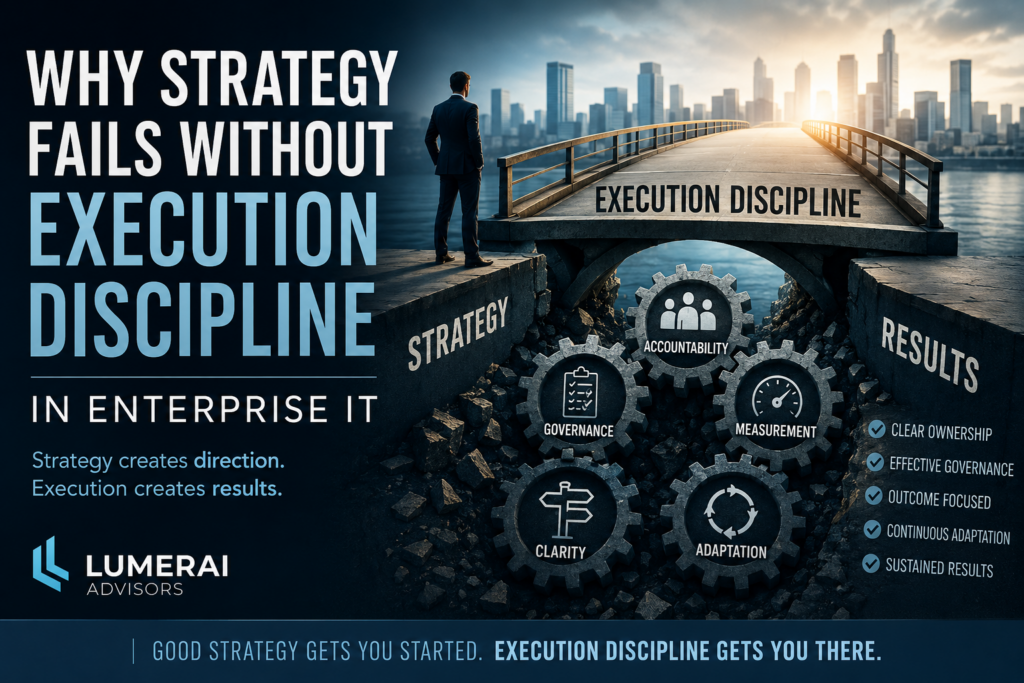
Former Fortune 500 CIO Matt Rider explains why enterprise technology strategies fail when organizations lack execution discipline. Drawing on decades of leadership experience, the article explores accountability, governance, operating models, and the organizational behaviors required to translate strategy into measurable business outcomes.