
Why Strategy Fails Without Execution Discipline in Enterprise IT
Enterprise technology strategies rarely fail because they lack vision.They fail because organizations lack the execution discipline to carry themthrough. Boards approve ambitious roadmaps. Executive teams endorse multi-yeartransformation agendas. Consultants produce compelling narratives. And eighteenmonths later, progress is fragmented, teams are exhausted, and business impactis marginal. This gap between strategy and execution is not a delivery problem. It isa leadership and operating model failure. In large, regulated enterprises, execution does not happen throughenthusiasm or alignment workshops. It happens through structure: clearownership, enforced prioritization, and accountability mechanisms that persistbeyond kickoff decks and steering committees. Without these elements, evenwell-designed strategies become performative exercises — visible activitywithout sustained progress. The root issue is often organizational design. Many enterprises continueto operate with fragmented accountability models: strategy owned by one group,funding controlled by another, delivery executed by a third, and outcomes ownedby no one. In that environment, drift is inevitable. Priorities change weekly.Initiatives compete rather than reinforce each other. Leaders measure progressthrough artifacts rather than impact. High-performing organizations operate differently. They design executionsystems with the same rigor they apply to architecture. Ownership is explicit.Tradeoffs are visible. Funding models reinforce priorities rather thanundermine them. Progress is evaluated through measurable change in businessoutcomes, not volume of activity. Execution discipline is not a cultural aspiration. It is an engineeredcapability. This is where many transformation efforts quietly fail. Organizationsinvest heavily in new frameworks, tooling, and operating models, yet avoid themore difficult work: redefining decision rights, enforcing prioritization, andaligning incentives with enterprise outcomes. Without those changes,transformation becomes theater — highly visible, resource-intensive, andultimately inconsequential. The organizations that outperform their peers are not those with the mostambitious strategies. They are the ones who design execution environmentscapable of sustaining focus, absorbing complexity, and translating intent intoresults. They treat execution as a first-class system, not an afterthought. Until enterprise leaders approach execution discipline with the sameseriousness they bring to strategy formulation, transformation will continue tounderdeliver against its promise. About the AuthorMatt Rider is a former Fortune 500 Chief Information Officer with more than 25years of experience leading enterprise-scale modernization, integration, andoperating model transformation across highly regulated financial servicesorganizations. His work has spanned technology strategy, governance,cybersecurity, data, and executive advisory. Matt writes and advises on howsenior leaders can design organizations capable of sustained change at scale.
Why Strategy Fails Without Execution Discipline in Enterprise IT
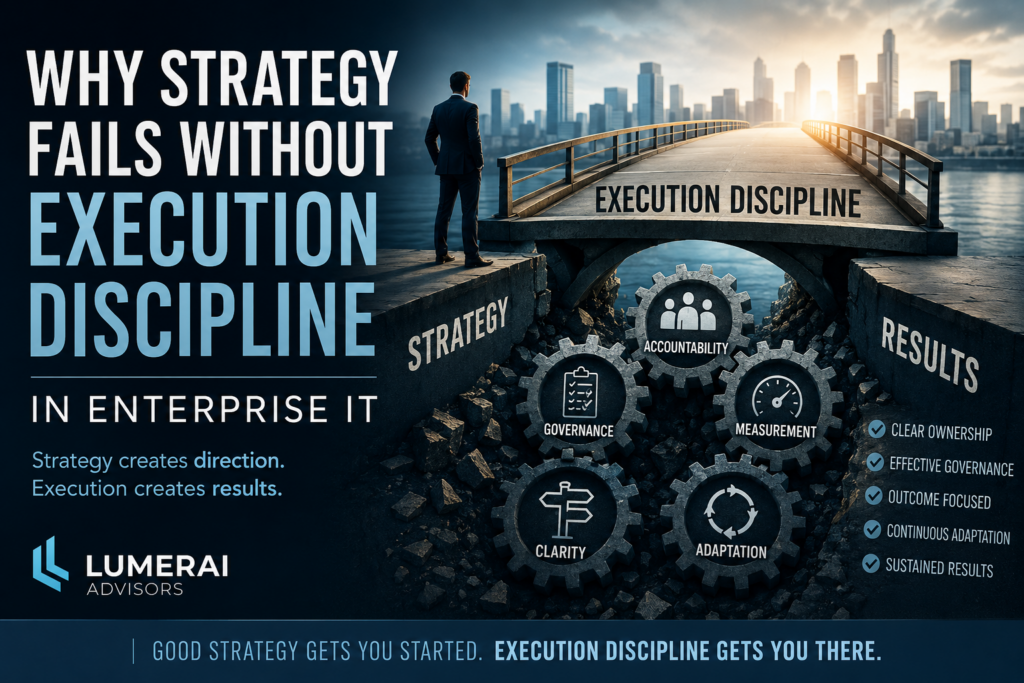
Former Fortune 500 CIO Matt Rider explains why enterprise technology strategies fail when organizations lack execution discipline. Drawing on decades of leadership experience, the article explores accountability, governance, operating models, and the organizational behaviors required to translate strategy into measurable business outcomes.