The question isn’t whether your organization will be transformed by AI. That ship has sailed.
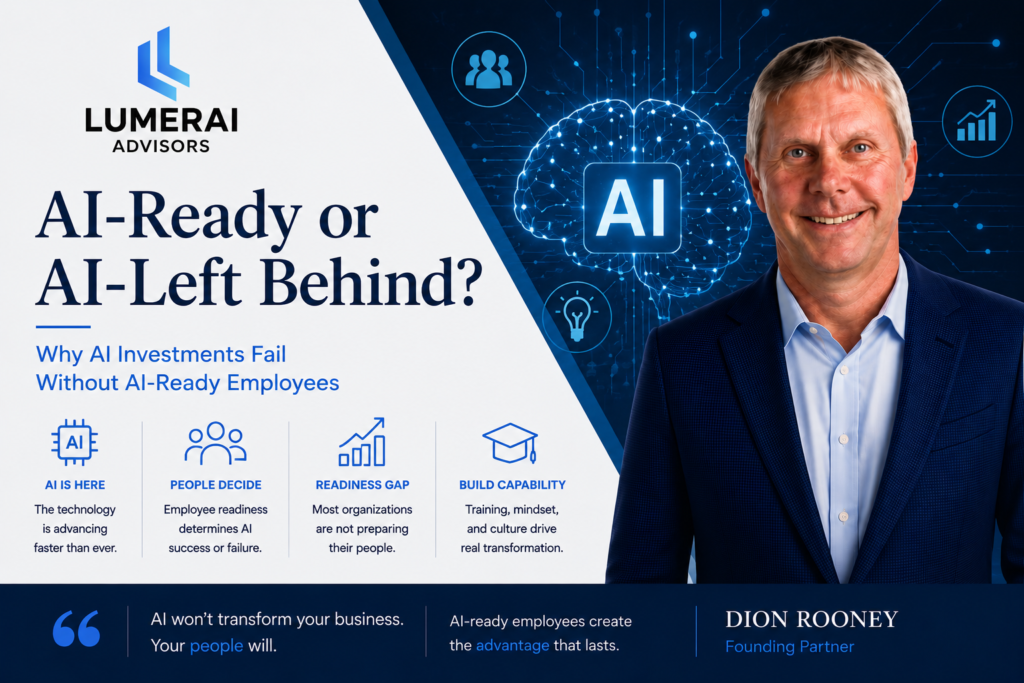
The question is whether your workforce will become a competitive advantage in an AI-powered economy or whether AI will simply expose capability gaps that already exist. Your AI strategy is only as strong as the people expected to execute it. Most organizations are measuring the wrong thing. They track AI licenses, adoption, training completion rates, and prompt engineering workshops. Yet despite billions of dollars invested in AI, only a small percentage of organizations are realizing meaningful business value. The reason is simple. AI transformation is not primarily a technology problem. It is a workforce capability problem. The question leaders should be asking is not whether employees can use AI. It is whether they can make better decisions because of it. Do your people actually know how to work in an AI-powered world? Not “have they attended a webinar” or “did we roll out Copilot.” I mean: do they fundamentally understand how to think alongside AI, direct it, interrogate its outputs, and apply judgment where the machine falls short? That’s a very different bar — and most organizations have no honest answer. Executive Takeaways The Numbers Are Damning The data is in, and it’s unambiguous. According to IDC, 94% of CEOs and CHROs identify AI as their top in-demand skill for 2025, yet only 35% of leaders feel they’ve actually prepared their employees for AI-driven roles. Meanwhile, a 2026 DataCamp/YouGov survey of 500+ enterprise leaders found that 59% admit their organization has an AI skills gap, even though most are already spending on AI tools. Think about that: majority investment, minority readiness. PwC’s 2025 AI Jobs Barometer adds another dimension: AI-exposed roles are evolving 66% faster than other positions and command a 56% wage premium. That means the gap isn’t just an operational inconvenience — it’s a competitive liability that compounds every quarter you don’t address it. We’ve Been Asking the Wrong Question Most workforce AI assessments are built around the wrong mental model. They ask: “Can this person use the AI tool?” That’s like evaluating a surgeon by whether they can hold a scalpel. The right question is: “Can this person make better decisions because of AI?” Working effectively in an AI world requires a fundamentally different skill architecture than what most job descriptions, competency models, and performance reviews are built to measure. It’s not about prompt engineering. It’s about something deeper. The World Economic Forum’s Future of Jobs Report puts it plainly: employers anticipate that 40% of core skills will change by 2030. Not augmented — changed. That’s not a training program. That’s a reinvention of what “qualified” means. What “AI-Ready” Actually Looks Like After 35 years leading technology transformation across global retailers, manufacturers, and PE-backed companies, I’ve seen many skill paradigm shifts. This one is different in a critical way, it cuts across every function, every level, and every geography simultaneously. True AI readiness requires capabilities across three dimensions, yet most organizations focus exclusively on the first. The Lumerai AI Readiness Model Level 1: Tool Fluency Can employees effectively use AI tools? Level 2: Critical Reasoning Can they challenge and validate AI outputs? Level 3: Human Edge Can they apply uniquely human judgment, creativity, and leadership? BCG research found that companies successfully addressing AI talent shortfalls achieve 2.3x faster AI adoption and 67% higher AI ROI. The skill assessment isn’t a HR box to check, it’s a value creation lever. Warning Signs Your Workforce Isn’t AI Ready Why Most Assessments Miss the Mark Here’s the uncomfortable truth, most organizations are confusing activity with capability. Deploying Copilot is not an AI strategy. Sending people to a LinkedIn Learning course is not workforce transformation. And asking employees to self-report AI comfort level is not an assessment. The DataCamp report reveals the paradox in stark terms, most enterprises are offering some form of AI training, yet only 35% have a mature, workforce-wide upskilling program. The organizations with that mature program are nearly twice as likely to report significant AI ROI. The rest are spending money and just making noise. Effective assessment requires measuring against a defined target, not a generic “AI skills” list, but a role-specific, business-context-specific model of what AI-assisted performance actually looks like in your environment. A Framework Worth Building If you’re serious about knowing where your workforce stands, here’s where to start: Map your role exposure: Not every role is equally disrupted or equally enabled by AI. Start with a realistic heat map of AI exposure across your organization — which roles are most automatable, which are most augmentable, and which create the highest risk if AI is used without adequate oversight. Define role-specific AI competency profiles: A CFO who needs to interrogate AI-generated financial models requires a different skill profile than an operations manager using AI for demand forecasting. Generic frameworks produce generic results. Assess with scenarios, not surveys: Self-assessment is unreliable for novel skill domains. Scenario-based evaluations present a realistic AI-assisted decision situation worth observing. Close the loop with your technology roadmap: Your AI skills strategy needs to anticipate where your tools are heading, not just where they are today. Agentic AI is arriving faster than most teams realize. If your workforce isn’t prepared to work alongside autonomous AI agents, you’ll be wasting time and money rebuilding capability. The Leaders Who Act Now Will Define the Gap McKinsey estimates that 88% of organizations now use AI in at least one business function. Only 1% have achieved true AI maturity. The distance between those two numbers is, in large part, a human capability problem. The CEOs and CIOs who understand that AI tools without AI-ready people produce expensive mediocrity will act differently in 2026. They’ll treat workforce AI assessment not as a one-time initiative, but as an ongoing strategic process as embedded in their operating rhythm as financial reviews and technology audits. The question isn’t whether your organization will be transformed by AI. That ship has sailed. The question is whether your workforce will become a competitive advantage in an AI-powered economy or whether AI will